Alpine Linux Rebuilds GitLab Server and Resets Passwords Following Targeted Exploitation Attempts

Alpine Linux, the ultra-lightweight open-source operating system widely relied upon as the foundational base for modern Docker container images, has been forced to completely rebuild its central development infrastructure. The drastic measures were taken after malicious actors launched targeted exploitation attempts against a critical, maximum-severity vulnerability in the project’s GitLab server. Although subsequent forensic investigations revealed no definitive evidence that the attackers successfully executed arbitrary code or tampered with official software packages, missing logging data and an absence of outbound network connection records left the project with no choice but to assume the worst and execute a full infrastructure recovery.
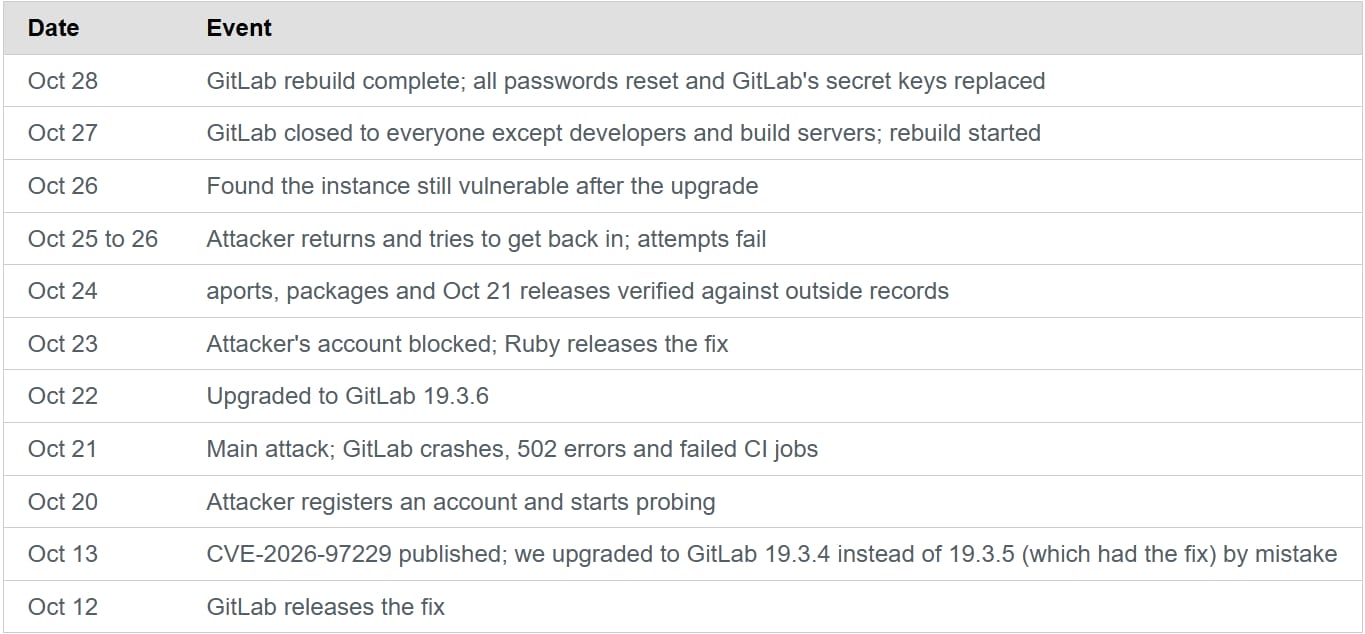
The security crisis unfolded over a two-day period between October 20 and October 21, when automated intrusion attempts began hammering Alpine Linux’s development environment. The attacks were specifically engineered to exploit CVE-2026-97229, a severe flaw categorized as a maximum-severity remote code execution vulnerability. Throughout the attack window, the malicious payloads repeatedly caused GitLab processes to crash. Security logs reviewed by the project team indicated that several of these exploit attempts came alarmingly close to succeeding, raising immediate concerns over the integrity of the underlying infrastructure.
The Target: A Vital Component of the Software Supply Chain
To understand the gravity of the incident, one must look at the crucial role Alpine Linux plays in the global software ecosystem. Known for its minimal footprint, security-oriented design, and speed, Alpine Linux serves as the standard base image for millions of containerized applications and cloud-native services deployed worldwide.

The project’s self-hosted GitLab instance acts as the beating heart of its development operations. It hosts critical code repositories, manages peer code reviews, and runs continuous integration and continuous deployment pipelines. Crucially, this environment houses the "aports" build recipes—the foundational blueprints used by developers to compile and package every piece of software distributed in the Alpine repositories. Because of this architectural centrality, any successful tampering with the Alpine GitLab environment could trigger a devastating downstream supply chain attack, potentially compromising countless enterprise applications and developer workflows globally.
Anatomy of a Maximum-Severity Flaw
The vulnerability at the center of the incident, tracked as CVE-2026-97229, is an integer overflow flaw residing within Onigmo, the regular expression compiler bundled natively in Ruby and utilized extensively by GitLab. The vulnerability carries profound risk because it allows unauthenticated, remote attackers to achieve arbitrary code execution on a target server under specific operational conditions.
GitLab first publicly disclosed the existence of the flaw and rushed out security patches on October 12. The vendor warned at the time that malicious actors could trigger the vulnerability simply by submitting a specially crafted, highly complex regular expression within a CI/CD pipeline configuration file.
However, applying the fix turned out to be a complex operational hurdle for Alpine Linux’s infrastructure maintainers. Initially, the project had installed GitLab version 19.3.4 rather than the explicitly patched 19.3.5 release. Even when the team later upgraded the server to version 19.3.6, the security flaw remained exposed. The complication arose because properly mitigating CVE-2026-97229 required an underlying patch to the Ruby runtime environment. While GitLab bundles its own specific Ruby builds within its official package distributions, Alpine’s custom container deployment utilized a tailored image setup that inadvertently left the vulnerable Ruby engine exposed to exploitation.

The Attack Window and Forensic Limitations
On October 20 and 21, malicious actors seized on this oversight, submitting specialized, hostile CI/CD pipeline configurations designed to trigger the Onigmo integer overflow flaw. The incoming requests triggered eight distinct worker crashes on the server. Of those crashes, analytical reviews indicated that four were partially successful, demonstrating that the malicious payloads interacted deeply with the application processes, though none definitively achieved full, confirmed command execution.
Compounding the risk, investigators discovered that the attackers had actively downloaded Alpine’s custom GitLab container image during the reconnaissance and exploitation phase. This behavior strongly suggested that the threat actors were methodically preparing a sophisticated, targeted supply-chain compromise tailored specifically to Alpine’s build environment.
Faced with the reality of missing log entries and a lack of granular outbound network connection records, the Alpine Linux project team determined they could not mathematically or forensically rule out a successful breach.
"Because we cannot rule out code execution, and the evidence we would need to confirm it no longer exists, we took the harder route and rebuilt the GitLab instance from scratch," the Alpine Linux team explained in a public post detailing the incident response.
Recovery Actions and Security Verification
Following the realization that a partial or full compromise could not be disproven by existing logs, the project team initiated an aggressive remediation protocol. This included completely wiping and rebuilding the GitLab instance from the ground up, forcing an immediate password reset for all system accounts, and invalidating existing user sessions.
Simultaneously, the team launched a deep forensic audit of all code repositories, official software packages, and distribution releases produced up to October 27. Fortunately, the investigation delivered reassuring news regarding the distribution channels: Alpine found zero evidence of tampering within any repository commits, packages, or signed software releases. Furthermore, the project’s cryptographic signing keys—which are essential for authenticating legitimate software updates—were found to be completely safe, as those sensitive keys are never stored on the GitLab server itself.
Despite the reassuring package integrity checks, a successful exploitation of the GitLab server, had it fully succeeded, could have exposed a trove of sensitive internal data. This potentially included user account details, salted password hashes, multi-factor authentication secrets, sensitive CI/CD pipeline variables, integration credentials, and the contents of private development projects, though no unauthorized access to these assets has been definitively confirmed.
As part of the ongoing recovery and hardening process, Alpine Linux is strongly urging all users and contributors associated with its development platform to immediately reset their GitLab passwords. Additionally, developers and administrators relying on Alpine’s infrastructure are advised to update their systems and pull the updated alpinelinux/gitlab:19.3.6 container image published on October 27. This updated release bundles Ruby version 3.3.13, which definitively patches the underlying CVE-2026-97229 vulnerability and closes the security gap that triggered the emergency infrastructure rebuild.

Related News