Trezor Warns of Suspected Hardware Implant in Safe 5 Crypto Wallet Sold by Southeast Asian Reseller
Hardware cryptocurrency wallet manufacturer Trezor has issued an urgent security warning after receiving credible reports regarding a suspected malicious hardware implant discovered inside a Trezor Safe 5 device. The compromised hardware was reportedly distributed by regional reseller CryptoBilis in Southeast Asia, raising fresh concerns over supply-chain security within the digital asset custody sector.
While the Prague-based company has not yet physically received the suspect device to conduct a thorough laboratory examination and definitively confirm the presence of a malicious implant, it has proactively advised potentially affected users to immediately secure their digital assets. Trezor is urging customers who bought devices through the specified channel to transfer their private keys and digital funds to known, secure wallets as a precaution against potential theft.
Trezor hardware wallets are physical electronic devices designed to securely store cryptocurrency private keys offline and authorize blockchain transactions without exposing sensitive credentials to internet-connected computers. The Safe 5 model represents one of the company’s latest and most advanced offerings, widely available for purchase through its official global channels as well as authorized third-party distributors and local retailers.
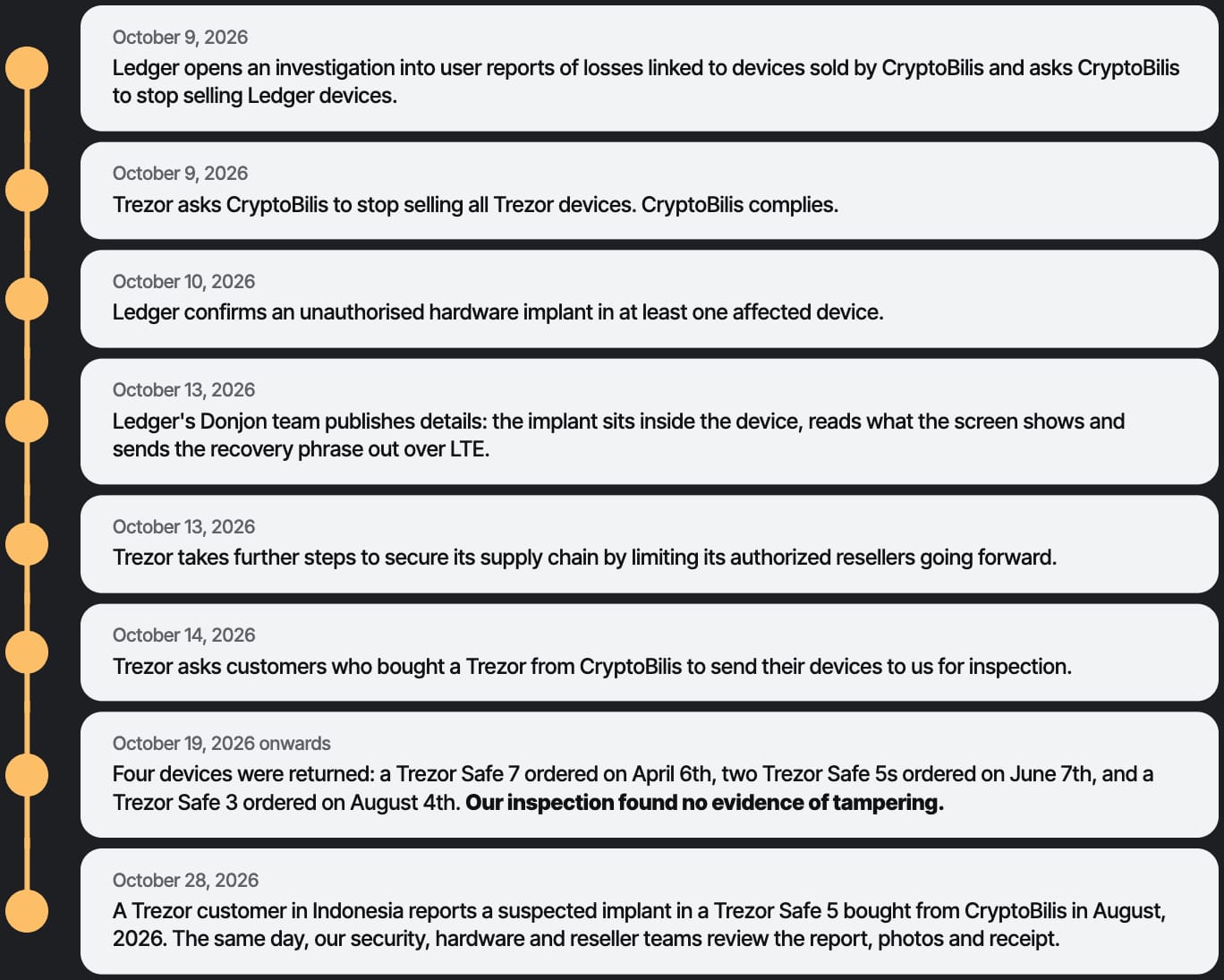
According to details shared by Trezor, the security concerns came to light following an alert from an Indonesian customer who purchased a Safe 5 device through the popular e-commerce platform Tokopedia. The transaction was fulfilled by the regional vendor CryptoBilis in August 2026. Upon opening the packaging and inspecting the hardware, the customer discovered an unauthorized, extra circuit board neatly integrated between the wallet’s primary logic board and its display screen. This hidden modification was reportedly equipped with a cellular module and an accompanying antenna, pointing to a sophisticated hardware interception.
Based on preliminary and unconfirmed information provided by the customer, the physical implant appears engineered to capture sensitive information visually displayed on the hardware wallet’s screen. This notably includes the critical wallet recovery phrase—the master sequence of words required to restore access to a user’s cryptocurrency holdings. When the compromised device is powered on, the malicious modification is believed capable of transmitting this captured data over a cellular mobile network to an external, unauthorized recipient, bypassing standard air-gapped security assumptions.
Crucially, CryptoBilis is the exact same third-party retailer that was implicated earlier this month in a nearly identical hardware supply-chain incident involving Ledger, another major manufacturer of hardware cryptocurrency wallets. In that prior incident, investigators discovered similar spy implants embedded inside competing devices. The physical form factor, layout, and suspected functionality of the implants found in both the Trezor and Ledger devices appear strikingly similar, suggesting a coordinated or closely related supply-chain attack targeting digital asset holders in specific geographical regions.
Following the revelations surrounding the Ledger compromise, the competing hardware wallet maker formally confirmed the security breach. Ledger subsequently urged all authorized resellers, distributors, and retail partners operating throughout Southeast Asia and Hong Kong to temporarily halt all commercial sales until comprehensive security audits could verify the absolute safety of their inventory.
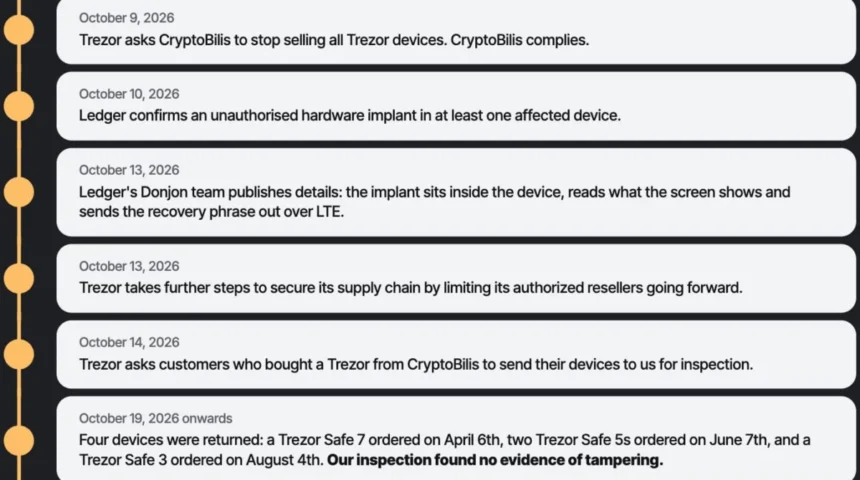
Taking swift defensive action in response to the unfolding Ledger incident—and operating proactively before receiving any direct indication that its own products had been compromised—Trezor immediately suspended all device sales through CryptoBilis on October 9, 2026. The manufacturer later announced broader corporate measures, indicating it would completely restructure and tightly audit its global network of third-party resellers and retail distributors to enforce stricter security protocols and prevent future supply-chain tampering.
At the time of its public advisory, Trezor stated that it was not yet aware of any actual financial losses or funds being stolen as a direct result of this suspected supply-chain attack. The company promised to provide further technical updates and transparency reports as soon as the suspect device completes shipping and arrives at its engineering facilities for comprehensive forensic analysis.
Meanwhile, the broader regional security landscape has grown increasingly tense. Multiple reports of significant financial losses sustained by Ledger users have continued to emerge since the beginning of the month. The growing crisis was further underscored by an official public advisory issued by the Singapore Police Force, which formally warned the public about tampered cryptocurrency hardware wallets and added an estimated $3,500,000 to the mounting tally of reported losses in the region.
Given the severity of the potential threat, Trezor has strongly recommended that consumers avoid setting up, initializing, or utilizing any hardware wallet purchased through CryptoBilis from March 2026 onward. For individuals who have already configured and used a device obtained through this specific vendor, the company advises immediately migrating all funds to a newly created wallet initialized with a completely fresh recovery phrase generated on a verified, secure device.
To assist affected customers, Trezor confirmed that buyers who can provide valid proof of purchase through the implicated reseller are eligible to contact customer support to receive a replacement device or an official voucher for a brand-new unit. Furthermore, the company explicitly cautioned users that attempting to weigh hardware wallets as a diagnostic method is completely unreliable for determining whether a device has been physically opened or tampered with by malicious actors during transit.

Related News