Fear, Labor, and Politics Collide in California’s Central Valley as High-Stakes Midterm Elections Loom
BAKERSFIELD, California — In a nondescript car park in Bakersfield, a simple yet poignant memorial has taken shape. Adorned with vibrant orange marigolds and flickering prayer candles, it has been erected to honor the recently deceased labor organizer and civil rights legend Dolores Huerta. Her legacy remains deeply woven into the fabric of California’s Central Valley, where she helped found the United Farm Workers union (UFW) in the 1960s and 1970s. Alongside union leader Cesar Chavez, Huerta fought tirelessly to secure better wages, health protections, and fundamental working conditions for the migrant and Latino laborers whose sweat and toil built the backbone of the state’s massive agricultural sector.
Today, echoes of her life’s work are visible across the region. The iconic rallying cry “Sí, se puede”—coined by Huerta and translating to “Yes, it can be done”—is prominently displayed on the marquee of a local theater in her honor. Yet, even as Huerta’s tradition of social and economic justice continues to resonate deeply, a harsh current reality grips the valley. An aggressive uptick in immigration raids over the past month has starkly underscored the degree to which economic and political insecurity remains a stubborn, terrifying daily fact of life for the region’s agricultural workforce.
Since early October, federal immigration agents—frequently operating in masks and driving unmarked vehicles—have fanned out across the Central Valley. The operations are part of a 45-day federal crackdown titled “Operation Save California,” spearheaded by the administration.
These sweeping raids, executed as part of a broader mass deportation campaign, have rapidly transformed into a fierce political flashpoint. They now sit at the center of the hard-fought race for California’s 22nd congressional district, one of several competitive contests across the state that Democrats view as vital to capturing a majority in the United States House of Representatives in the midterm elections on November 3.
While Republican incumbent David Valadao has long been a fixture of the Central Valley political landscape—successfully winning six of his last seven races through deep local roots and bipartisan appeal—progressive challenger Randy Villegas is seeking to unseat him. Villegas is attempting to capitalize on mounting popular frustration over the skyrocketing cost of living, healthcare cuts, and the pervasive fear generated by the sudden surge in immigration enforcement.
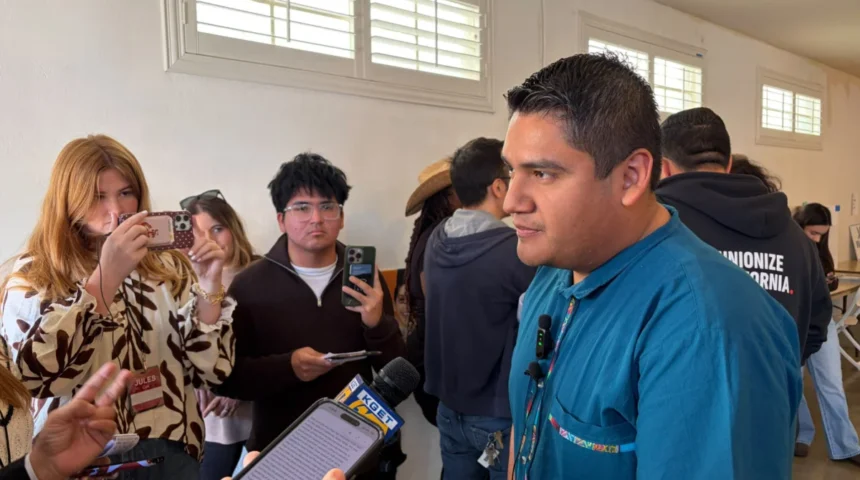
Just one day before the election, inside a small building located only a short distance down the road from the Huerta memorial in Bakersfield, a packed room of volunteers chanted the late activist’s signature slogan. Energized by speeches from prominent labor leaders and Democratic U.S. Senators Adam Schiff and Alex Padilla, the volunteers prepared to fan out across neighborhoods for a final weekend of door-to-door campaigning.
“I’ve spoken to local business owners who have told me how their businesses are now struggling as a result of these ICE raids, and many of them have now pivoted to delivering things like groceries,” Villegas told Al Jazeera, noting that the atmosphere of fear has forced many residents to lock their doors and avoid leaving their homes. “It’s having an impact on people who just want to go to work, want to go to school,” he added.

‘Unlawfully Targeted’
Federal immigration authorities have consistently defended the operations, maintaining that enforcement actions strictly target individuals with criminal records and firmly denying any allegations of racial profiling or discrimination.
“Allegations that DHS law enforcement engages in ‘racial profiling’ are disgusting, reckless, and categorically FALSE,” the Department of Homeland Security stated in an email correspondence. “What makes someone a target for immigration enforcement is if they are illegally in the US—NOT their skin color, race, or ethnicity.”
However, the administration’s portrayal of highly targeted operations focused narrowly on individuals with serious criminal backgrounds stands in stark contrast to the ground-level accounts shared by farmworkers, labor organizers, local municipal officials, and civil rights advocacy groups. These local observers describe an aggressive dragnet approach characterized by sweeping tactics and widespread collateral disruption.
“These are not criminals. These are hard-working, long-term members of our communities being unlawfully targeted simply for looking Latino and working class,” Teresa Romero, president of the United Farm Workers, whose members have actively campaigned for Villegas, said in a statement released on October 10. “We are seeing car windows being smashed and farm workers dragged from vehicles in the middle of the road while on their way to work.”
The human cost of these operations is reverberating through families who have lived in the region for decades. One woman, speaking with Al Jazeera over the phone on the condition of anonymity, recounted how her husband—a hardworking farmworker in Fresno County—was detained by immigration agents while returning home from his shift during the first week of October.
“I understand that if they [those arrested] are criminals or have done bad things, they have brought it on themselves,” the woman said. “लेकिन my husband has not done anything. The only thing he has done is work.”
She added that her four children, all of whom are United States citizens born in the country, have suffered severe emotional distress following the incident. Some of the children now begin to cry uncontrollably whenever they hear an unexpected knock at the door, gripped by the constant fear that their mother will also be taken away from them.

‘Word Spreads’
Local municipal leaders report that such traumatic accounts have spread rapidly through tightly knit rural communities, creating an atmosphere of deep unease that touches nearly every aspect of daily life.
“When you have a small community like ours, and folks are actually detained, word spreads,” said Olivia Calderon, mayor of the city of Arvin. “I had pastors ask me whether ICE takes a day off on Sunday because people don’t want to go to church,” she added.
Political challenger Villegas has directly linked the raids to incumbent Representative Valadao’s legislative record, pointing specifically to Valadao’s vote in favor of a bill designed to significantly expand funding and resources for Immigration and Customs Enforcement (ICE). Critics have frequently accused the agency of employing excessive force and displaying a disregard for civil liberties during enforcement actions.
When pressed about the tangible impact of the raids during a candidate debate in early October, Valadao largely mirrored the federal government’s official stance. He argued that many of those targeted possess criminal backgrounds and characterized the enforcement mandates simply by stating that “it is what it is.”
As the national battle for control of the House of Representatives enters its final hours, the race in the 22nd district has attracted intense nationwide scrutiny and high-profile political visitors. Prominent national figures—including progressive Senator Bernie Sanders and Representative Alexandria Ocasio-Cortez on the left, alongside Republican House Speaker Mike Johnson on the right—have traveled to the Central Valley in recent months to rally support for their respective candidates. Labor organizations like the UFW have simultaneously marshaled an army of members to knock on doors and mobilize voters for Villegas.
Despite a partisan redistricting process enacted by California voters in 2025 that drew new electoral maps intended to favor Democratic candidates, public opinion polls indicate an exceptionally tight race between Valadao and Villegas.
Representative Valadao has repeatedly proven himself to be a remarkably resilient political candidate. Raised in the Central Valley by Portuguese immigrant parents who settled in the region to work as dairy farmers, Valadao has cultivated deep, enduring ties with ranchers, agricultural growers, and conservative rural voters who wield substantial political influence. While the state of California as a whole remains a reliable stronghold for the Democratic Party, the rural interior often serves as favorable terrain for Republicans.

While the Democratic presidential ticket carried California by nearly 20 points in 2024, former President Donald Trump won Kern County—where Bakersfield is situated—by a nearly identical margin.
Nevertheless, Villegas and his campaign are banking on voter discontent over the rising cost of living, which has been exacerbated by broader geopolitical conflicts, including the Trump administration’s military campaign against Iran that sent global energy and fuel prices soaring.
Priscilla Ortega, a 23-year-old resident of the nearby city of Lamont, expressed deep frustration over both economic pressures and the social climate. She said she feels “annoyed and very angry” about surging prices and the ripple effects of the immigration enforcement actions.
Describing the impact of soaring fuel costs on her daily commute to a regional warehouse job, Ortega noted that the financial strain hits household budgets directly.
“It was really unnecessary,” she said of the war and its economic fallout. “That could have gone to food for my household or bills that need to be paid. People are sick of the prices increasing.”

Related News