Asia-Pacific Watches US Midterm Elections Closely Amid Energy Crisis and Trade Pressures
Kuala Lumpur, Malaysia — Across the Asia-Pacific region, governments and businesses reeling from the severe energy shock caused by the United States and Israel’s ongoing war on Iran are watching Tuesday’s US midterm elections with intense interest.
Many across the region are hoping to see enormous changes during the remainder of President Donald Trump’s term, according to political and economic analysts. These desired shifts range from an end to the military conflict in the Middle East to significant alterations in Washington’s aggressive policies on trade and global tariffs. However, despite expectations that the Democrats are poised to capture the House of Representatives—and potentially take control of the Senate from Trump’s Republican Party—few experts believe that a dramatic pivot in US foreign or economic policy is realistically within reach.
“Of course, everybody is watching,” said Steven Okun, a trade specialist and the chief executive of APAC Advisors, a Singapore-based consulting firm. “It’s great political theatre.”
Outside of the Middle East itself, arguably no region globally has been hit harder by the war on Iran than the Asia-Pacific. Before the outbreak of the conflict in January, the region imported the vast majority of the Gulf oil and gas transiting through the critical Strait of Hormuz. When Iran moved to close this vital maritime chokepoint in direct response to initial US and Israeli military strikes, much of the broader Asia-Pacific region was immediately plunged into severe supply constraints and soaring energy shortages.
The Philippines, which traditionally relies on the Gulf for more than 90 percent of its crude oil imports, has been operating under a strict national energy emergency since March. Meanwhile, skyrocketing fuel costs have severely drained the foreign exchange reserves of the region’s poorest economies, including Cambodia, Laos, Myanmar, and East Timor, according to assessments published by the Institute of Southeast Asian Studies (ISEAS)-Yusof Ishak Institute in Singapore. At the same time, regional economic powerhouses such as Indonesia, Malaysia, Thailand, and Vietnam have been forced to allocate massive government funds toward fuel subsidies in a desperate bid to shield everyday consumers from inflationary shocks.
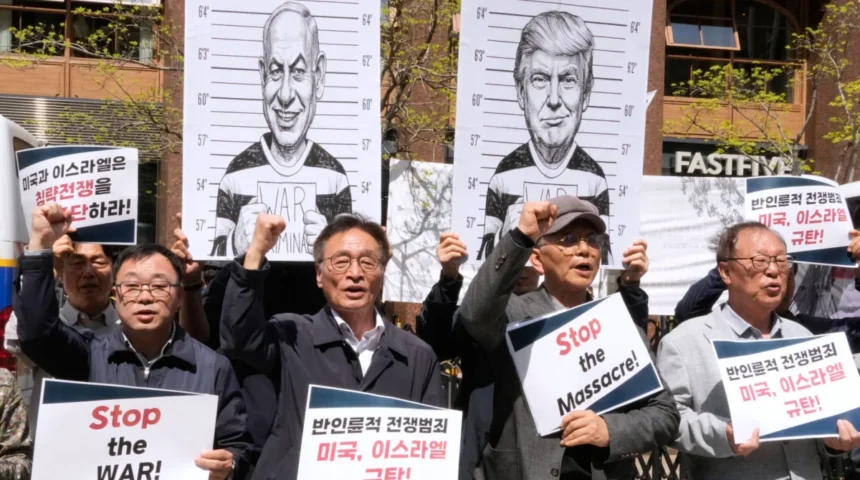
Public opinion throughout the Asia-Pacific remains overwhelmingly opposed to the war. Yet, Okun noted that a Democrat-controlled US Congress is statistically and constitutionally unlikely to possess the leverage required to force President Trump to bring the eight-month-old conflict to a close.
“With Iran, I don’t see [a Democrat-controlled Congress] having much change at all, other than the fact that the war will be investigated and there will be oversight hearings,” Okun told journalists. “We might even see an impeachment of the secretary of defence, but it doesn’t change the overall impact of the war.”
Under the United States Constitution, formal authority to declare war is vested in Congress. However, the Trump administration has repeatedly insisted that the military operations and strikes against Iran were executed under the umbrella of self-defence. Consequently, the executive branch has thus far ignored binding congressional resolutions directing the White House to withdraw US military forces from active hostilities.
Should a newly empowered, Democrat-led Congress pass legislation specifically designed to restrict ongoing military operations or cut off operational funding, President Trump retains the absolute power of the veto. Overriding a presidential veto requires a two-thirds supermajority vote in both the House and the Senate, a threshold that Democrats are almost guaranteed to fall short of achieving.
“Tariffs don’t change”
On the critical fronts of international trade and tariff enforcement, analysts similarly see very little room for a divided or opposition-controlled Congress to successfully rein in the White House.
The US president severely rattled global financial and commodity markets last year by imposing sweeping “reciprocal” tariffs ranging from 10 percent to 50 percent on approximately 90 countries worldwide, with the explicit policy goal of shrinking the persistent US trade deficit. Once again, Asian economies bore a disproportionate share of the economic burden. Cambodia was confronted with a staggering 49 percent tariff, Laos faced 48 percent, Vietnam was slapped with 46 percent, and Myanmar encountered 45 percent.
After the US Supreme Court struck down those specific reciprocal tariffs in February, the Trump administration swiftly pivoted to alternative policy instruments. In July, the administration introduced new tariffs of 10 percent and 12.5 percent targeting goods originating from 60 distinct trading partners, officially accusing them of failing to adequately prevent imports manufactured using forced labour. Across Asia, this expanded hit list notably included economic giants like China, Japan, and South Korea, alongside seven Southeast Asian nations: Cambodia, Indonesia, Malaysia, the Philippines, Singapore, Thailand, and Vietnam.
“In some ways, the new Congress is not going to matter to the Asia Pacific because it’s not going to affect trade policy,” Okun emphasized. “Congress cannot change that […] Tariffs don’t change. The war doesn’t change.”
Despite the prevailing pessimism, a small contingent of analysts perceives a narrow opening for policy shifts.
Stephen Olson, a visiting fellow at the ISEAS-Yusof Ishak Institute, argued in a recent analytical essay that a strong voter rebuke of traditional “Trumpism” at the ballot box could theoretically embolden a dormant, pro-free-trade wing within the Republican Party. According to Olson, this faction has largely been intimidated into standing down throughout the duration of the Trump presidency.
Such a political realignment could offer a glimmer of hope for Southeast Asian export-driven economies that remain fundamentally dependent on unfettered access to the American consumer market. Olson noted that a Democratic-controlled Congress could actively lobby and push for targeted carve-outs and regulatory exceptions that might afford the region’s exporters a modicum of relief. Nevertheless, any foundational, long-term shift in broader US trade architecture will likely have to wait until the 2028 presidential election cycle.
Joshua Kurlantzick, a senior fellow for Southeast Asia and South Asia at the Council on Foreign Relations, pointed out that the strategic wish list of the Asia-Pacific region extends far beyond commercial trade into the realm of national security.
“I think nearly all of Asia would like to see enormous changes, across many domains, during the rest of Trump’s term,” Kurlantzick told media outlets. “But I think much of the region believes this will not happen.”
Beyond seeking greater stability in ongoing trade and tariff policy, Asia-Pacific nations would ideally like to feel more secure regarding enduring security guarantees from Washington, Kurlantzick explained. Furthermore, regional capitals desire a clearer, more visible and consistent US naval and military presence in the South China Sea—where Beijing’s expansive territorial claims directly overlap with the sovereign claims of five Southeast Asian nations—as well as across the Taiwan Strait, the sensitive waterway separating mainland China from the self-governing island of Taiwan, which Beijing claims as its own territory.
Commercial enterprises across the region will also be closely monitoring whether a major electoral defeat for the GOP translates into a greater willingness among congressional Republicans to unite with Democrats on key issues affecting Asian corporate interests. These include ongoing concerns regarding punitive tariffs, overarching trade policy, foreign arms sales, and a general desire to mitigate broad economic unpredictability, Kurlantzick noted.
US-China ties
One specific area where policy analysts genuinely anticipate tangible legislative movement involves future US regulatory frameworks concerning Chinese advanced technology.
Regardless of which political party ultimately secures control of Capitol Hill, the incoming Congress is widely expected to pass significantly tougher restrictions on China, according to Okun of APAC Advisors.
Among the anticipated legislative measures is the Remote Access Security Act, a bill designed to extend federal export controls to cover remote access to American goods, software, and proprietary technology. Another key piece of legislation is the Chip Security Act, which would legally mandate companies to verify that advanced artificial intelligence chips remain securely housed in authorized physical locations, thereby preventing illicit diversion to foreign adversaries. Additionally, discussions center around the Multilateral Alignment of Technology Controls on Hardware Act—commonly referred to as the MATCH Act—which aims to pressure international allies into bringing their own domestic controls on chipmaking manufacturing equipment directly into alignment with Washington’s strict standards, keeping cutting-edge semiconductor technology out of Beijing’s hands.
“The next Congress is going to pass them regardless of midterms because both parties agree on them,” Okun stated. “The person who is least restrictive now on China is the US president,” he added, pointing to Trump’s recent efforts to court Chinese President Xi Jinping.
The two leaders have met twice over the course of the year as diplomatic ties have experienced a relative warming trend following a bitter and financially costly trade war last year. In an effort to preserve this fragile bilateral trade truce, Trump has notably delayed final approval on a proposed $14bn package of military arms sales to Taiwan, which would otherwise stand as the largest single weapons transfer package ever extended to Taipei.
Meanwhile, some regional analysts harbor lingering concerns that a lame-duck US president, increasingly hemmed in at the domestic level by an opposition-controlled Democratic Congress, might lean more aggressively and unpredictably into foreign policy initiatives.
“We should not be surprised by continued erratic foreign policy,” warned James Guild, an assistant professor at the Indonesian International Islamic University.
“The Democrats have a poor record of effectively opposing and holding Trump accountable using conventional tools of congressional oversight,” Guild observed. “We will have to wait and see if they rise to the moment this time.”

Related News