Glassnode Unveils Alpha Lab to Bridge the Gap Between On-Chain Data and Quantitative Trading Strategies

Crypto investors today find themselves navigating an unprecedented deluge of market information. From deep on-chain activity and exchange flows to complex derivatives positioning, spot markets, order books, and underlying network fundamentals, each data stream reveals a distinct and vital facet of the broader digital asset economy. While this vast breadth of information is undeniably one of Glassnode’s greatest strengths, it simultaneously introduces a formidable challenge for market participants right at the starting line: where should one actually begin?
When an analytics catalogue contains thousands of specialized metrics, finding the small, highly relevant set of indicators that truly matter for a specific investment decision can easily morph into a time-consuming research project of its own. Experienced quantitative research teams often have the luxury of building custom pipelines capable of testing countless combinations, data transformations, and indicator thresholds. Yet, for many discretionary investors, quantitative funds, and analysts, moving from a compelling chart in a studio dashboard to a systematic, executable decision rule still demands an excessive investment of time, complex coding skills, and specialized domain knowledge.
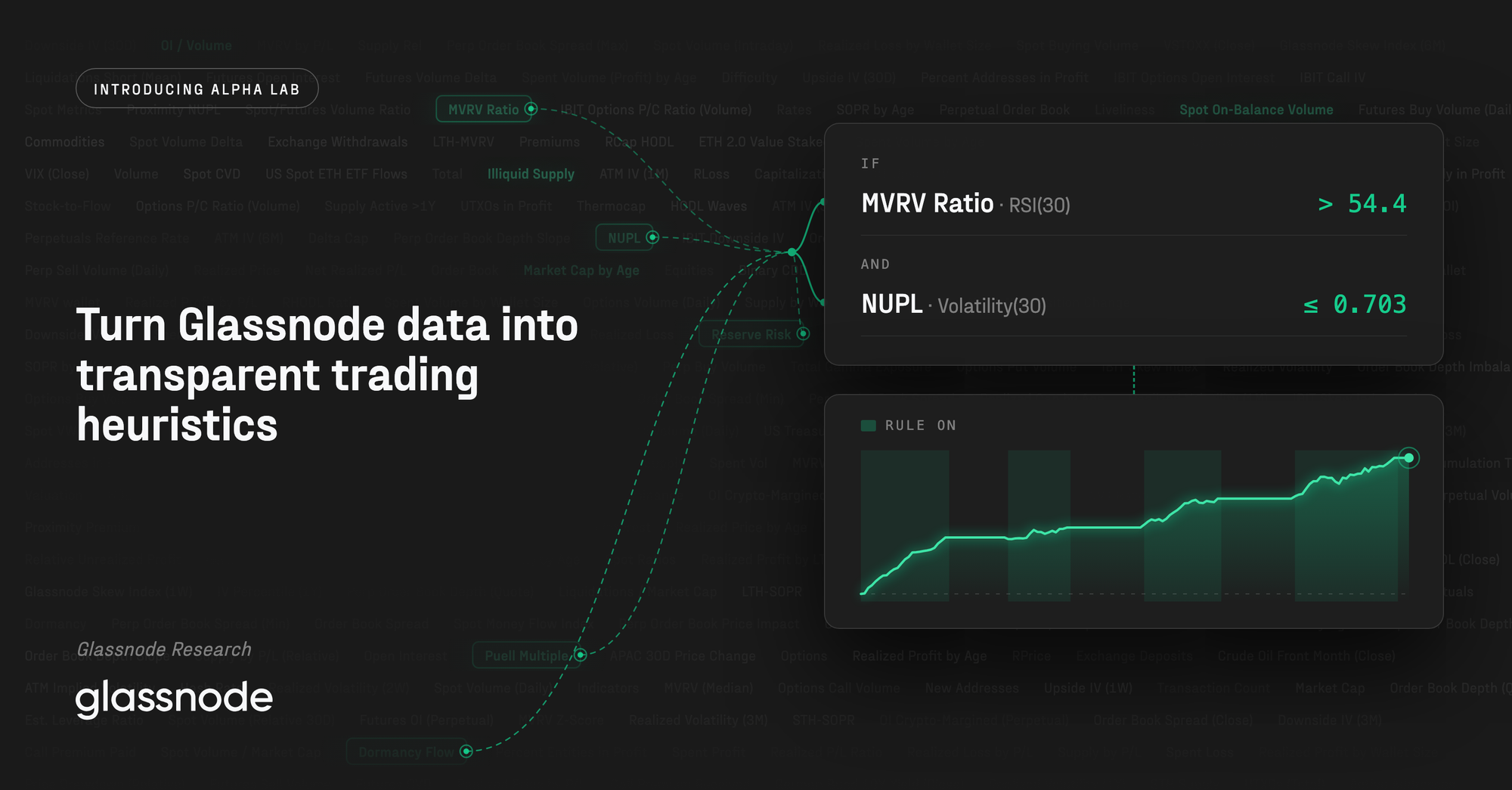
To systematically close this persistent gap, the platform has officially introduced Glassnode Alpha Lab, a powerful new quantitative research platform engineered to search through Glassnode’s extensive data universe to surface simple, human-readable trading heuristics. Rather than forcing users to manually code and backtest thousands of permutations, Alpha Lab allows an investor to articulate what they want to identify, select the specific market data domains they wish to investigate, and let a sophisticated research engine test which exact combinations have historically yielded the most useful predictive power. The overarching goal is remarkably straightforward: transform an overwhelming metric universe into a focused, curated set of actionable ideas that an investor can easily understand, critically challenge, and seamlessly incorporate into their own proprietary research and portfolio management workflows.
Start with the Investment Question
The research workflow within Alpha Lab begins with a fundamental investment question, such as identifying which specific Glassnode metrics have historically helped isolate high-probability buying opportunities in Bitcoin. From that initial query, the user selects the category of metrics the platform should explore—ranging from traditional on-chain metrics and spot market data to futures, options, and order-book dynamics—and determines the primary optimization objective. Users can prioritize stronger risk-adjusted returns, which are measured directly through the Sharpe ratio, or focus purely on absolute performance metrics over chosen time horizons.
Once the asset and objective are defined, the platform relies on precise data labeling to establish a ground truth. Every single day within the available historical record is marked as either a favorable buying opportunity or a non-favorable period based entirely on how the market actually behaved subsequently. Each selected metric is then mathematically expanded into numerous transformed variants of itself, setting up a clear statistical inquiry: which of those specific metric readings were consistently present on the historically successful days and absent on all others?
To answer this efficiently, the system constructs ensembles of decision trees where every branch represents a quantitative threshold separating the winning days from the rest. Hundreds of these trees are grown simultaneously, with an internal optimizer continuously refining how they are constructed. Every single attempt is scored rigorously through a trader’s lens, evaluating how a strategy derived from those parameters would have actually performed in real-world market conditions.
Instead of returning an opaque, black-box prediction, the engine extracts its strongest findings as transparent heuristics. Because each decision tree is kept deliberately shallow, every path that terminates in a positive outcome forms a concise, readable rule comprising one or two metric conditions that describe a specific market zone where successful days clustered. Each discovered zone is then evaluated based on its historical hit rate and the depth of the historical dataset supporting it. A resulting rule might manifest as a straightforward directive indicating that when a specific transformed metric falls below one threshold while another rises above a second, a prime environment exists for improving risk-adjusted returns on Bitcoin.

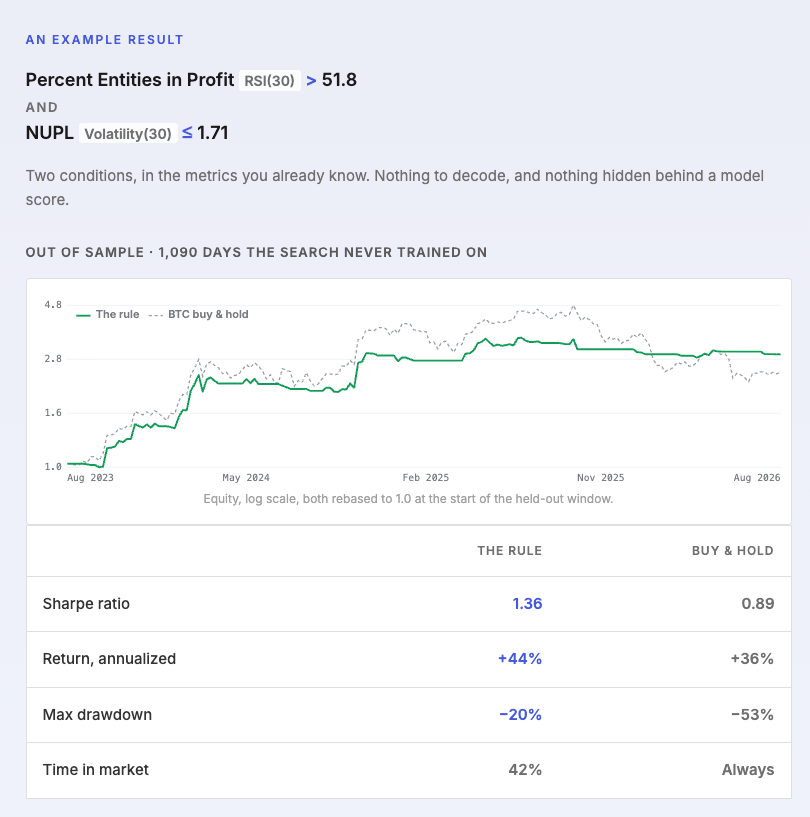
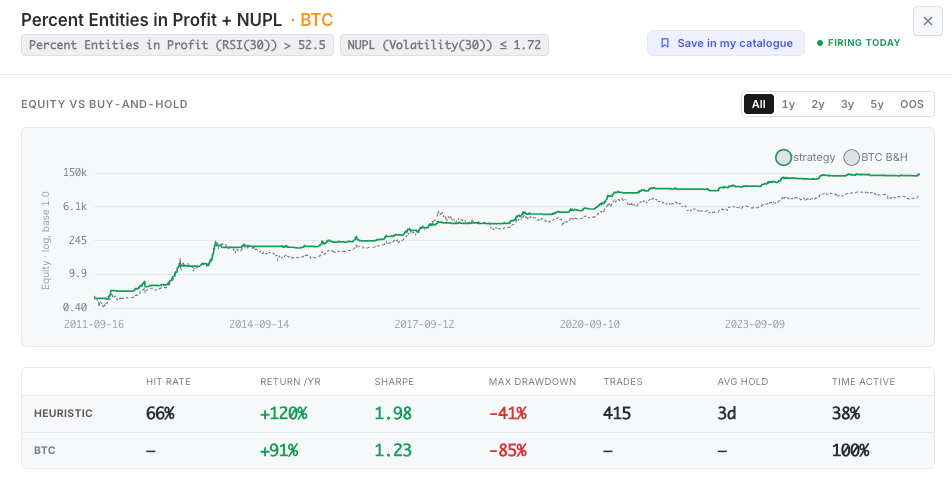
Every generated rule is accompanied by a comprehensive suite of evaluative evidence, including historical return figures, Sharpe ratios, maximum drawdowns, hit rates, trading frequencies, and a detailed equity curve. Users retain the ability to benchmark the rule directly against the underlying asset, inspect performance across varying time horizons, and instantly verify whether the rule’s underlying conditions are actively firing on the latest available market data. This methodology surfaces high-potential relationships while keeping the foundational logic completely transparent.
Three Ways to Research
Recognizing that different market participants require varying degrees of control over their analytical workflows, Alpha Lab provides three distinct pathways into its core research engine.
Easy mode is meticulously designed for speed and accessibility. Users can quickly choose an asset, specify whether they are hunting for long or short opportunities, select the metrics they wish to scan, and define their desired search effort. The application then executes the underlying workflow in the background, returning the most promising rules packaged as clean, readable signal cards. These cards can be viewed as paired metrics or decomposed into single-metric rules, and they can be effortlessly filtered according to an investor’s individual preferences, such as drawdown limits, risk-adjusted returns, historical hit rates, or specific evaluation windows. The workflow is intentionally iterative, empowering users to refine their metric selections, rerun searches, and compare new outputs against previous attempts to build a structured discovery loop.
Advanced mode is tailored for quantitative researchers who demand the ability to inspect and control every single step of the modeling process. This mode exposes the entire feature space, allowing users to select both source metrics and precise mathematical transformations, including z-scores, relative strength indexes, moving averages, volatility metrics, and percentile-based features. Furthermore, transformation windows can be manually adjusted to rigorously test how a single underlying metric behaves across vastly different time horizons. Researchers can also move beyond default labeling by painting custom market zones directly onto historical price charts, enabling the investigation of highly specific hypotheses. Once a search concludes, Advanced mode reveals the direct path from machine learning models to final rules, permitting detailed analysis of feature influence, full heuristic tables, and individual rule mechanics. Crucially, the platform supports rigorous stress-testing to ensure that a discovered relationship is structurally sound rather than a fragile historical artifact dependent on a single exact parameter threshold.
Agents mode introduces a cutting-edge autoresearch loop to the platform. Through Alpha Lab’s Model Context Protocol server, compatible artificial intelligence agents gain direct access to the exact same metric catalogue and optimization engine utilized by the human interface. Investors can assign an agent a broad research objective—such as continuously exploring metric groups until it uncovers a rule that improves risk-adjusted performance relative to a designated benchmark—and allow the system to autonomously run, evaluate, and refine successive search iterations. While the agent handles the heavy computational lifting, the human researcher maintains absolute control over the foundational questions, economic assumptions, and final qualitative judgments, with top-performing findings easily transferred back to the visual interface for deeper analysis.
From Discovery to a Living Catalogue
To ensure that research does not exist merely as a static backtest, Alpha Lab incorporates a centralized Catalogue containing pre-identified strategies saved and maintained by the Glassnode research team. Users can browse these catalogued strategies by asset, directional bias, and risk-performance profiles, studying how specific rules performed across their full history, out-of-sample periods, and live trading windows established after cataloguing. Investors can similarly save their own proprietary findings to a personalized repository, fostering a collaborative research universe for their internal teams.
Over time, this living catalogue evolves far beyond a simple list of historical backtests. The platform actively flags strategies whose recent market behavior has begun to weaken, identifies overlapping signals, and highlights potential gaps in portfolio coverage. This approach benefits directly from the Lindy effect, positing that the longer a trading strategy continues to function successfully in a live environment on unseen data, the greater the confidence in its structural robustness. Complementing this repository, the Market Pulse feature aggregates currently active long and short rules to provide a concise, top-level read on how the broader body of research evidence is leaning at any given moment.
A Research Process Built on Sound Methodology
Alpha Lab’s underlying methodology is deliberately constructed around rigorous quantitative standards designed to mitigate the risks of data overfitting and ensure that discovered relationships generalize effectively beyond the historical data used in their initial discovery. The framework builds upon proprietary research workflows originally developed internally at Glassnode for the Bitcoin Sharpe Signal, drawing confidence from more than three years of verifiable live track record.
The automated search functions as a random forest executed across a strictly constrained budget of trials, with tree depth capped at two to preserve human readability and limit model complexity. Validation is executed across three rigorous stages. Walk-forward validation sequentially trains models on chronological data blocks and evaluates them on subsequent periods, thereby respecting the natural forward flow of time in financial markets. An out-of-sample holdout reserves the most recent twenty percent of historical data, completely excluding it from the initial search phase to serve as an independent evaluation benchmark. Once a rule is formally catalogued, live evaluation tracks its performance on newly incoming market data that could not have possibly influenced its selection. Finally, all reported performance figures are presented on a net basis, fully incorporating realistic assumptions regarding trading slippage.
Who Alpha Lab is For
Glassnode has designed Alpha Lab to serve a diverse spectrum of market participants who recognize the value of on-chain analytics but require a streamlined, evidence-backed path from raw data exploration to execution. For discretionary investors and traders, the platform cuts through analytical noise to reveal precisely which metrics and thresholds warrant attention before executing a trade. For quantitative research teams, it provides a deeply configurable environment for rapid feature engineering, model comparison, and robustness stress-testing. For forward-thinking organizations experimenting with autonomous research agents, the platform offers a structured, measurable loop grounded in institutional-grade data and consistent evaluation frameworks.
The beta release of Glassnode Alpha Lab is currently rolling out to a select group of clients and institutional research teams. As the platform opens its doors to early users looking to test the software against live production workflows, Glassnode continues to position the tool as an advanced research utility designed to make complex blockchain data substantially easier to translate into focused, transparent, and actionable market intelligence.

Related News