Popular Sci-Fi RPG ‘Goddess of Victory: NIKKE’ Hit by Malicious Supply-Chain Attack Targeting PC Players
The developers of the globally popular sci-fi shooter role-playing game Goddess of Victory: NIKKE have confirmed that their PC game launcher scripts were compromised in a sophisticated supply-chain attack. The breach resulted in the distribution of malicious payloads designed to harvest sensitive user credentials, personal data, and cryptocurrency wallet information from unsuspecting players.
According to an official notice published by the development team on the social media platform X, a client update was hurriedly issued on November 4 at 02:30 UTC+9 to address the security loophole. The incident has raised serious concerns among the gaming community regarding software distribution safety and the integrity of content delivery networks used by major game publishers.
"We have identified an issue indicating that the PC Launcher’s script files may have been tampered with by a third party," the statement published on X explained. "Accordingly, client fixes and an update were implemented on November 4 at approximately 02:30 (UTC+9). We are currently investigating the scope of the impact caused by this issue, and we will provide further details regarding follow-up measures in a separate notice."
Goddess of Victory: NIKKE is an internationally recognized sci-fi shooter RPG developed by the South Korean studio Shift Up. Available across Windows, iOS, and Android platforms, the game has amassed a massive player base since its initial release in late 2022. Its publisher, Level Infinite, has previously reported achieving more than 45 million downloads globally, while Google Play Store metrics alone show over 10 million individual downloads, highlighting the vast potential attack surface the compromised launcher exposed.
Malicious Launcher Scripts Delivered Obfuscated Backdoor
While Level Infinite’s initial public statements offered limited technical specifics regarding the breach, a comprehensive independent security report published on GitHub by security researcher MotherSphere shed light on the mechanics of the attack. According to the researcher’s findings, the incident centered around four JavaScript files hosted directly on Level Infinite’s official content delivery network.
The investigation alleges that these crucial script files were illicitly modified months prior, specifically on September 27, 2026. The injected malicious JavaScript code was engineered to silently download supplementary payloads from external, attacker-controlled servers every time a player launched the game on their personal computer.
To evade detection by traditional monitoring tools and casual inspection, the injected code was heavily obfuscated and concealed within otherwise legitimate script architecture. It relied on two specific external domains, insightjs[.]com and insightjs[.]org, to fetch the secondary stages of the attack, incorporating a fallback mechanism to switch domains if the primary server experienced downtime.
BleepingComputer security analysts independently examined two of the modified JavaScript files and verified the presence of the obfuscated loader. The mechanism was designed to fetch and execute code from the attacker-controlled domains. According to MotherSphere’s technical analysis, the downloaded architecture abused native functionalities within the game launcher to retrieve and execute a malicious LuaJIT payload known as insight.bundle. This component subsequently installed a specialized remote-access agent designated as K2F.

This backdoor provided malicious actors with extensive capabilities on compromised machines. The remote-access agent allowed unauthorized individuals to execute arbitrary commands, browse and download local files from the host system, capture live screenshots, harvest NIKKE account login credentials, and siphon valuable information stored within web browsers.
Furthermore, the malware included functionality to deploy an additional Windows dynamic-link library file named platform_experience_helper.dll. This secondary component was designed to maintain persistence, remaining active on the system even after the player closed the game launcher.
Cryptocurrency Theft Risks and Ongoing Fallout
Analysis of strings extracted from a DLL sample uploaded to VirusTotal revealed alarming capabilities concerning digital assets. The malware contained specialized routines to target and intercept cryptocurrency wallet data stored within browser extensions. Among the targeted applications were widely used extensions such as MetaMask, Phantom, Coinbase Wallet, and several others.
The code was structured to capture sensitive wallet parameters, including private keys and recovery phrases, which could grant unauthorized actors direct access to victims’ cryptocurrency holdings. Despite these advanced capabilities embedded within the auxiliary DLL, security experts emphasize that it remains unclear whether the threat actors actively deployed this specific component across all infected systems or successfully stole financial assets from players.
The investigation also revealed discrepancies in the publisher’s remediation timeline. MotherSphere reported that while Level Infinite replaced three of the compromised JavaScript files with clean versions on November 3, a tampered copy of the fourth file was reportedly still being served to active users as late as 22:26 GMT. This lingering vulnerability suggested that at least one compromised script remained accessible online even after the initial corporate patch deployment.
To assist users in determining whether their systems were compromised, the independent researcher published specific indicators of compromise. One primary indicator is the appearance of the string k2f_chan registered inside the Launcher/intl_service/debug.log file located within the main NIKKE installation directory on local drives. Security analysts note that while this log entry confirms the execution of the malicious Lua agent, it does not definitively prove whether the cryptocurrency-targeting DLL was successfully loaded alongside it.
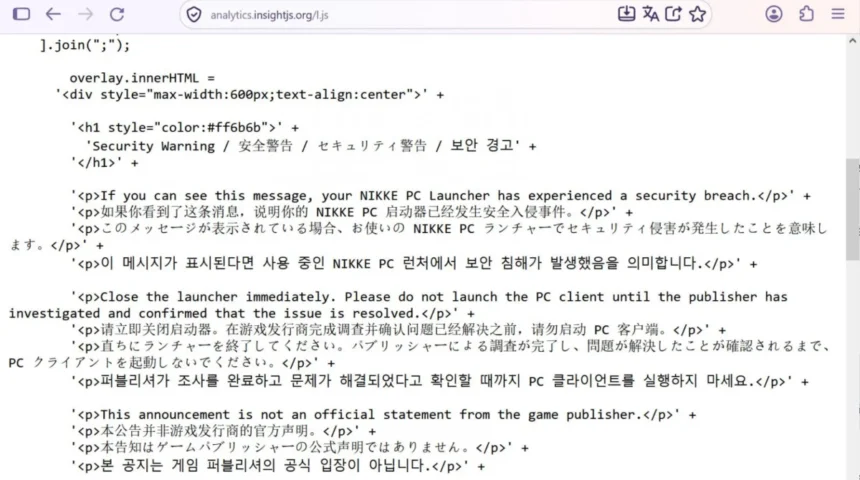
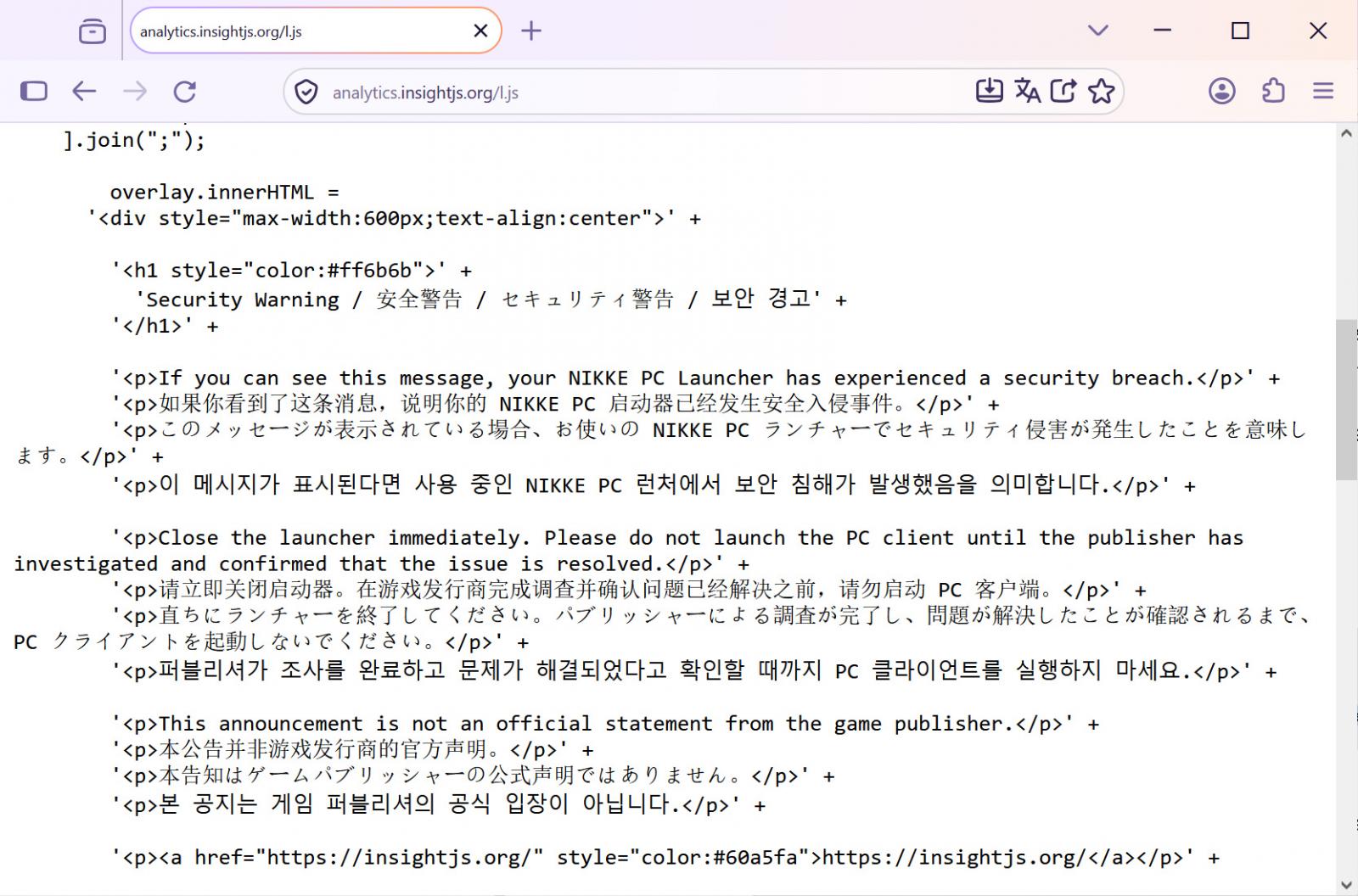
Meanwhile, unusual activity was detected surrounding the attacker-controlled infrastructure. BleepingComputer observed that the backup domain, insightjs[.]org, began serving code designed to display an explicit security warning directly inside the game launcher interface. The multilingual warning, presented in English, Chinese, Japanese, and Korean, urged players to immediately close the launcher and avoid opening the PC client until the game publisher officially verified that all security risks had been neutralized. Because this advisory did not originate from official corporate channels, uncertainty remains regarding who currently controls the domain or why the malicious payload was swapped out for a warning message.
Level Infinite has been contacted by security media outlets for further comment regarding the independent researcher’s findings, but no official response has been provided as of publication time. In light of the supply-chain breach, cybersecurity professionals advise potentially affected players to conduct thorough system scans using updated antivirus solutions. Individuals who find definitive evidence of compromise are urged to take precautionary measures, including performing a complete operating system reinstallation and updating sensitive passwords and account credentials from an entirely clean and secure device.

Related News