Vercel Rolls Out Device Bound Session Credentials to Thwart Infostealer Malware

Cloud platform and Next.js developer Vercel is gradually rolling out Device Bound Session Credentials (DBSC) across its ecosystem, introducing a robust new layer of defense designed specifically to combat the growing threat of information-stealing malware. The deployment marks a significant step forward in securing developer environments against unauthorized session hijacking, a tactic increasingly favored by cybercriminals aiming to access sensitive corporate repositories and cloud deployments.
The new security mechanism was officially announced by Vercel’s Chief Technology Officer, Malte Ubl, via a statement on X. The core function of DBSC is to securely bind an active login session directly to a user’s physical device. This is accomplished by generating and storing a private cryptographic key within the device’s Trusted Platform Module (TPM)—the same dedicated hardware security subsystem that modern laptops and smartphones utilize for biometric features like fingerprint readers and facial recognition. Because this private key is deeply embedded and locked within the hardware, it creates a secure cryptographic chain of custody for the user’s login state.
Consequently, even if a piece of infostealer malware manages to successfully harvest a user’s session cookies from a browser, those stolen credentials become entirely useless if they are exported and attempted to be reused on another machine. The authentication server explicitly requires validation from the original hardware’s TPM private key, effectively neutralizing the utility of purloined cookie data.

Vercel operates as a major cloud platform widely utilized by software developers around the globe to deploy, manage, and scale websites, complex web applications, and cutting-edge autonomous AI agents. In addition to its cloud infrastructure hosting services, the company is globally recognized as the primary creator and maintainer of Next.js, one of the most popular and widely adopted React-based web frameworks in the software engineering industry.
The current DBSC implementation specifically targets authentication flows at vercel.com, the central web console where developers log in to oversee their projects, manage team permissions, and monitor active deployments. Elaborating on the technical mechanics of the rollout, Ubl explained that DBSC functions by storing the private key inside the user’s device TPM and utilizing that unique key to sign the corresponding authentication cookie. He emphasized the absolute security of the architecture by pointing out that the private key can never be retrieved under any circumstances—not by Vercel, not by the user, and certainly not by malicious software attempting to exfiltrate system data.
The introduction of DBSC by Vercel also serves to complement existing browser-level security mitigations, such as Google Chrome’s App-Bound Encryption framework. That particular browser feature was introduced to make it significantly harder for malicious infostealers to easily extract plain-text browser cookies from local storage directories. By building upon these browser-side mitigations, Vercel’s implementation of DBSC provides an additional, independent layer of architectural protection that focuses specifically on preventing the lateral movement and fraudulent reuse of stolen session data across foreign hardware devices.
At present, the DBSC feature is fully compatible with Google Chrome running on macOS and Windows operating systems. However, Vercel is deliberately executing the deployment as a gradual rollout. This phased approach allows the platform’s engineering teams to closely monitor telemetry and carefully manage and resolve any potential edge cases, particularly those involving complex OAuth application interactions, before making the feature universally mandatory or widespread.

In tandem with the browser-based DBSC rollout, Vercel is simultaneously deploying a parallel protective technology known as DPoP, or Demonstration of Proof-of-Possession, specifically designed to secure authentication and operations executed through the Vercel Command Line Interface (CLI). This ensures that developers interacting with the platform via terminal environments benefit from an equivalent standard of hardware-backed session security.
Security Review also lands
The rollout of hardware-bound session credentials arrives closely on the heels of another major platform update. Earlier this week, Vercel officially launched a new feature called Security Review in public beta for organizations utilizing Pro and Enterprise team tiers. The capability is integrated directly into the Vercel Agent, providing an automated security analysis layer that systematically scans code changes on every single push made to connected GitHub repositories, provided the feature has been explicitly enabled by the development team.
The newly introduced system relies on a combination of static code analysis and custom, team-defined security policies to automatically flag a wide variety of common security pitfalls. These include critical oversights such as missing authorization checks on backend routes, insecure data handling practices, and accidentally exposed API secrets or credentials embedded directly within source code. Furthermore, if the repository permissions are appropriately configured to allow it, the Vercel Agent possesses the capability to not only flag these vulnerabilities but also autonomously validate and commit code fixes to remediate the issues before they reach production environments.
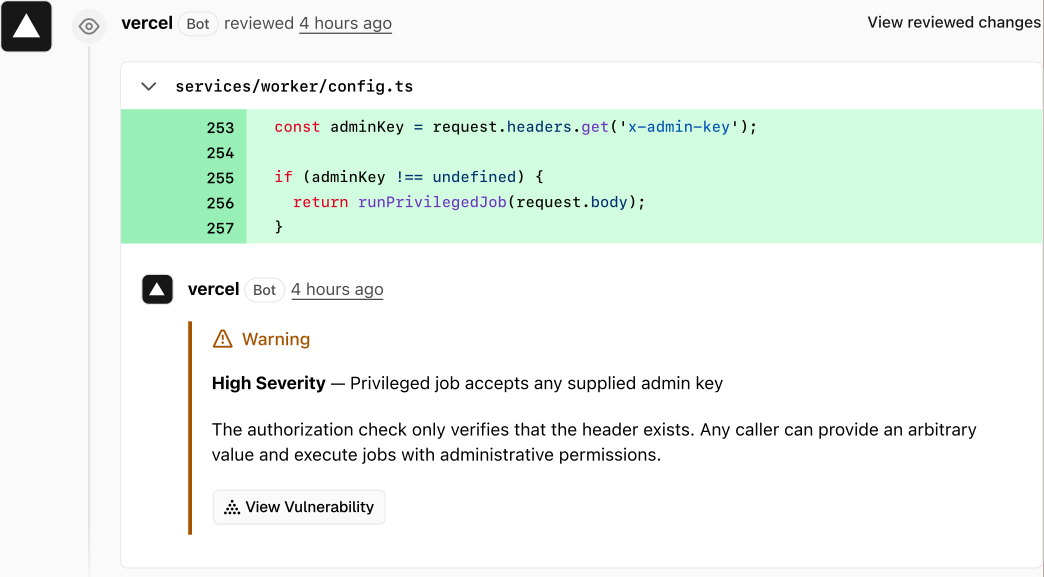
Vercel announced that scans performed by the Security Review system will be provided completely free of charge until November 10, 2026, while any automated, agent-generated code fixes will be billed separately according to consumption and tier guidelines. Discussing the origins of the tool, Ubl revealed that Vercel’s internal security and engineering teams had successfully deployed and tested the feature internally several months prior to its public release. Having already proven its operational worth by catching numerous vulnerabilities during internal development cycles, the platform decided to package the capability and make it broadly available to its wider customer base.
The heightened focus on platform-wide security and developer tooling follows a notable security incident earlier in the year. In April, Vercel confirmed it had suffered a security breach that impacted a subset of its customers. During that incident, malicious actors successfully breached Vercel’s internal systems by first compromising an employee’s Google Workspace account hosted at Context.ai.
According to post-incident disclosures, the attacker leveraged that initial unauthorized access to navigate internal corporate systems and view environment variables that had not been properly flagged and isolated as sensitive data. The fallout included attempts by a threat actor impersonating the notorious hacking collective ShinyHunters to publicly market and sell allegedly stolen source code, access authentication keys, and underlying database contents associated with the platform. By introducing advanced cryptographic session protections like DBSC and proactive automated code scanning via Security Review, Vercel is actively working to harden its infrastructure against similar vectors of unauthorized access moving forward.

Related News