White House Reschedules Hearing for Fed Governor Lisa Cook to December Amid Ongoing Legal and Political Battle
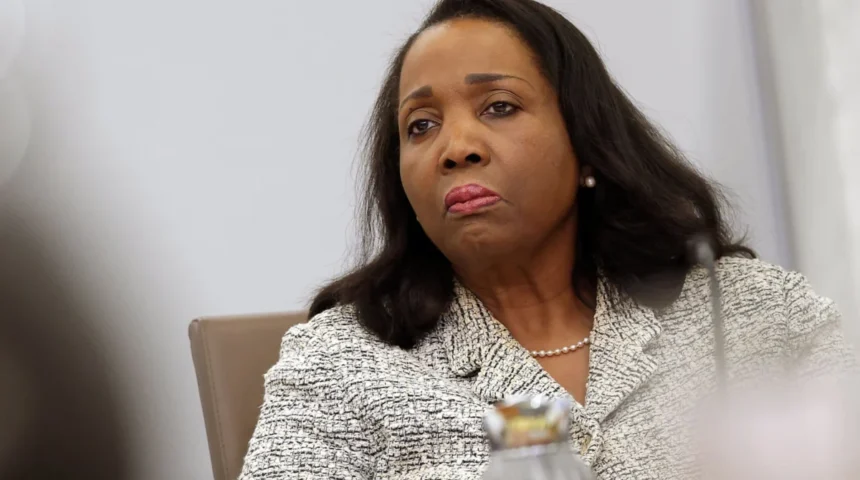
WASHINGTON — A special investigative committee appointed by President Donald Trump to examine allegations of false statements made by Federal Reserve Governor Lisa Cook has officially rescheduled a high-stakes hearing, pushing the proceedings back from this Thursday to December 14, according to a White House official.
The adjustment to the schedule, which was first reported by The New York Times on Wednesday evening, came at the direct request of Cook. Her legal counsel, prominent defense attorney Abbe Lowell, outlined the necessity for a delay in an October 14 letter addressed to the administration. Lowell maintained that several foundational questions regarding the legitimacy, scope, and procedures of the newly formed committee and its ongoing investigation would need to be thoroughly addressed before Cook could participate in any formal hearing.
In his initial communication regarding the matter, Lowell indicated that the earliest possible date for such a proceeding would be in December. Despite the newly agreed-upon date, it remains unclear whether Cook, who has consistently and vehemently denied any wrongdoing, will ultimately consent to appear before the White House panel when it convenes next month.
The unfolding drama is the latest chapter in a prolonged and contentious institutional struggle between the White House and the independent central bank. President Trump initially attempted to fire Cook from the Federal Reserve Board of Governors in August 2025, setting off a wave of legal challenges and high-profile debates over the autonomy of the nation’s monetary policy leadership. However, that initial termination effort was blocked in the courts, leading to the creation of the current investigative panel.
President Trump established the specialized "committee of inquiry" in early October to look into specific allegations that Cook provided false statements related to "one or more mortgage instruments." The formation of the committee came more than three months after the Supreme Court intervened in the ongoing power struggle, ruling that the president, at least for the time being, does not possess the unilateral authority to fire Cook from the board of the central bank.
The Supreme Court’s decision left in place a lower court’s preliminary injunction, which effectively prevents Cook from being terminated while a broader lawsuit challenging the constitutionality and validity of her dismissal works its way through the judicial system. While the nation’s highest court ultimately did not rule on the broader constitutional question of whether a president holds the ultimate authority to fire a sitting member of the Federal Reserve Board of Governors, it found a specific procedural flaw in the administration’s first attempt.
According to the legal rulings surrounding the case, Trump’s initial effort to oust Cook failed primarily because she was not afforded adequate due process to challenge the accusations and the termination effort against her. Legal analysts and observers have widely noted that the newly established committee of inquiry may be specifically designed by the administration to cure those procedural defects. By ostensibly providing Cook with a formal investigative hearing, the administration could be seeking to demonstrate to the Supreme Court and other reviewing judicial bodies that she was indeed given the due process previously found to be lacking.
The stakes of the investigation and the subsequent legal maneuvers extend far beyond the individual status of a single board member, touching on the core principles of central bank independence. The Federal Reserve operates as an independent agency within the government, a structural design meant to insulate monetary policy decisions—such as setting interest rates—from short-term political pressures. Attempts by the executive branch to remove sitting governors have historically been exceedingly rare and legally perilous, making the ongoing battle between the White House and Governor Cook a landmark test of executive authority over independent regulatory institutions.
As the new December 14 date approaches, questions remain regarding how the proceedings will unfold and whether Cook’s legal team will obtain the clarifications they demanded regarding the committee’s mandate. Requests for comment sent by CNBC to Abbe Lowell and the legal representation for Governor Cook were not immediately answered following the announcement of the rescheduled hearing date.
With the legal landscape still unsettled and the constitutional boundaries of presidential oversight hanging in the balance, the confrontation between the White House and the Federal Reserve continues to develop against a backdrop of intense public and institutional scrutiny.

Related News