Democratic Sweep of Congress and Geopolitical Pressures Set Up a Volatile End to 2026 for Wall Street
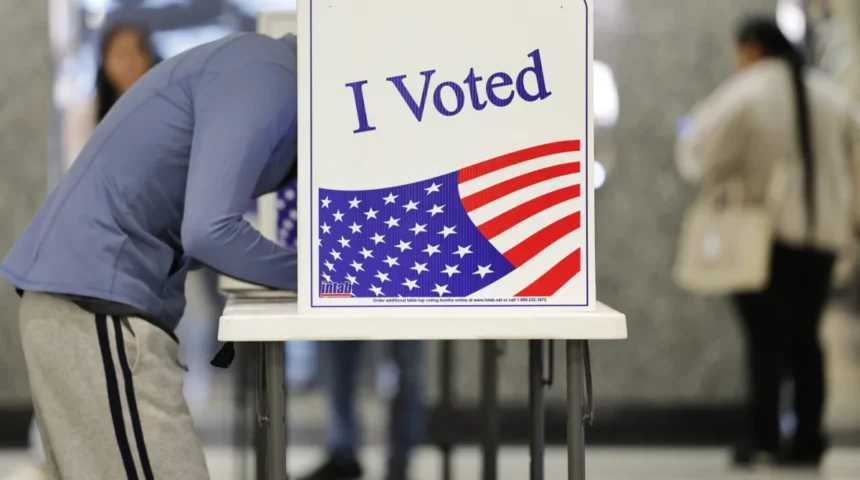
As election returns rolled in on Tuesday evening, prediction markets pointing toward a Democratic sweep of Congress appeared increasingly accurate. Wall Street, which had largely not priced in a total shift of legislative power heading into the midterms, now faces a complex political climate that could serve as a notable headwind for investors through the remainder of the year.
While short-term market movements are currently taking center stage, the typical historical pattern following midterm elections is traditionally bullish over a multi-month horizon. However, market participants are increasingly wondering whether equities will buck this positive historical trend this time around. A primary driver of this skepticism is the fact that the S&P 500 has already recorded massive gains going into the election, leaving some analysts to warn that investors may be overly complacent.
Regarding specific equities to watch, a major Democratic victory on Tuesday night—particularly in closely watched state contests such as the Texas gubernatorial race—carries the potential to add fuel to an ongoing artificial intelligence stock sell-off. This downward pressure is driven by the circulating notion that stricter national regulations and data center restrictions could soon gain legislative momentum. Additionally, defense stocks could face immediate pressure amid growing fears of federal spending limits.
Expected Stock Market Reaction
Prediction markets calling for a blue sweep are looking to be correct as election results roll in Tuesday evening, though the reality of the shift has created a complex environment for institutional portfolios. While investors are signaling what experts describe as a "begrudging acceptance" to the base-case scenario of a Democratic takeover, that outcome was not how many were positioned.
According to Tobin Marcus, head of U.S. policy and politics at Wolfe Research, recent survey data compiled by the firm among more than 100 institutional investors suggests that market participants were not strongly positioned for any particular election result.
"Investors seem to have a significant dose of skepticism about whether the final outcome is going to be quite as favorable to Democrats as the polling suggests," Marcus told CNBC, noting that his firm shares the view that the underlying polling likely overstated overall Democratic strength.
Major financial institutions have modeled various scenarios for Wall Street’s immediate reaction. JPMorgan strategists previously projected that a blue wave could knock the S&P 500 down by about half a percent on Wednesday, though overnight futures indicated that steeper losses could materialize.
Conversely, market analysts note that a scenario where Republicans managed to retain both chambers of Congress could have spurred an immediate relief rally. Sameer Samana, head of global equities and real assets at the Wells Fargo Investment Institute, pointed out that a divided government or continued Republican legislative control would have been received quite differently by risk assets.
Citigroup strategists indicated earlier in the week that Republicans losing the House of Representatives while managing to hold onto the Senate could have acted as a tailwind for equities heading toward year-end. Meanwhile, JPMorgan traders had predicted up to a 1% upward pop on Wednesday if Republicans successfully maintained the chamber, an outcome that looked increasingly unlikely as votes were tallied.
Looking past any immediate short-term volatility, historical data shows that stocks tend to rally once midterm elections have officially concluded. In fact, the S&P 500 has risen during the one-year period following every single midterm election dating back to the early 1980s.

Yet, because the S&P 500 has already notched double-digit gains so far in 2026, many veterans on Wall Street worry that market participants are displaying dangerous levels of complacency heading out of the ballot box. Jonathan Krinsky, chief market technician at BTIG, noted that during typical midterm election years, the S&P 500 experiences an average drawdown of 14% at some point during the second half of the calendar year.
"The reason stocks often perform well in November during midterms is because the S&P 500 typically is weak into the elections. We have the opposite setup this year," Krinsky wrote. "Therefore, while consensus is that we see a post-midterm rally, we think the opposite is actually more likely."
AI Jitters Meet the Ballot Box
The political shifts arriving on Capitol Hill coincide with a broader market environment that has recently come under significant pressure due to turbulence within the artificial intelligence trade. That underlying sector stress led the Nasdaq Composite to post its worst single-day performance since June late last week, and AI-related shares led the market lower once again on Monday.
A strong showing from Democrats in Tuesday’s midterm elections threatens to amplify that downward pressure even further. At the state level, increased Democratic control is widely viewed as a fundamental headwind for equities heavily associated with data centers and technological capital equipment.
"It solidifies the early kind of cautionary signs in different states around the advancement of AI infrastructure," Rob Rains, an analyst at Washington Analysis, told CNBC.
At the same time, major financial institutions maintain that extreme outcomes remain constrained. Goldman Sachs strategists noted this week that while a newly empowered Democratic Congress might move to limit lucrative data center tax incentives, a nationwide moratorium on such facilities looks fundamentally unlikely regardless of the final election outcome.
Individual state dynamics remain critical focal points for investors. Texas, for instance, serves as a central hub for the massive data center buildout currently underway across the United States. A surprise loss in the state by Republican Governor Greg Abbott carries the potential to spook the market in the short term, according to Wolfe Research’s Marcus.
Defense and Healthcare Stocks
Beyond the technology sector, a blue wave is expected to create contrasting fortunes for defense contractors and healthcare providers. Market analysts and portfolio managers suggest that federal spending priorities are bound to shift under a new legislative alignment.
"A substantial Democratic sweep could limit real spending growth unless a broader bipartisan agreement increases both defense and health-care funding," said Alex Sagal, a global equity analyst at the Wells Fargo Investment Institute. However, Sagal added that despite potential legislative headwinds, the underlying earnings outlook for the defense industry remains stable to modestly positive.
For the healthcare sector, the political shift represents a major catalyst. Wolfe Research’s Marcus noted that healthcare will undoubtedly become one of the biggest focuses for policymakers, as Democrats are expected to mount a strong push to restore expired Affordable Care Act enhanced premium subsidies or systematically unwind some of the Medicaid reforms enacted through the One Big Beautiful Bill Act.

"Healthcare stocks have been doing really well lately," said Jed Ellerbroek, a portfolio manager at Argent Capital Management. "I think part of that is the anti-AI trade, but I also think part of that is just optimism that Democrats are taking over."
Ellerbroek indicated that his firm is keeping a close watch on hospital-related equities such as HCA Healthcare and Tenet Healthcare, alongside major managed care and health insurance providers like UnitedHealth Group and Centene.
Bank Pressure Incoming?
The financial sector also faces a period of heightened uncertainty. Financials stood out as the worst-performing S&P 500 sector in early 2026, reeling from President Donald Trump’s public calls for Congress to pass legislation that would cap credit card interest rates at 10%. While the sector managed to recover some ground—bringing its year-to-date gains to roughly 3%—market conditions could grow unstable once again under a divided or Democratic-led Congress.
"Democrats will come in wanting to show tangible progress on the affordability issue, and that means targeting sectors that are front and center in consumer budgets," said Matthew Aks, an analyst at Evercore ISI. "We know Trump has populist instincts, populist leanings, and could he pick a couple of issues and decide to team up with the Democrats on those issues and target those industries in a populist way? Absolutely."
Given that Democratic legislative control is traditionally associated with increased regulatory oversight—whereas Republican control is generally viewed through the lens of deregulation—analysts suggest Democrats may aggressively pursue credit card rate caps if they secure enough leverage.
"I think if Democrats have control of one or both chambers, they would try to pass it and see if they could get Trump to either sign it or force him to veto it, and that would let Democrats kind of score a political point," Aks added.
Iran Wild Card
Compounding the domestic political uncertainty is a major geopolitical variable. President Trump could choose to restart military actions against Iran after holding off on any major strikes leading up to the midterm elections. Such a move has the capacity to completely upend the broader equity market while causing energy stocks to significantly outperform. Crude oil prices jumped by more than 10% over the course of October, though they surrendered a large portion of those gains during trading on Monday.
National retail gasoline prices stood at an average of $4.17 per gallon on Sunday, representing a nearly 40% increase compared with the same period last year, according to data from AAA.
"If there are escalations, that could obviously put upward pressure on prices just ahead of Thanksgiving," said Patrick De Haan, head of petroleum analysis at GasBuddy, noting that the holiday period coincides with traditional peak travel periods for millions of Americans visiting friends and family.
If the administration ultimately decides to take forceful military action, it could effectively snuff out any remaining hope for a traditional post-midterm year-end market rally. Evercore ISI warned that the S&P 500 could retreat by double digits to end the year down near the 6,800 mark if crude oil prices spike violently and the president moves toward kinetic escalation in Iran ahead of the new Congress taking office in January.

Related News