NASA’s Hubble Space Telescope Uncovers Cosmic Mystery of Missing Oxygen in Nearby Dwarf Galaxies
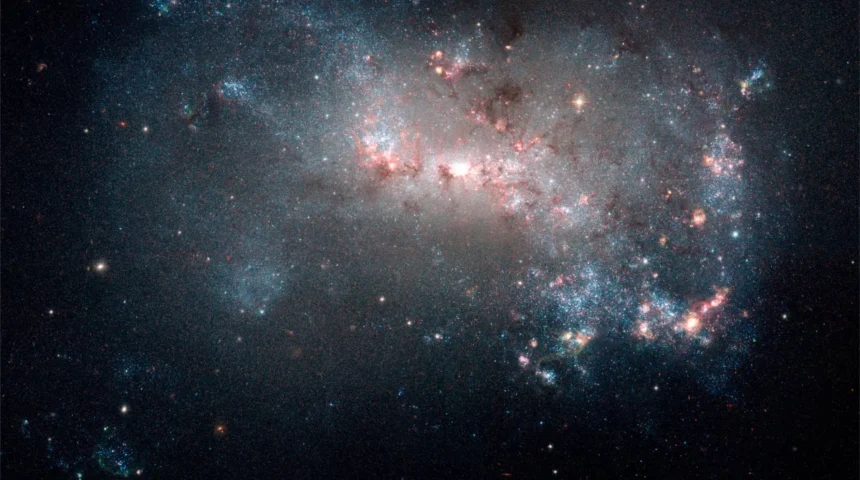
Every breath you take carries a profound cosmic heritage: the oxygen filling your lungs was forged deep inside ancient stars long before our solar system existed. But new research reveals that the universe’s smallest galaxies are notoriously bad at holding onto this life-giving element, aggressively hurling the vast majority of it out into the vast expanses of intergalactic space.
A recent study published in The Astrophysical Journal details findings from astronomers who examined 37 nearby dwarf galaxies using observations from NASA’s Hubble Space Telescope. These compact stellar systems vary dramatically in size, holding anywhere from a few thousand to hundreds of millions of stars. Despite their varying populations, these small galaxies share a striking commonality: on average, they have managed to retain a mere 11 percent of the total oxygen produced by their stars over cosmic time.
The efficiency rates among these dwarf galaxies vary, though none manage to keep most of their stellar output. The most efficient dwarf galaxies in the sample held onto roughly a quarter of their manufactured oxygen, while the least efficient retained a scant 4 percent. By contrast, much larger, more massive galaxies—like our own Milky Way—tend to retain three to four times as much oxygen, anchoring the heavy elements securely within their massive gravitational wells.
The primary culprit behind this cosmic eviction is the explosive death of massive stars. When these giant stars exhaust their nuclear fuel, they collapse and detonate in cataclysmic explosions known as supernovas. These violent blasts unleash powerful galactic winds packing enough force to sweep interstellar gas clear out of a galaxy’s boundaries. Because dwarf galaxies possess relatively weak gravitational fields, they struggle immensely to counteract these powerful winds, allowing the gas—and the oxygen embedded within it—to escape into the surrounding void.
To better understand this phenomenon, astronomers launched a dedicated research initiative known as Galaxies Losing Oxygen via Winds, or GLOW. The project aims to track oxygen across multiple cosmic environments: inside the cores of stars, drifting through the diffuse gas between stellar systems, and finally spilling out into the distant space between galaxies.
Scientists rely heavily on oxygen for these tracking efforts for purely practical reasons. Aside from hydrogen and helium, which were formed in the primordial moments of the Big Bang, oxygen is the most abundant element in the universe. It serves as an ideal tracer for how galaxies recycle matter on a grand scale, because astronomers can measure its spectral signatures easily, and the physical mechanisms governing its creation inside stars are well understood.
"So, it’s really for practical reasons that we’ve chosen oxygen," explained Kristen Wingfield McQuinn, the GLOW principal investigator based at the Space Telescope Science Institute in Baltimore, in a NASA statement.
To accurately tally the oxygen inventory of these distant systems, McQuinn and her team had to utilize the sharp, high-resolution imaging capabilities of the Hubble Space Telescope. The observations needed to be precise enough to pick out individual stars—a feat made difficult by the fact that very few dwarf galaxies sit close enough to Earth for astronomers to capture that level of detailed imagery.
These sharp Hubble images allowed the research team to reconstruct the individual star-formation history of each dwarf galaxy. By understanding how many generations of stars had lived and died within each system, the researchers could calculate precisely how much oxygen those stars should have produced over the galaxy’s lifetime.
The team then measured what remained. Surprisingly, nearly all of the surviving oxygen was found residing in each galaxy’s diffuse gas reserves rather than locked inside its stars. To paint a complete picture, the researchers integrated ultraviolet and optical data from Hubble with complementary data gathered by radio and infrared telescopes.
The analysis also revealed that a galaxy’s neighborhood plays a significant role in its ability to retain elements. Galaxies situated in crowded cosmic regions, specifically those located within about 3 million light-years of a much larger galaxy, tended to hold onto a noticeably higher percentage of their oxygen. Conversely, dwarf galaxies drifting in relative isolation—those farther away from a large galactic neighbor—all managed to retain less than 15 percent of their oxygen.
According to the research paper, this geographic disparity could mean that surrounding intergalactic gas helps push lost oxygen back into a galaxy, or that a dwarf galaxy occasionally sweeps up oxygen previously blasted away by nearby systems. However, the researchers emphasize that this localized pattern is currently based on only a small sample of observed galaxies and requires further verification.
Even with these detailed tallies, the final destination of the missing oxygen remains an open question in modern astrophysics. Earlier studies looking into the problem found that only a tiny fraction of the missing oxygen—somewhere between 1 and 7 percent—resides in the thin, hot halo of gas surrounding a typical galaxy. Even when accounting for cooler gas reservoirs, these surrounding halos likely hold at most about one-third of the total oxygen that the galaxies’ stars manufactured over time.
The remaining bulk of the oxygen likely escaped entirely into intergalactic space, traveling millions of light-years away from its birthplace, though scientists cannot yet confirm this with absolute certainty.
To solve this lingering mystery, researchers are already looking toward the next generation of space observatories. McQuinn, who also leads science operations for the upcoming Nancy Grace Roman Space Telescope, plans to use the new observatory to discover even smaller and fainter galaxies than those currently cataloged. Once identified, she plans to study their stellar populations in greater detail by combining observations from Hubble and the James Webb Space Telescope.
Meanwhile, other members of the research team are zeroing in on the mechanics of the outflow itself. Grace Telford, an astronomer at the University of Utah working alongside the GLOW team, is currently using Hubble to zoom in closely on the massive stars responsible for both manufacturing oxygen and driving the powerful winds that blow it away.
If future observations confirm that the vast majority of this missing oxygen truly escaped into the cosmos, it would mean that the universe’s smallest, most unassuming galaxies are actually its most prolific chemical distributors. These dwarf systems may be silently seeding the wider universe with the very same element that now fills our lungs.

Related News