Real Wages Slip Into Negative Territory as Energy Costs Squeeze American Households
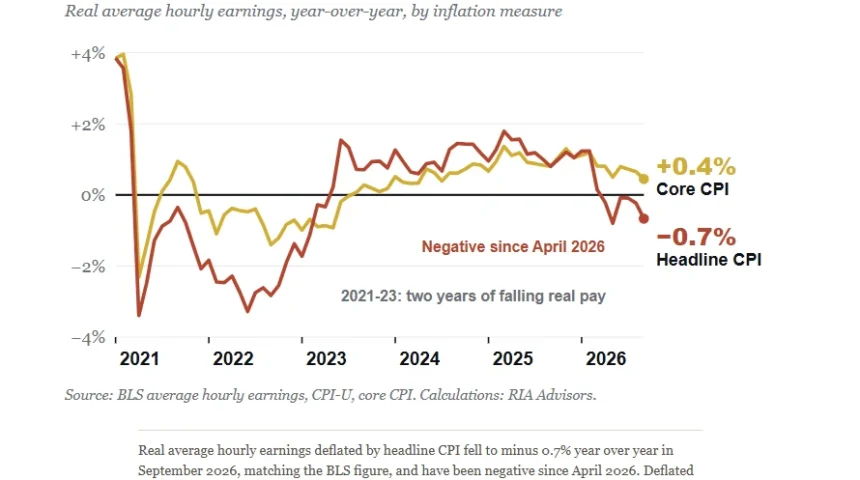
Real wages have slipped below zero for the first time in three years, and the resulting financial squeeze is quickly manifesting in consumer stocks long before it registers in broader Gross Domestic Product figures.
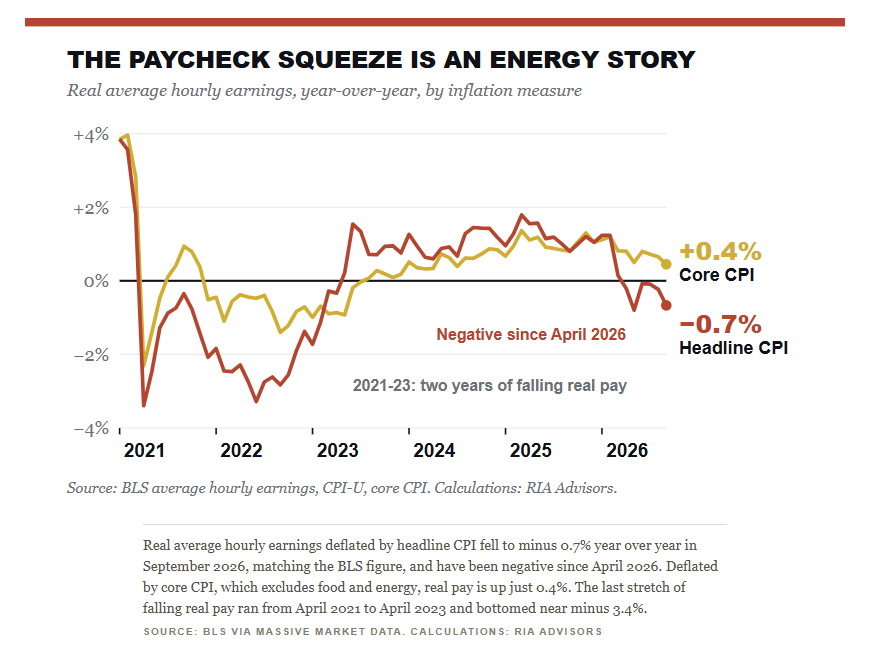
While the September jobs report initially dominated economic headlines with a meager payroll gain of just 29,000 and an outright negative revision for July, a more critical indicator emerged twelve days later within the Bureau of Labor Statistics’ real earnings release. Real wages in 2026 are sliding deeper into negative territory, driven by a sharp divergence between headline inflation and nominal paychecks. Average hourly earnings, when adjusted for inflation, fell 0.7% over the twelve months leading through September, marking a decline more than double that of August. This downturn breaks a positive streak that had held firm since the spring of 2023, fundamentally shifting the economic math for every business that relies on discretionary household spending.
Where Did The Raise Go?
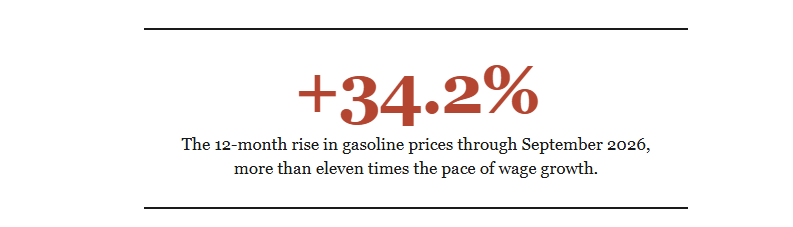
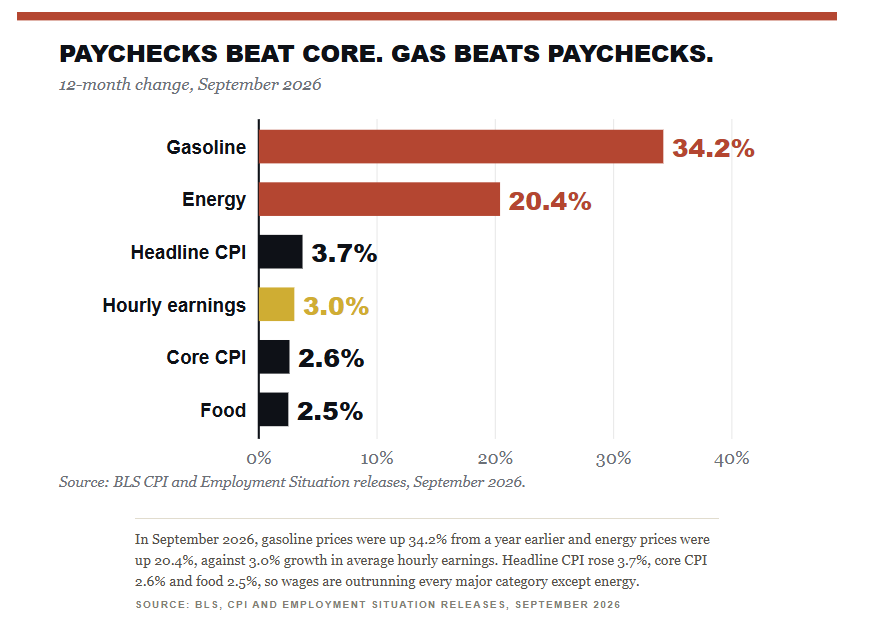
Workers did receive pay increases, a point frequently emphasized by proponents of a strong labor market. Average hourly earnings rose roughly 3.0% over the past year, which would typically represent a respectable figure under normal economic conditions. The core issue, however, lies at the fuel pump and utility meter. Gasoline prices have surged 34.2% from a year ago, while the broader energy index is up 20.4%. Food prices have ticked up 2.5%, whereas core Consumer Price Index data, which excludes volatile food and energy categories, runs at a modest 2.6%.

In short, average paychecks are keeping pace with almost everything except energy. This disparity explains why two different measures of real pay paint contrasting economic pictures. Deflating wages by core CPI shows real pay still expanding at roughly 0.4% annually. Conversely, deflating wages by headline CPI—representing the actual prices consumers face at checkout counters and gas stations—reveals that real pay has contracted every single month since April.
This dynamic underscores that the modern economic pressure on households is fundamentally an energy tax, disproportionately punishing families with the least budgetary flexibility. A working-class household commuting significant distances to work or heating an older, less energy-efficient home allocates a substantially larger percentage of every dollar to energy than a wealthy household. Consequently, standard average real wage figures likely understate the severe impact currently felt across the bottom half of the income distribution.
How Households Are Covering The Gap
Consumers rarely curtail spending the moment real income turns negative. Instead, households typically deploy immediate workarounds to bridge the financial divide, relying currently on three primary mechanisms.
First, workers are logging longer hours. The average workweek has expanded by 0.6% compared to a year ago, yet real weekly earnings still slipped 0.1%. While those extra hours successfully kept weekly pay ahead of inflation in August, they failed to do so by September.
Second, consumers are spending past their baseline income. Real consumer spending rose 0.6% in August while real disposable income remained entirely flat, leaving the personal saving rate pinned at a meager 4.1%.
Third, households are accelerating their borrowing. Credit card balances climbed to $1.26 trillion in the second quarter, with serious delinquency rates hovering near 7% annualized. This reliance on revolving debt poses the most acute risk to financial stability. High interest rates transform a temporary energy shock into a persistent structural drag on household budgets, as compounding interest persists long after gasoline prices eventually normalize. Families borrowing today to fill their tanks will still be servicing that debt well into the following year.
This environment fuels a persistent macroeconomic puzzle: if consumers are facing such severe financial constraints, why does spending continue to grow? Wall Street analysts frequently point to consumer "resilience," yet every workaround bridging the spending gap has a definitive threshold. While longer hours, depleted savings, and escalating credit card debt can temporarily mask income deficiencies for a few quarters, none can sustain consumption indefinitely.
Why Real Wages Hurt More Now Than in 2022
Skeptics frequently argue that real wages fell far more severely in 2022—dropping by more than 3% at their worst point—yet consumers maintained robust spending habits regardless. While accurate, that comparison overlooks the unique structural conditions that protected households during that period. In 2022, job openings exceeded 11 million, allowing workers to rapidly secure higher-paying employment by switching jobs, while families still maintained substantial pandemic-era savings cushions.
Today, job openings have contracted to roughly 7.1 million, the unemployment rate sits at 4.2%, and the economy added a paltry 29,000 jobs in September. The modern consumer faces a smaller initial shock but possesses far fewer financial shock absorbers. A worker in 2022 could quit on a Friday and secure better compensation by Monday. By contrast, consumers navigating today’s "low hire, low fire" labor market enjoy no such flexibility, rendering a seemingly modest drop in real wages far more damaging than the steeper declines recorded four years earlier.
Consumer Stocks Are Already Voting
Financial markets rarely wait for official GDP reports to signal underlying shifts. The relative performance ratio of consumer discretionary stocks to consumer staples has plummeted approximately 19% from its late-2025 peak. This indicates that institutional capital has quietly rotated away from discretionary goods and toward essential items for the majority of the year. Market charts reveal this structural breakdown occurred in February, a full month before surging gasoline prices were fully reflected in official CPI prints.
Early indicators from third-quarter corporate earnings confirm this defensive rotation. Domino’s reported U.S. same-store sales up a nominal 0.3%, accompanied by a decline in items per order as customers tightened budgets. While September retail sales appeared resilient on the surface with a 0.8% headline increase, stripping out gasoline sales reveals a meager 0.2% gain. Upcoming earnings reports from major retailers will likely echo common defensive refrains regarding trading down, selective purchasing behavior, and smaller basket sizes—corporate lexicon that typically surfaces quarters before it impacts top-line revenue figures.
Where the Bulls Are Right
Market optimists maintain a valid perspective regarding the cyclical nature of energy shocks. Commodity spikes eventually reverse, and when they do, macroeconomic math shifts accordingly. Gasoline represents a modest share of the CPI basket, meaning a sharp downward correction in crude oil could restore positive real wage growth within months. Gulf oil flows have shown signs of recovery, and national gasoline averages pulled back temporarily before renewed crude volatility. If oil prices break downward, beaten-down discretionary equities could experience a sharp relief rally.

However, building an investment portfolio around an optimistic oil forecast remains precarious while geopolitical tensions persist in critical shipping lanes and Brent crude holds elevated valuations. Inflation driven by supply shocks ultimately cures itself, but that cure arrives through demand destruction—and demand destruction inevitably materializes first within the earnings statements of companies selling non-essential goods.
What Real Wages Mean for Portfolios
Managing portfolios in this environment requires a careful assessment of equity exposure relative to the health of lower- and middle-income consumers. Investors must treat temporary relief rallies in consumer names with caution until corporate earnings guidance confirms underlying strength. When consumers face financial strain, corporate pricing power and pristine balance sheets supersede simple growth narratives. Maintaining patience as an investment posture allows market participants to monitor monthly real earnings prints closely, reserving aggressive capital deployment into consumer sectors until paychecks definitively outpace headline inflation once more.

Related News