Chancellor Merz to nominate Aigner as Germany’s first woman president
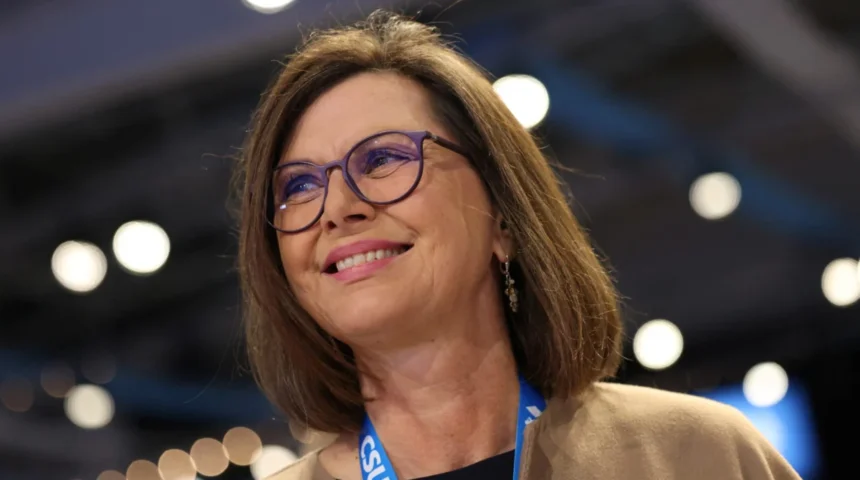
Merz revealed his decision during a private dinner on Sunday evening, addressing key leaders of his centre-right Christian Democratic Union (CDU) party. The announcement marks a significant turning point in German domestic politics, positioning a prominent conservative figure from the party’s regional sister faction to occupy Bellevue Palace, the official residence of the German head of state.
Aigner, who currently serves as the speaker of the Bavarian state parliament, is a prominent member of the Christian Social Union (CSU), the conservative Bavarian party that operates in permanent alliance with the CDU at the federal level. According to internal party schedules, her formal nomination is expected to be rubber-stamped at a joint meeting of the CDU and CSU leadership on Monday, after which her election to the high office would become virtually certain under Germany’s current political configuration.
Under standard German political convention and the realities of coalition governance, the parties forming the governing coalition must reach a consensus on a joint presidential candidate to ensure a smooth transition. The current federal governing coalition is anchored by the CDU, the CSU, and the centre-left Social Democratic Party (SPD). Significantly, the SPD has frequently voiced its support for Aigner as a unifying and capable choice for the presidency, smoothing the path toward broad parliamentary backing.
The process of choosing the next head of state involves the Federal Convention, a unique and massive body convened solely for this singular constitutional purpose. The assembly, which brings together members of the federal parliament, the Bundestag, and an equal number of delegates chosen by the sixteen state legislatures, is scheduled to cast its ballots to decide on incumbent Frank-Walter Steinmeier’s successor on January 30.
Steinmeier, a senior member of the Social Democratic Party who first took office in 2017, will reach the constitutional limit of two five-year terms in March 2027, paving the way for a succession process that has now burst into the open.
While the German president holds a role that is largely ceremonial, it carries profound moral and constitutional weight. The head of state is responsible for signing legislation into law, formally appointing federal ministers, and representing the nation on the international stage. Beyond these administrative duties, the German president traditionally plays the crucial role of a neutral arbiter who stands safely above the daily fray of partisan politics, serving as a primary moral compass and a unifying symbol of national cohesion during times of crisis.
The path to Aigner’s impending nomination has not been entirely straightforward within the conservative camp. The CSU had originally put forward Aigner’s name earlier this year, championing her extensive administrative experience and deep roots in both regional and national governance. However, the CDU leadership initially held back from formally endorsing her while Chancellor Merz weighed various alternative candidates. This period of hesitation and internal deliberation notably strained relations between the long-standing sister parties, making Sunday evening’s resolution a welcome relief for party managers seeking unity ahead of the upcoming electoral cycle.
At 61 years of age, Aigner brings a wealth of political experience to the table. She began her extensive political career at the local level in Bavaria before making the jump to federal politics, where she was elected to the Bundestag, Germany’s federal parliament, in 1998. During her time in Berlin, she built a formidable reputation as a pragmatic policy-maker, eventually serving as the federal minister of agriculture and consumer protection under former Chancellor Angela Merkel.
Following her tenure in the federal cabinet, Aigner chose to return to her home state of Bavaria to focus on regional politics. She quickly established herself as a powerhouse in Munich, ultimately ascending to the role of speaker of the Bavarian state parliament in 2018, a prestigious position she has held ever since, presiding over the legislative debates of one of Germany’s most economically powerful and politically influential states.

Related News