Foundation Announces Release of Envoy 2.3.1, Bringing Crucial Bug Fixes and Reliability Improvements to Mobile Platforms
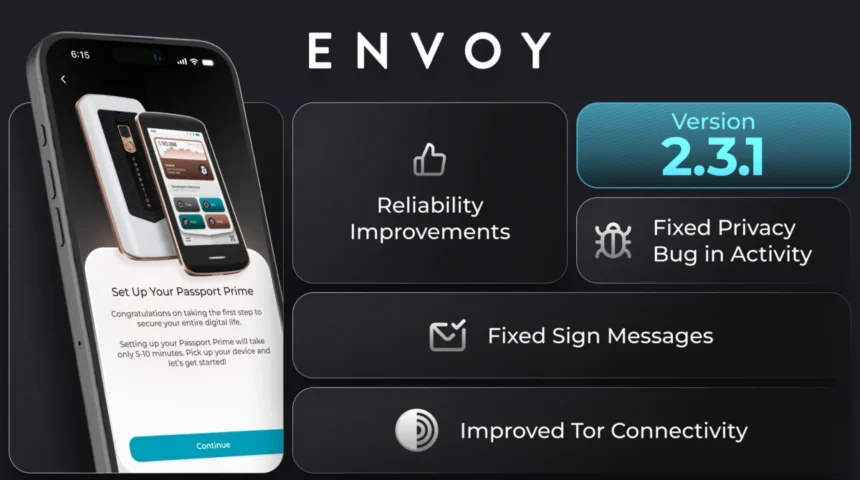
Foundation has officially announced the rollout of Envoy version 2.3.1, the latest iteration of its companion mobile application, now available across major mobile platforms. Serving as a direct follow-up to the previous 2.3.0 release, this update places a heavy emphasis on resolving critical bugs, enhancing overall application reliability, and bolstering security features for users managing their digital assets.
The new software package is currently making its way to users worldwide, though availability may vary depending on the chosen platform. While the update has been published and is ready for download, Foundation has noted that users might experience a significant lag between the initial publication and general availability in app stores. This delay is a standard part of the distribution cycle, driven primarily by the rigorous review policies and processing times enforced by the Apple App Store and the Google Play Store. Users eager to secure the latest improvements can check for updates directly on their preferred platform or visit the official Foundation download page.
Alongside the software rollout, Foundation has issued a vital security advisory to protect its user base from ongoing malicious activities. The company reiterated a strict security stance, warning users that any phone calls or emails claiming a Passport hardware device recall or alleging a compromised device are entirely fraudulent. Foundation emphasized that its representatives will never reach out via phone call or email to ask a user for their recovery phrase. This warning comes as phishing attempts targeting cryptocurrency and hardware wallet users continue to evolve in sophistication.
What’s Changed in Envoy 2.3.1
Envoy 2.3.1 arrives as a targeted patch release designed to iron out friction points identified by the community following the deployment of version 2.3.0. The development team focused heavily on user privacy, connectivity stability, and hardware integration to ensure a smoother and more secure experience for Passport owners.
Among the primary improvements is a fix addressing an important privacy leak. In previous versions, transactions associated with passphrase accounts could inadvertently appear within the global Activity feed, potentially exposing financial activity that users intended to keep partitioned. Version 2.3.1 resolves this issue, ensuring that passphrase-protected accounts maintain their intended privacy separation.
The update also restores message signing capabilities from non-zero accounts when users are operating with the Passport Prime hardware device. This fix restores full functionality for advanced users who rely on non-zero derivation paths for signing messages, bridging a gap that was present in the prior software iteration. Furthermore, the application now correctly displays the "latest" firmware version for Passport Prime directly on the Devices tile, eliminating confusion regarding firmware update statuses.
Network connectivity and communication protocols have also received substantial enhancements. For users operating in regions or network environments where Google blocks Tor exit nodes, Envoy 2.3.1 improves Tor connectivity, ensuring more reliable and private routing. The release additionally resolves a frustrating repeated Tor restart loop that previously drained device resources and interrupted background synchronization.
For Android users, particularly those operating on older iterations of the operating system, the update restores QuantumLink Bluetooth pairing capabilities on Android 10 and Android 11 devices. This restoration ensures backward compatibility and seamless communication between the mobile app and hardware devices for a broader segment of the user base. Finally, the development team has shipped critical security updates to various underlying wallet dependencies, hardening the application against potential vulnerabilities.
Verifying Envoy on Android
For advanced users and privacy-conscious individuals who wish to take an optional, additional step to verify the integrity of the software, Foundation continues to support binary verification. Users operating on Android devices who want to independently confirm that their downloaded Envoy binaries are authentic and untampered with can follow the official verification guide provided on the Foundation website, ensuring maximum transparency and trust in the open-source software supply chain.

Related News