Full Steam Ahead: The Rise of Fiscal Dominance and Its Challenge to Central Banks
As global financial markets navigate a shifting macroeconomic landscape, structural fiscal deficits have officially surpassed private sector lending and monetary policy as the primary drivers of economic activity and inflation. This paradigm shift marks a fundamental alteration in modern liquidity dynamics, leaving traditional central banking tools increasingly obsolete and setting the stage for an extended era of fiscal dominance.

The Fiscal Backdrop Today
The warning signs of this new era have been flashing across global markets for years. In September 2022, the United Kingdom gilt market suffered a historic crash that nearly dismantled the nation’s pension system. Triggered by former Prime Minister Liz Truss’s controversial "mini-budget"—a fiscal package featuring unfunded tax cuts and increased government spending—the crisis unfolded while UK consumer price inflation was running above 10% year-over-year and debt-to-GDP ratios sat at levels unseen since the 1960s.

Investors viewed the fiscal agenda as reckless, sparking a massive sell-off in gilts. Because UK pension funds were deeply intertwined with the gilt market through leveraged strategies, they faced a wave of margin calls that threatened their ultimate solvency. This placed the Bank of England in an untenable position. The central bank had been aggressively raising interest rates and implementing quantitative tightening to combat inflation. However, the market’s violent reaction to the government’s fiscal agenda forced the central bank to temporarily abandon its anti-inflationary mandate. Instead, the Bank of England was compelled to intervene by purchasing long-dated bonds to stabilize the financial system.

This episode exposed a critical vulnerability: fiscal policy can severely constrain central bank independence. The Bank of England’s struggle is far from an isolated incident. Governments worldwide continue to run massive fiscal deficits even as sovereign debt burdens reach historic highs, creating an environment ripe for fiscal dominance.

In the United States, debt-to-GDP ratios remain elevated at levels last seen during World War II. However, a profound structural difference separates the current environment from the past forty years: interest rates are no longer structurally falling. From the late 1980s onward, declining interest rates made it progressively easier for governments to manage and expand their debt burdens. That dynamic reversed rapidly over a recent four-year window, during which the federal funds rate multiplied while public debt expanded by more than 30%. As interest rates spiked, the U.S. Treasury’s interest expenses surged in tandem, transforming net interest into one of the largest expenditures in the federal budget.

Defining Fiscal Dominance
Economists have long debated the precise parameters of fiscal dominance, but a consensus definition describes it as an economic condition wherein a country’s debt and deficit levels become so elevated that monetary policy ceases to be an effective tool for controlling inflation. Under this condition, persistently high interest rates in an environment of perpetually large deficits risk exacerbating rather than subduing inflation.

Complementary analyses suggest that fiscal dominance occurs when government fiscal deficits equal or eclipse private sector lending and central bank monetary policy in driving overall economic activity. Traditionally, money is created primarily through private sector lending—where commercial banks and credit markets issue loans by crediting borrower accounts—and monetized government deficits. Over the last four decades, however, government spending has consistently outpaced revenue collection, shifting the fulcrum of economic influence toward the public sector.

With national debt surpassing $36 trillion and an increasing reliance on short-duration borrowing, higher interest rates rapidly amplify government interest expenses. These interest payments flow from the Treasury to bondholders across the private sector, including households, money market funds, banks, pension funds, corporations, and hedge funds. In effect, these disbursements function as a form of economic stimulus, injecting liquidity directly into the economy even as the Federal Reserve attempts to constrain private sector lending through higher interest rates. This dynamic creates an inflationary feedback loop where rate hikes inadvertently widen deficits and stimulate demand.

The Wrong Tool For the Job
Because today’s inflationary pressures stem primarily from structural fiscal deficits rather than private sector credit creation, traditional monetary tightening has lost its potency. Historical precedents, such as former Federal Reserve Chairman Paul Volcker raising interest rates to nearly 20% in the early 1980s, succeeded because inflation at that time was fueled by private sector borrowing.

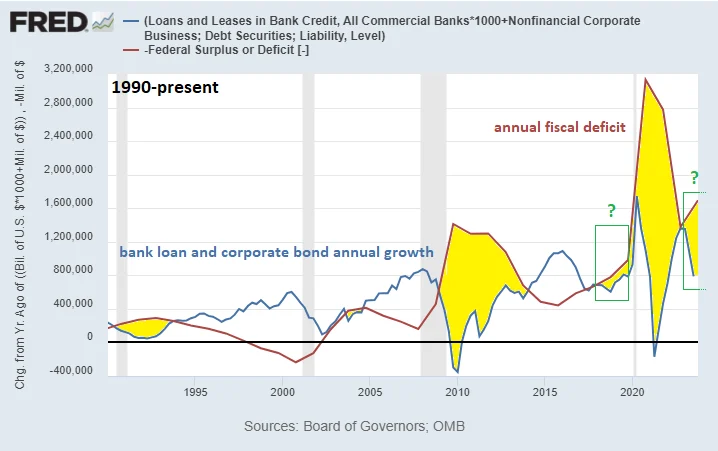
Comparative financial data illustrates this structural transformation. For most of the late 20th century, private sector debt creation vastly outpaced public deficit accumulation. Over the past fifteen years, however, the annual growth of fiscal deficits has far outpaced organic private credit creation, even during periods of economic expansion. Consequently, private borrowing has been crowded out by government borrowing and spending, rendering interest rate hikes an ineffective remedy for consumer price inflation.

Structural Fiscal Deficits Lead to Persistent Inflationary Pressures
Historically, deficit spending operated as a countercyclical tool, designed to stimulate the economy during downturns and contract during periods of growth. Governments were expected to run surpluses and reduce debt when economic conditions improved. Today, however, structural deficits are driven by systemic obligations, including an aging population requiring higher entitlement spending, escalating healthcare costs, and compounding interest on accumulated debt.

When combined with ongoing money supply growth, these structural deficits generate persistent inflationary pressures. Crucially, this inflation does not exclusively manifest in consumer price indices. In the absence of severe supply constraints in commodities and energy, excess liquidity injected via government spending frequently flows into financial assets. Consequently, prices for equities, real estate, gold, and bitcoin have surged, eroding purchasing power and worsening wealth concentration for households even when official consumer price metrics appear stable.

Where Could the Public Debt Go From Here?
Net interest expense has emerged as a dominant force in federal outlays, recently exceeding both Medicare and defense spending for the first time. To evaluate the sustainability of this trajectory, analysts separate total public debt into marketable debt, which trades on secondary markets and imposes a direct cost on taxpayers, and non-marketable debt, which consists largely of internal trust fund holdings.

Evaluating marketable debt requires analyzing the government’s maturity profile. With a heavy reliance on short-term instruments like Treasury bills that require 100% annual rollover, the government faces substantial refinancing risks in elevated interest rate environments. Mathematical models projecting public debt growth across fixed interest rate scenarios reveal starkly divergent outcomes. Under a fixed 5% interest rate, debt-to-GDP ratios climb past 108% over a decade, whereas a fixed 2% rate allows the ratio to decline below 95%.

However, debt-to-GDP ratios can be misleading. As demonstrated by extreme cases like Turkey, rapid nominal GDP growth fueled by currency debasement and deficit spending can artificially deflate debt-to-GDP ratios while nominal debt and inflation spiral out of control. While the United States is unlikely to experience inflation on that scale, a moderately hot nominal GDP environment may mask the true extent of underlying debt accumulation.

Who Will Buy Debt?
The viability of the U.S. fiscal path ultimately depends on finding buyers willing to absorb continuous waves of debt issuance. Domestic institutions face regulatory constraints, such as liquidity coverage ratios that limit bank capacity, while pension funds and insurance companies navigate interest rate risk. Foreign ownership of U.S. debt has also steadily declined as international investors diversify reserves amid geopolitical shifts.

Although stablecoin issuers have emerged as notable short-term buyers of Treasury bills, absorbing tens of billions of dollars in debt, they generally avoid long-duration bonds due to immediate liquidity requirements. If private and foreign demand for long-term Treasuries continues to wane, the Federal Reserve may find itself forced to act as the buyer of last resort through resumed quantitative easing. Such interventions risk expanding the money supply and further eroding the purchasing power of the dollar.

Can Private Credit or DOGE Save the Day?
Resolving fiscal dominance requires either a substantial expansion of private sector economic dominance or meaningful reductions in fiscal deficits. While private credit markets have grown significantly over the past two decades, they still comprise only a minute fraction of total non-financial debt, leaving them too small to alter the broader macroeconomic balance.

Attention has consequently turned toward government spending reductions, spearheaded by advisory entities such as the proposed Department of Government Efficiency. While ambitious proposals target trillions in federal spending cuts, the structural composition of the federal budget presents formidable obstacles. More than 60% of federal spending consists of mandatory programs, including Social Security, Medicare, and Medicaid, which are legally mandated and politically protected. Furthermore, defense spending remains insulated by geopolitical realities and bipartisan commitments to military modernization.

This leaves non-defense discretionary spending—representing roughly 14% of the federal budget—as the primary target for potential cuts. Even total elimination of this budget category would fall short of sweeping deficit-reduction targets. Compounding the challenge, mandatory entitlement programs and interest expenses are projected to account for the vast majority of nominal spending growth over the coming decade, easily eclipsing potential discretionary savings.

Furthermore, federal tax revenues in the United States are deeply correlated with equity market performance due to the financialized nature of the economy. Policies that trigger severe asset market corrections could inadvertently depress capital gains and dividend tax receipts, causing deficits to widen rather than narrow.

Navigating Fiscal Dominance
As structural fiscal deficits continue to anchor economic activity, traditional monetary policy tools remain ill-equipped to resolve modern inflation. Although lowering interest rates could alleviate sovereign borrowing costs, it risks compromising central bank independence and currency stability. Conversely, maintaining elevated rates exacerbates the fiscal deficit through higher interest expenditures.

Stabilizing factors, including the global demand for U.S. dollar-denominated debt and the nation’s ability to issue debt in its own currency, suggest that the era of fiscal dominance will likely prove persistent and intractable rather than culminating in sudden economic collapse. In this environment, navigating ongoing currency debasement and preserving purchasing power increasingly involves allocating capital toward scarce, hard assets across real estate, equities, gold, and bitcoin.

Related News