ARK Invest and Glassnode Release Comprehensive Report Mapping Bitcoin, Ethereum, and Solana on the Decentralization Spectrum
The perennial debate over whether a blockchain is truly decentralized or centralized often misses the intricate realities of network design. Rather than functioning as a simple binary choice, every structural decision made by a network—ranging from underlying block sizes to complex staking models—places it somewhere along a vast spectrum. Every position along this continuum introduces distinct architectural tradeoffs.
To bring empirical clarity to this ongoing discussion, investment management firm ARK Invest and blockchain data platform Glassnode have released a joint report titled The Decentralization Spectrum: Design Tradeoffs In Digital Assets. The comprehensive study evaluates the world’s three largest blockchain networks—Bitcoin, Ethereum, and Solana—by examining four foundational design features: auditability, security, governance, and ownership. Furthermore, the report quantifies each network’s structural standing utilizing a six-dimension scoring framework built upon rigorous data from Glassnode and a diverse array of primary network sources.
One Spectrum, Four Design Features
Decentralized and centralized network architectures weight their core design features in fundamentally different ways. Within a fully auditable network, any participant can independently verify the entire ledger simply by running a full node. Meanwhile, distributed consensus significantly raises the real-world coordination costs and resources an adversarial party must expend to compromise the ledger. Furthermore, community-driven governance prevents any single entity from forcing unilateral upgrades, while widely dispersed ownership guarantees that no concentrated insider group can dominate long-term decision-making.
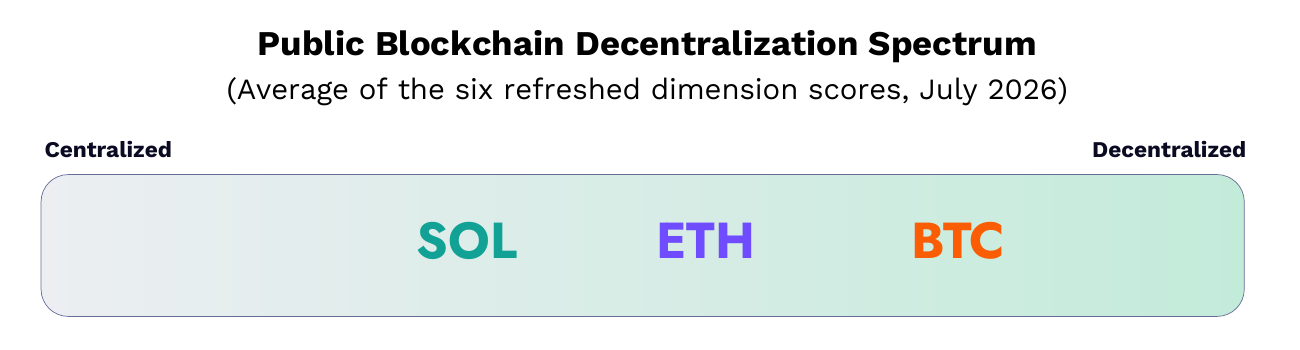
By aggregating and averaging the scores across the report’s six core dimensions, the study establishes a clear sequential ordering of the industry’s Big Three networks along the decentralization spectrum, highlighting how architectural priorities shape their ultimate operational profiles.
Who Really Controls Block Production?
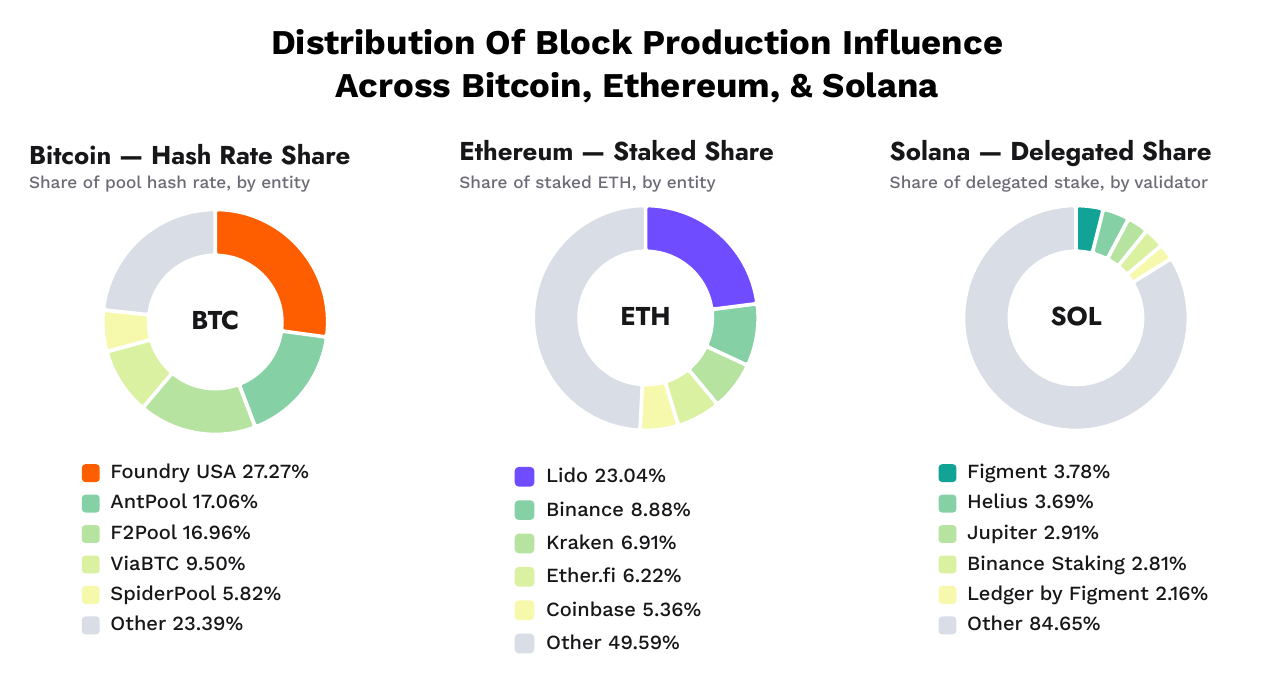
At the heart of network security lies a fundamental question: how many independent parties would need to actively collude in order to alter or censor the ledger? To answer this, the research measures several critical variables, including the concentration of hash rates and delegated stakes, the absolute capital required to acquire a 1% stake in each network, exit fluidity, and underlying client software diversity.
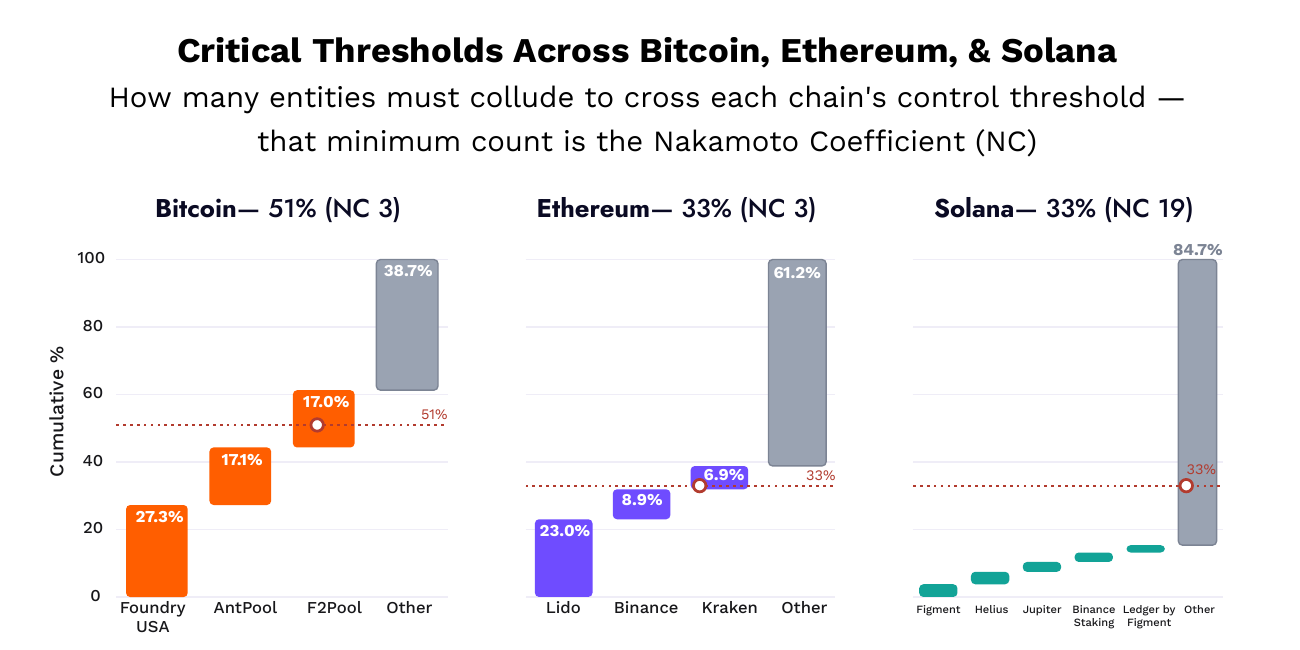
The findings challenge several common assumptions within the digital asset ecosystem. For instance, both Bitcoin and Ethereum reach their critical control thresholds with just three major entities governing their block production or validation processes. In contrast, Solana requires 19 entities to cross a similar threshold, though network-specific dynamics such as validator pools and token delegation add significant nuance to the comparison.
Exit fluidity also reveals stark operational differences. A Bitcoin miner wishing to divest or exit a 1% position can effectively do so within roughly thirty seconds simply by powering down their hardware. Conversely, unstaking an equivalent capital position on Ethereum can take anywhere from days to weeks, particularly during periods of high network stress or market volatility.
The Geography of Decentralization
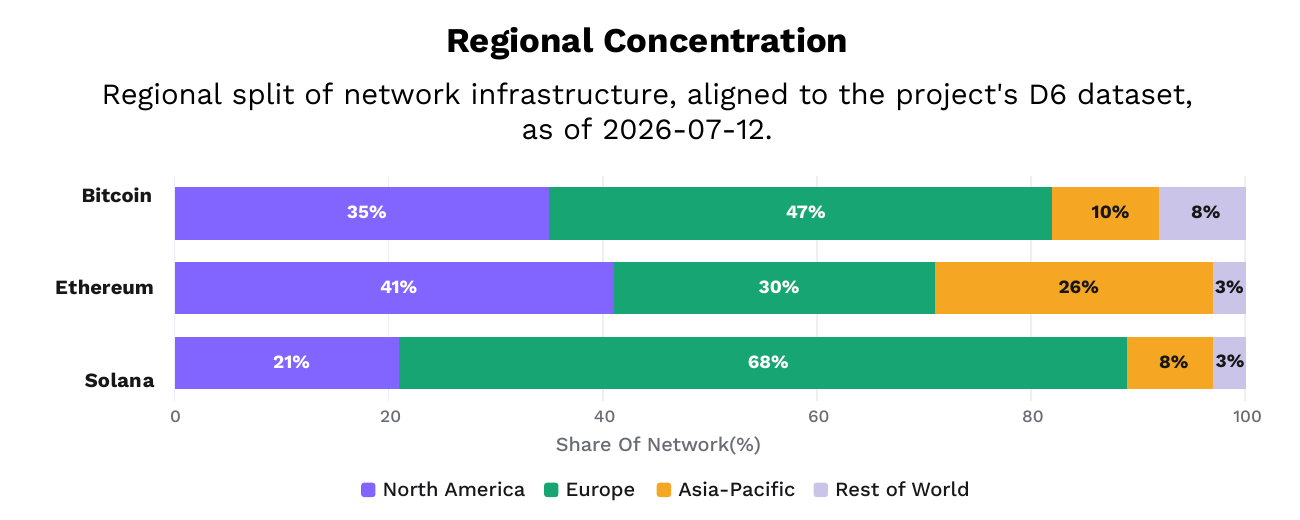
Beyond software and tokenomics, the physical geography of network infrastructure plays a vital role in determining how resilient a blockchain is against localized censorship, regulatory coercion, or infrastructure failures. Bitcoin boasts the most evenly distributed physical node footprint among the three, with an estimated 63% of its nodes operating privately behind Tor to enhance censorship resistance.
Ethereum relies more heavily on traditional cloud computing infrastructure, with Amazon Web Services (AWS) alone hosting roughly 20% of its total node count. Solana takes a markedly different approach by design, running virtually all of its core validation infrastructure within professional data centers to optimize for speed and hardware performance. The new report maps these regional distributions, hosting environments, and provider concentrations in detail across all three ecosystems.
Six Dimensions, One Scorecard
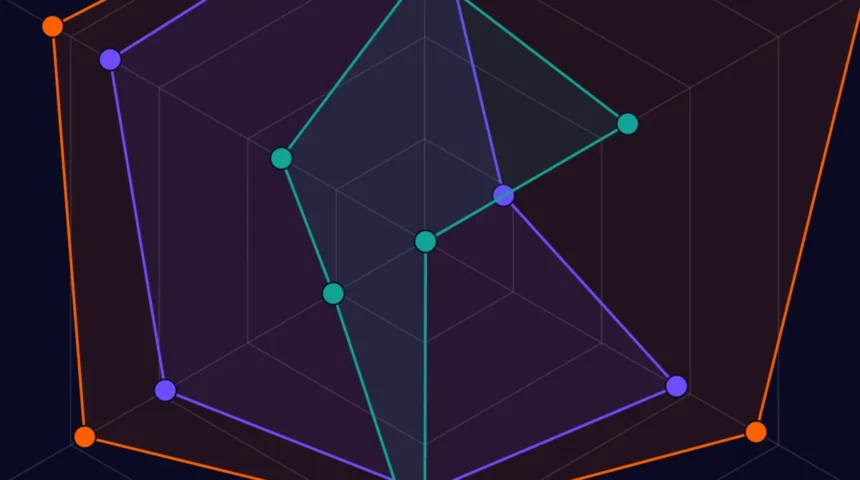
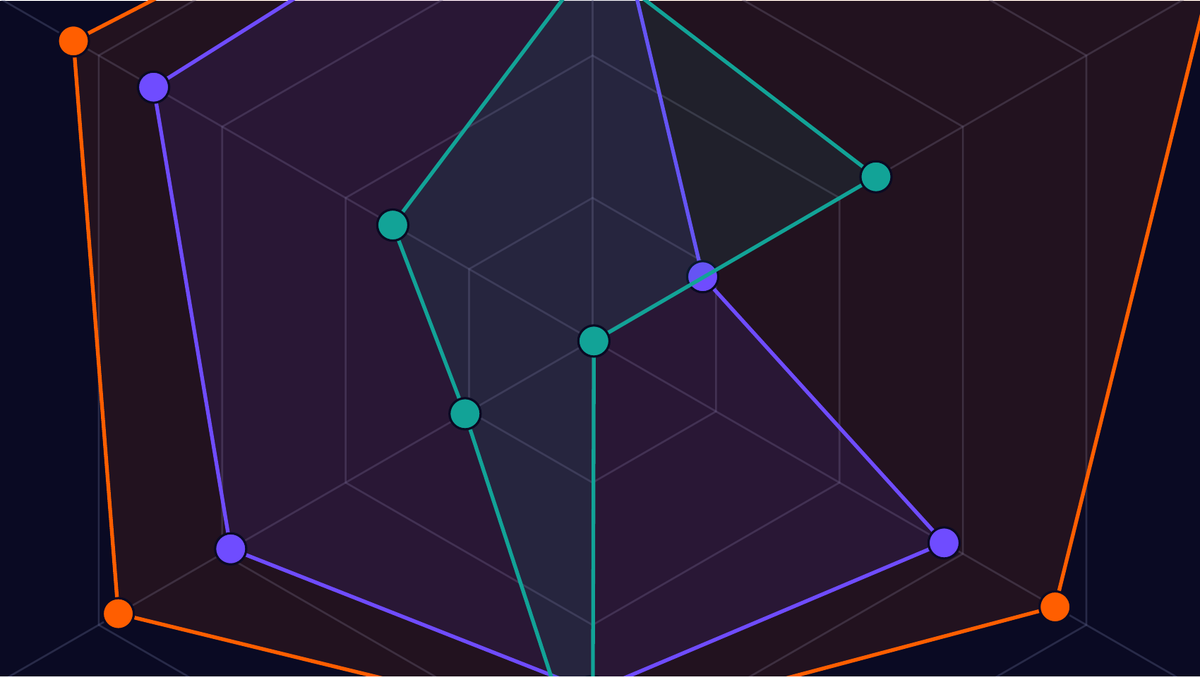
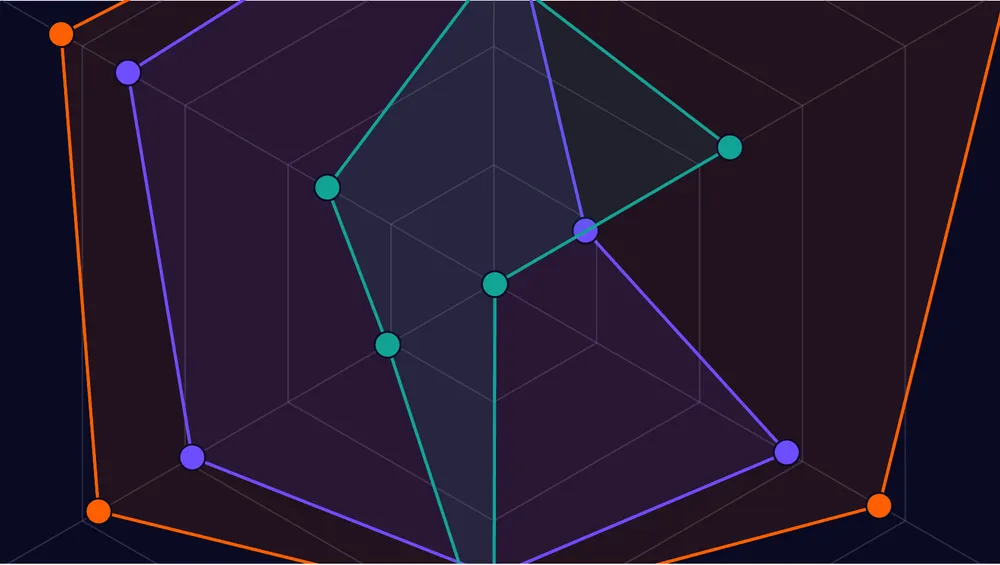
The quantitative core of the collaborative study scores each network across six distinct metrics: ownership distribution, exit fluidity, network verification overhead, critical resilience threshold, blockchain reconstruction overhead, and geographic and provider resilience.
The findings emphasize that no single network captures the leading position across every dimension. Bitcoin emerges strongest in terms of auditability, ownership distribution, and geographic resilience. Ethereum occupies a balanced middle ground, while Solana deliberately trades absolute decentralization in favor of high throughput, raw performance, and rapid coordination speed. A comprehensive methodology appendix included in the publication documents the mathematical framework behind each assigned score.
Read the Full Report
Different real-world use cases naturally tolerate varying risk profiles. A high-throughput consumer payment network and a high-value institutional settlement layer occupy different points on the decentralization spectrum by deliberate design. The full report walks through each design feature and all six quantitative dimensions in depth, featuring detailed analyses of node economics, historical governance case studies ranging from Bitcoin’s SegWit activation to Solana’s SIMD-228, and comprehensive supply distribution data for all three digital asset networks.
Disclaimer: This report does not provide any investment advice. All data is provided for information and educational purposes only. No investment decision shall be based on the information provided here and you are solely responsible for your own investment decisions.

Related News