Crossroads for Paks II: Can Hungary’s Flagship Nuclear Project Survive Its Mounting Crises?
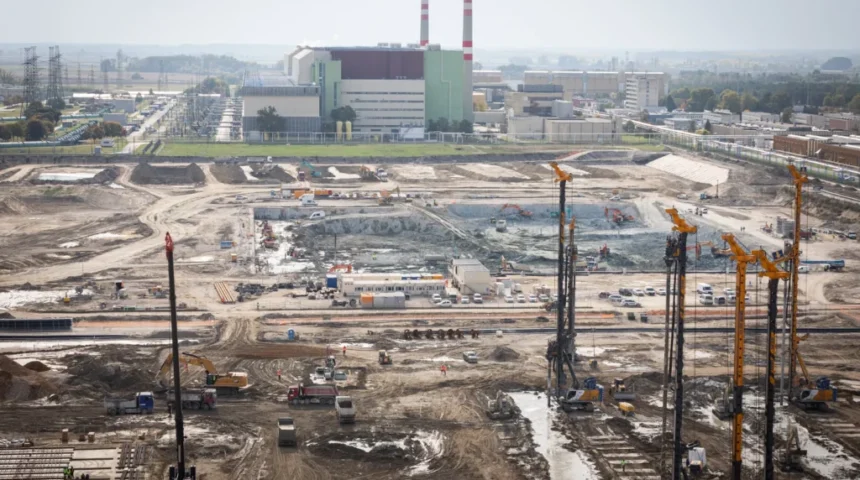
More than a decade after its initial political conception, Hungary’s ambitious Paks II nuclear expansion project remains trapped in an early and deeply uncertain stage of development, despite the formal commencement of construction. Conceived in 2014 through a high-level political agreement rather than rigorous economic justification, the investment has accumulated a staggering delay of approximately ten years compared to original timelines. While the symbolic "first concrete" milestone reached in early 2026 marked a formal shift in the project’s status, experts argue it represents little tangible progress toward completion. Amid soaring costs, unresolved legal battles, and shifting geopolitical realities, the ultimate price tag and even the fundamental economic rationale of the venture remain heavily in question.
Authored by energy analyst András Perger, a recent evaluation of the project underscores that Paks II is plagued by serious risks that extend far beyond normal construction hurdles. The convergence of geopolitical friction, technological bottlenecks, and regulatory setbacks means the future of the multi-billion-euro investment is more precarious than ever. With a political transition taking shape following Hungary’s May 2026 elections, the country faces a pivotal moment. The incoming administration is positioned to conduct a comprehensive review of the project, though policymakers inherit a minefield where every available option carries profound financial, legal, and strategic complications. Analysts suggest that a suspension of construction during this review is imperative, paired with full transparency and public disclosure of all project data to chart a realistic path forward.
Background and Origins
The conceptual roots of the Paks II project stretch back to 2008, when preliminary planning for new nuclear capacity at the existing Paks site began under a different political climate. By 2009, the Hungarian Parliament had granted initial approval for the initiative. Although initial discussions and international expectations pointed toward an open, competitive tender process to select a technology provider, the trajectory of the project shifted dramatically in 2014. Without an open bidding procedure, the Hungarian government directly awarded the massive nuclear contract to Russia’s state atomic energy corporation, Rosatom.
The framework for the partnership was sealed early that year through an intergovernmental agreement between Hungary and Moscow, accompanied by a major financing arrangement. By the end of 2014, the formal Engineering, Procurement, and Construction (EPC) contract—commonly referred to as a turnkey agreement—was officially signed. The plan outlined the construction of two advanced VVER-1200 reactor units, each boasting a capacity of 1,200 megawatts. The total value of the contract was pegged at EUR 12.5 billion, with the vast majority—80 percent—financed through a massive state loan provided by the Russian government.
From its inception, the project faced sharp criticism from independent energy analysts, economists, and civil society organizations like Energiaklub. Critics pointed out that the decision lacked a comprehensive feasibility and economic assessment, argued that the choice of a Russian partner was driven by geopolitical motivations rather than market efficiency, and warned of severe financial, technological, and strategic vulnerabilities. Furthermore, early warnings highlighted structural asymmetries within the contracts that heavily favored the contractor, alongside the inherent financial and schedule risks typical of mega-scale nuclear developments.
Delays and Escalating Costs
Over the years, the Paks II timeline has slipped dramatically. Original projections anticipated that the new units would enter commercial operation by 2026 at the latest. Instead, the project enters 2026 facing a delay of roughly a decade. Detailed, official schedules for completion have largely remained shielded from public view, while official statements frequently rely on vague and likely optimistic estimates pointing vaguely to the "early to mid-2030s."
Such delays, while frustrating for planners, align with historical trends in the global nuclear sector, yet Paks II has suffered from a unique confluence of compounding factors. Regulatory hurdles involving European Union procedures have caused repeated stoppages. Rosatom has also struggled to adapt its engineering and nuclear licensing practices to stringent EU standards, which differ significantly from Russian domestic regulatory frameworks. Additionally, internal project management shortcomings, the complex geopolitical fallout from the Russia-Ukraine war, and late engineering modifications—such as the requirement to construct a massive concrete protection wall around the excavation pit to safeguard the operating Paks I reactors—have all drained time and resources.
Financial pressures have grown in parallel with the schedule slippage. The original EUR 12.5 billion budget is widely considered obsolete. Unofficial estimates suggest that total expenditures could easily soar to EUR 25 billion, especially when factoring in related infrastructure and overhead costs that were omitted from the initial official calculations. Furthermore, the broader economic rationale for the plant has eroded. The rapid, cost-effective expansion of renewable energy sources and modern battery storage technologies over the past decade has fundamentally altered the European energy landscape, casting doubt on whether baseload nuclear power of this scale will remain economically competitive upon completion.
Current Project Status and Milestones
On February 5, 2026, construction crews poured the first batch of concrete for the foundation of the first new unit, designated Paks-5. According to criteria set by the International Atomic Energy Agency (IAEA), this ceremonial and technical milestone officially transitions the project into the "under construction" phase.
However, energy watchdogs emphasize that this designation is primarily a formal administrative change rather than a sign of genuine momentum. The project has witnessed several similar symbolic milestones over the past decade—such as site preparation completions and the ordering of long-lead components—none of which translated into accelerated construction speeds. Crucially, this status applies only to the first unit, while the timeline for the second unit, Paks-6, remains entirely opaque. The date of commercial generation for either reactor remains an open question, while foundational technical and legal dilemmas continue to plague the site.
Compounding Risks and Legal Turmoil
Beyond standard financial and execution risks, Paks II is uniquely exposed to geopolitical turbulence. The heavy reliance on a Russian state contractor introduces continuous vulnerability to shifting EU and U.S. sanctions regimes. While these risks have historically been managed through temporary, ad hoc waivers and exemptions, there are no long-term guarantees that such measures will remain sustainable as geopolitical tensions persist.
A critical technological hurdle involves the project’s Instrumentation and Control (I&C) system—essentially the digital nervous system of the power plant. Originally partnered with German industrial giant Siemens, the project lost its primary I&C supplier due to shifting geopolitical and corporate realities. Finding a replacement system capable of meeting stringent EU nuclear safety requirements has proven exceptionally difficult, and a viable, compliant solution has yet to be publicly established.
Adding to these operational nightmares, the legal foundation of the project was severely shaken in September 2025. The European Court of Justice (ECJ) annulled the European Commission’s 2017 decision that had approved state aid for the Paks II investment. Initiated by Austria, the legal challenge successfully argued that the European Commission acted unlawfully by greenlighting the state aid without properly investigating Hungary’s decision to bypass open public procurement rules and award the contract directly to Rosatom.
The European Commission now faces the complex task of determining its next steps. Legal experts note that the ruling could trigger an entirely new, exhaustive state aid investigation, potentially freezing the project in a prolonged regulatory standstill lasting several years. Observers have expressed bafflement that Hungarian decision-makers chose to proceed with the February 2026 concrete pouring ceremony without adequately resolving or accounting for these profound legal vulnerabilities, attributing the decision to the lopsided contractual power held by the Russian partner. Throughout the project’s lifetime, deadline extensions and contract modifications have almost universally favored the Russian side.
The Path Forward: Review and Scenarios
The political landscape shift following the May 2026 elections offers a window of opportunity to reassess the viability of Paks II from the ground up. Pledges made during the election cycle, coupled with preliminary preparatory government decrees, point toward a comprehensive review of the entire enterprise. Independent energy experts are expected to be brought in to evaluate all available options with maximum transparency, and a temporary suspension of physical construction has been recommended during the audit period.
Should the incoming government move away from the current trajectory, it will face a daunting array of difficult choices, each carrying heavy consequences.
A total cancellation of the project would trigger severe legal and financial fallout, particularly regarding already executed works, manufactured components, and breach-of-contract penalties. While international sanctions regimes and potential force majeure arguments might offer some legal mitigation, abandoning the site would require a costly strategy to manage partially completed infrastructure and potential compensation claims from the contractor.
Alternatively, attempting to replace the main contractor would effectively mean scrapping the existing design and starting the entire project from scratch with a different reactor technology. Such a drastic pivot would demand brand-new licensing procedures, fresh EU state aid investigations, and many years of additional delays, while rendering most of the civil engineering work completed so far entirely useless.
Finally, attempting to continue the partnership with Rosatom under heavily renegotiated conditions appears increasingly unrealistic. Given a decade of chronic delays, quality control concerns, worsening sanctions risks, and the unresolved loss of key Western technology suppliers, the feasibility of finishing the plant under its current architectural framework remains highly questionable.
The views and opinions expressed in this article do not necessarily reflect those of the Heinrich-Böll-Stiftung European Union | Global Dialogue. This article was originally published on cz.boell.org.

Related News