ECB President Christine Lagarde to Step Down Early, Kicking Off High-Stakes Race for Successor Amid Eurozone Pressures
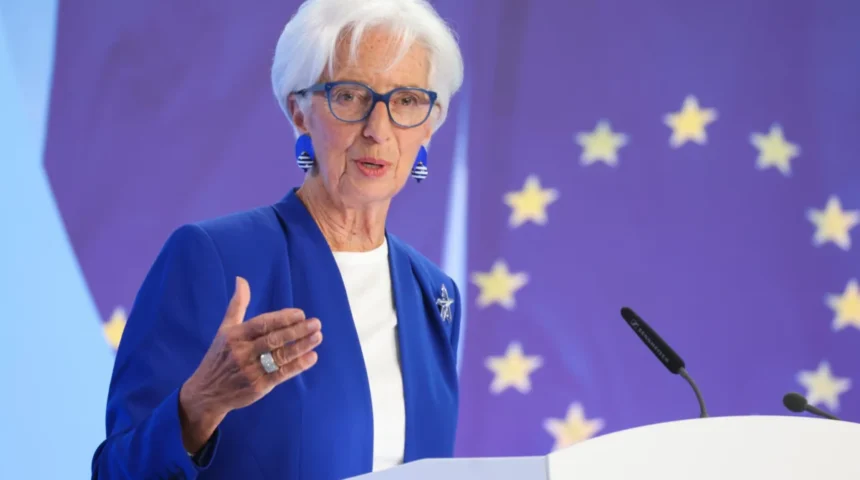
FRANKFURT — European Central Bank President Christine Lagarde announced on Thursday that she will step down from her high-profile role on February 7 of next year, cutting her landmark tenure short by nearly nine months.
Lagarde, who has steered the central bank through some of the most turbulent economic waters in modern European history since taking the helm in July 2019, made the surprise revelation ahead of a scheduled monetary policy decision. Her original eight-year mandate was formally slated to conclude in October 2027.
Reflecting on her years at the institution, Lagarde expressed deep gratitude for her time leading the Frankfurt-based central bank. "It has been a source of great pride to serve this institution. I thank all of those who have supported me on this journey over the past seven years," Lagarde said in a statement.
Following the announcement, members of the ECB’s Governing Council delivered a standing ovation during Thursday’s meeting in a show of collective appreciation for her leadership. The departure announcement arrived just hours before the central bank’s latest monetary policy verdict, where policymakers were widely anticipated to hold interest rates steady despite euro area inflation climbing to a three-year high in September.
European Council President Antonio Costa was among the first international leaders to publicly react to the news, offering a statement of gratitude for her dedicated service to the 21-nation currency bloc.
"She has provided a steady and determined stewardship, helping to safeguard stability and the resilience of the euro area," Costa said. He added that the official administrative process to appoint her eventual successor will begin immediately.
Lagarde’s tenure at the ECB will be remembered for extraordinary macroeconomic volatility. She took charge just months before the onset of the Covid-19 pandemic, which forced central banks worldwide to deploy unprecedented monetary stimulus. Soon after, her leadership was tested by the outbreak of the Russia-Ukraine war, which triggered severe supply-chain disruptions and a cascading series of energy price shocks. These geopolitical and economic headwinds combined to send inflation across the 21-nation euro area soaring above 11%, forcing the ECB into an aggressive and historically swift cycle of monetary policy tightening to restore price stability.
Born in Paris in 1956, Lagarde built an illustrious career spanning both law and international public service before arriving at the ECB. She initially earned distinction as a high-ranking corporate lawyer before transitioning into domestic French politics. In 2007, she shattered a major glass ceiling by becoming the first female finance minister of a G7 economy. Her international profile grew further in 2011 when she was appointed managing director of the International Monetary Fund (IMF), a position she held until moving to Frankfurt to lead the European Central Bank.
As her departure date approaches, speculation regarding her next career move has already begun. According to recent reporting by the Financial Times, Lagarde is viewed as a leading candidate to become the next chair of the World Economic Forum. Meanwhile, addressing domestic political rumors in recent media interviews, she has explicitly downplayed any suggestion that she plans to launch a bid for the French presidency in the upcoming 2027 national elections.
ECB Search for Lagarde’s Successor
Lagarde’s early exit compounds an already significant period of structural transition for the European Central Bank’s senior leadership. The central bank’s governing body is currently engaged in complex negotiations to fill multiple pivotal roles, with Chief Economist Philip Lane and Executive Board member Isabel Schnabel also scheduled to step down from their positions next year.
In the wake of Lagarde’s announcement, financial markets and policy analysts immediately turned their attention to the race to find her replacement. Former head of the Netherlands central bank Klaas Knot and former head of Spain’s central bank Pablo Hernández de Cos are widely regarded by market observers as the top contenders to inherit the ECB presidency.
"Both are excellent candidates," Carsten Brzeski, ING’s global head of macro, wrote in an email to CNBC on Thursday. "Nationality will also matter. While Knot might find more support among Northern European governments, the question is whether De Cos will be supported by the current Spanish government."
Brzeski added that both individuals possess deep technical credentials. "In any case, both would bring a high level of monetary policy expertise to the table. Something that Christine Lagarde had to pick up on when already in office," he noted, acknowledging Lagarde’s unique background as a lawyer and political leader rather than a career central banker.
Berenberg Chief Economist Holger Schmieding emphasized that the selection process will need to balance traditional criteria—such as monetary policy competence and regional balance—with the practical capability to manage potential financial turbulence. Specifically, the next president may need to navigate widening spreads in bond yields between member states as sovereign debt pressures mount across the continent.
Financial markets are currently debating whether the ECB could eventually be pressured to deploy one of its specialized intervention mechanisms. These concerns have intensified as France faces a mounting sovereign debt crisis, with further political uncertainty looming due to the country’s upcoming elections.
"As a former chair of the G20’s Financial Stability Board, Knot may have an edge in this respect," Schmieding observed in a research note.
The underlying geopolitical and fiscal landscape presents a delicate challenge for the incoming leadership. "The European Union is trying to guard itself at least somewhat against the risk that right-wing Marine Le Pen may win the French presidential election in April/May 2027," Schmieding said.
At the same time, he underscored that the central bank’s institutional boundaries remain clear. "However, the ECB has no mandate and no appetite to fund French fiscal follies. In our view, the ECB would only support France if Paris returns to more sustainable policies."

Related News