High-Stakes Battleground: Georgia Takes Center Stage in Final Stretch of US Midterm Elections
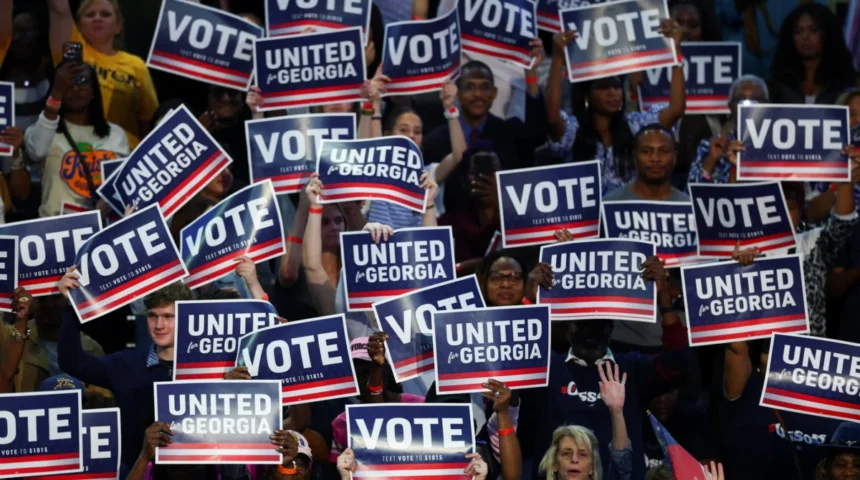
As the United States approaches next week’s crucial midterm elections, the political spotlight has intensified sharply on the American South, where Georgia has firmly entrenched its status as one of the nation’s most fiercely contested battleground states. Renowned for its razor-thin margins and intense partisan competition in recent federal election cycles, the state has become a primary focal point for both the Republican and Democratic parties, drawing massive investments of time, financial resources, and high-profile campaign visits from political heavyweights in a final bid to sway undecided voters.
The historical competitiveness of the state is well-documented, marked notably by a streak in which its three most recent Senate matchups were decided by high-stakes runoffs. Recognizing the immense weight that Georgia carries in the broader national balance of power, leadership from both sides of the political aisle has converged on the region. In a stark demonstration of the state’s strategic importance during the closing stretch of the campaign season, both US President Donald Trump and former US President Barack Obama traveled to Georgia this week to rally their respective bases and deliver their closing messages ahead of next week’s crucial vote.
Why is Georgia such a key state for the midterms?
For the Republican Party, and particularly for President Trump, Georgia represents a theater of immense personal and political significance. Trump has maintained a heavy physical presence in the state, campaigning twice in the northern city of Dalton over the past two weeks alone.
The state has long served as a source of deep personal grievance for the president, primarily because it was the central stage where he fiercely disputed his pre-election loss in the 2020 presidential contest. In the aftermath of that election, Trump famously refused to concede defeat to Joe Biden, launching a multi-state effort to challenge and overturn the certified results. Among those efforts, a now-infamous January telephone call captured Trump urging a top Georgia election official to recalculate the state’s presidential tallies in his favor, telling the official that he simply wanted to find 11,780 votes—which would amount to one more than his opponent’s margin.
These extraordinary events led to profound legal fallout. In 2023, Trump and several of his associates were formally charged with attempting to subvert the 2020 election results in Georgia. However, that high-profile criminal case was ultimately dismissed in its entirety after Trump was returned to office.
Despite official state audits and multiple bipartisan reviews that repeatedly upheld Biden’s 2020 victory, Trump revived unfounded claims of massive electoral fraud during his subsequent reelection campaigns. The lingering political friction was underscored during the 2024 presidential election, when Georgia ultimately voted for Trump by a margin of 2.2 percentage points. Ranking as the 28th largest margin for Trump across the 50 states, this slender victory margin left political observers in broad agreement that Georgia remains a true swing state capable of breaking in either direction.
What does polling in Georgia show?
Voters across Georgia are preparing to cast ballots in a comprehensive slate of major contests, including a high-profile race for governor, a critical United States Senate seat, and races for all of the state’s House of Representatives seats.
In the high-stakes Senate contest, polling averages compiled by MS NOW indicate that incumbent Democratic Senator Jon Ossoff holds a solid lead, registering at 52.6 percent compared to Republican challenger Mike Collins, who stands at 42.4 percent. Major network forecasters, including NBC, have leaned into these numbers, currently classifying the Georgia Senate race as "Likely Democratic."
In contrast, polling data points to a drastically tighter race for the governor’s mansion. The battle to succeed term-limited Republican Governor Brian Kemp—who is constitutionally barred from seeking a third consecutive term—features a fierce matchup between Democratic contender Keisha Lance Bottoms and Republican contender Rick Jackson. NBC polling characterizes this executive race as a quintessential toss-up, setting the stage for a dramatic finish.
Beyond the gubernatorial and Senate showdowns, Georgia voters are also making critical choices across the state’s 14 congressional districts. The current federal congressional delegation splits at nine Republicans and five Democrats. Additionally, voters are deciding pivotal state executive positions, including Lieutenant Governor, Attorney General, and Secretary of State, ensuring that the political alignment of the state government hangs heavily in the balance.
Who are the key contenders for the Senate?
Incumbent Senator Jon Ossoff is mounting a robust campaign for a second term in Washington. Ossoff first captured national attention and won his seat in a dramatic January 2021 runoff election, narrowly defeating Republican Senator David Perdue. That victory made him the youngest Democrat elected to the United States Senate in nearly four decades, as well as Georgia’s first Jewish senator.
Throughout his reelection campaign, Ossoff has focused his platform heavily on issues of economic affordability, expanded access to healthcare, and rigorous government accountability. On the campaign trail, Ossoff has frequently trained his fire on Donald Trump and his political allies, leveling accusations of corruption and entrenched conflicts of interest.
The theme of corruption was similarly amplified by former President Barack Obama during a high-energy campaign rally in Georgia on Wednesday. Addressing a packed auditorium, Obama sharply criticized Trump, alleging that the former president was intensely focused on personal self-enrichment, as well as enriching his family and political cronies.
"The guy has made billions of dollars while in office. We have never seen a president so intent on selling favors like this," Obama told the cheering crowd, echoing similar sharp critiques he delivered days earlier in Michigan, another vital battleground state.
On the Republican side, challenger Mike Collins secured his party’s nomination following a competitive primary run-off in June. Collins has built his campaign tightly around Trump’s broader political agenda, emphasizing strict immigration enforcement, border security, and the philosophy of smaller, less intrusive government.
The political stakes of the Senate race have been elevated further by Trump’s own remarks during his final-stretch campaign rallies. Trump has repeatedly signaled a transactional approach to federal governance, openly telling supporters that he intends to reward states and localities that deliver political victories for him.
At a recent rally, Trump spoke directly about Collins, telling the Republican candidate that he would have a direct line to the White House whenever he needed assistance for the state. However, the former president issued a stark warning regarding the consequences should Georgia voters choose to return Ossoff to the Senate. In a theatrical enactment of a hypothetical future phone call, Trump pantomimed Ossoff calling to request federal funding for his home state, declaring that his response would be dismissive and blunt: "I don’t give a damn what he wants."
Who are the key contenders for governor?
The race for governor has drawn intense national scrutiny, largely driven by the starkly contrasting backgrounds and platforms of the two major-party nominees.
Democratic nominee Keisha Lance Bottoms, the former mayor of Atlanta, has anchored her gubernatorial bid on core domestic priorities, including economic affordability, expanding healthcare access, increasing public education funding, and implementing robust environmental regulations. The Bottoms campaign has consistently messaged that her candidacy is designed to deliver tangible results for working families while providing steady, reliable leadership capable of cutting through the political uncertainty and division emanating from Washington. A victory for Bottoms would carry historic weight, making her the first Black woman ever elected as a governor in the United States.
Challenging Bottoms is 72-year-old billionaire businessman Rick Jackson. Jackson has directed a significant portion of his campaign strategy toward heavily criticizing Bottoms’ record as mayor of Atlanta, specifically targeting her administration’s handling of local crime during her tenure.
To press this argument, Jackson has personally financed an aggressive advertising campaign, pouring more than $200 million of his own personal wealth into television and digital ads. These advertisements prominently feature footage of civil demonstrations and instances of urban unrest in Atlanta following the 2020 fatal shooting of Rayshard Brooks, an unarmed Black man killed by a white Atlanta police officer during a period when Bottoms was serving as the city’s mayor.
As these intense campaigns enter their final hours, the overarching picture in Georgia reflects a massive mobilization of the electorate. According to data tracked and compiled by the University of Florida’s Election Lab, millions of Americans have already participated in early voting, with approximately 40 million ballots cast nationwide. This robust early turnout builds upon the momentum of past election cycles, tracking close to the 45.9 million early votes cast during the entirety of the 2022 midterm elections as voters across the country prepare for the final day of decision.

Related News