Japan’s GMO Group Urges Customers to Disclose and Shut Down PCs Amid Imminent Ransomware Threat
Japan’s internet and domain giant, the GMO Group, has taken the drastic step of urging its customers to immediately disconnect their systems from the internet and shut down their computers. This emergency advisory comes in the wake of a severe cyberattack against the company’s popular Onamae Desktop Cloud service, accompanied by a direct threat from a cybercriminal actor planning to detonate a ransomware payload across thousands of compromised customer servers.
The unfolding crisis highlights the profound vulnerabilities that can plague cloud infrastructure providers, leaving thousands of users scrambling to protect their local hardware and sensitive accounts. Following the initial threat, the company later confirmed that proprietary data belonging to both the corporate entity and its diverse customer base had already been published online by the attackers.
The security incident centers directly on the Onamae Desktop Cloud, a widely utilized Virtual Private Server (VPS) provider operating within Japan. The platform is managed by GMO Internet, a prominent member of the overarching GMO Internet Group and one of the country’s largest and most established domain registrars.
The sequence of events began to unfold last week when the corporation publicly announced that it had detected an unauthorized network intrusion. Internal telemetry and subsequent forensic investigations revealed that the security breach occurred on October 20. Investigators determined that the intrusion was severe enough to potentially install malicious software on up to 26,739 customer servers hosted on the cloud platform.
In an immediate attempt to mitigate the damage and minimize ongoing risks, the company initiated emergency shutdowns of the affected servers. By drastically reducing service availability, GMO sought to contain the lateral movement of the attackers before launching a full-scale forensic investigation into the vector and depth of the breach.
While the internet corporation moved swiftly to reassure its clientele that sensitive payment card information had thankfully remained secure and unexposed, it issued stark warnings regarding other credentials. Specifically, the company cautioned that MetaTrader 4 and MetaTrader 5, commonly known as MT4 and MT5, credentials alongside detailed trading-account histories may have been exposed, harvested, or otherwise compromised by the unauthorized intruders. As a precaution against unauthorized financial access, the company strongly urged all impacted users to immediately reset their account passwords and forcefully terminate any active digital sessions associated with those trading platforms.
Cyberattack Escalation
As the days progressed, the severity of the intrusion escalated rapidly. Subsequent operational updates released by the company confirmed the worst fears of management and users alike: proprietary and customer data had been definitively exfiltrated from the secure environments. Sensing leverage, the threat actor behind the breach initiated extortion demands, issuing a ransom note demanding an astounding 8 billion yen, which translates to approximately $50 million USD.
Taking a hardline stance against cyber extortion, GMO corporate leadership publicly announced that it would refuse to pay the exorbitant ransom demand. Instead, in an effort to acknowledge the severe disruption and frustration caused to its user base, the company announced a compensation scheme, promising to pay each affected customer 5,000 yen, or roughly $30 USD, for the inconvenience suffered.
The situation deteriorated further when GMO issued a fresh public warning alerting users that the threat actors were actively planning to leak stolen customer information across public forums. More alarmingly, the company warned that the perpetrators intended to remotely trigger a dormant ransomware payload that had been quietly planted on customer servers during the initial phases of the cyberattack days prior.
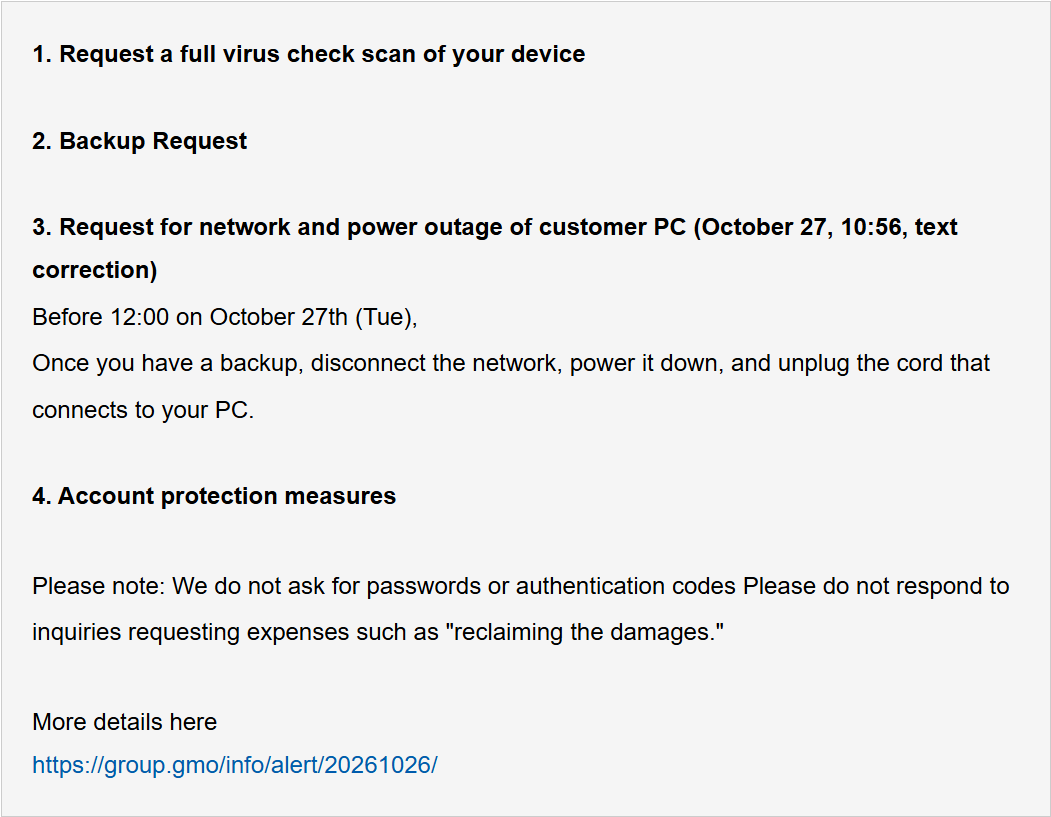
Acting on intelligence regarding this impending digital assault, the company escalated its defensive posture the very next day. GMO urgently requested that all customers physically disconnect their personal computers and workstations from the internet network, completely power them down, and unplug all network and power cables before noon. This desperate measure was deployed while the company collaborated closely with cybersecurity firm Trend Micro to remediate the infection vectors and recover from the multi-layered cyberattack.
In its direct communications to frightened clients, the company outlined the critical physical steps required to isolate the threat. Once users had secured a safe backup of their essential data, they were advised to immediately sever the network connection, power down the hardware entirely, and unplug the cord connecting the machine to the local network interface.
To combat the technical fallout, GMO announced that it was deploying automated and manual scanning protocols across all customer systems. These diagnostic sweeps were designed to determine definitively whether malware payloads were still lingering within customer environments. Furthermore, the company committed to offering equivalent personal computer hardware replacements to any users who ultimately suffered collateral damages resulting from an activated ransomware attack.
In a comprehensive operational report published earlier in the day, GMO officially confirmed that the threat actor had followed through on their preliminary threats by publishing both corporate and customer data on external sites. This development forced the company’s incident response teams to pivot toward verifying the authenticity of the leaked data sets to understand precisely what confidential information had entered the public domain.
For those customers whose private information was verifiably exposed in these data dumps, GMO stated that executive leadership would actively consider providing additional financial compensation packages to address the heightened risk profile.
Interestingly, as technical analysis of the situation matured, it became apparent that the attacker ultimately never acted on the most destructive aspect of their secondary threat. Investigators found no evidence that the promised ransomware payload was ever successfully activated or executed on customer machines, sparing the user base from a catastrophic loss of local files.
Nevertheless, in an effort to control the narrative and protect the privacy of those affected, GMO issued a stern warning directed at the general public and media organizations alike. The company strongly cautioned against downloading, viewing, or further disseminating the exposed information across public channels. GMO explicitly warned that it is fully prepared to pursue legal action against any individuals or entities caught spreading the leaked data, while simultaneously reaffirming its steadfast corporate policy refusing to negotiate with or pay the extortionists.

Related News