Pepenardo Transforms Bitcoin Magazine Covers Into One-of-a-Kind Artworks Following Las Vegas Exhibition
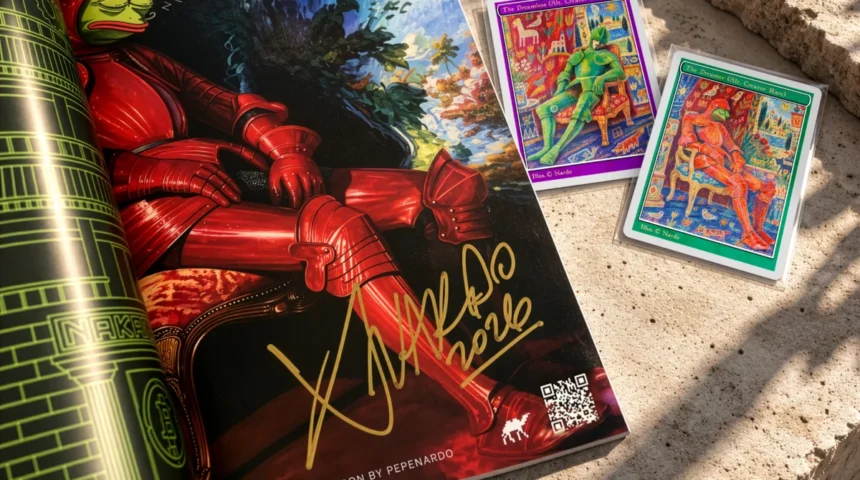
Contemporary artist Pepenardo has expanded his footprint in the intersection of fine art and digital culture by transforming six copies of Bitcoin Magazine’s 2036 Issue into original mixed-media artworks. Utilizing a simple Sharpie directly on the covers, the artist has imbued these finite publishing editions with signature motifs from his evolving visual universe, blending historical portraiture, financial market allegory, and prominent meme archetypes into physical artifacts of the Bitcoin era.
The hand-altered editions prominently feature familiar characters from Pepenardo’s established iconography, including the "Sleeping Knights," a visual concept previously showcased to international audiences during the MEMETIKRON exhibition at the BMAG Museum in Nashville and the Bitcoin 2026 conference in Las Vegas. Additional ink-drawn imagery across the custom covers introduces the masked rider of FAKEGENESIS, historical figures like Dorian Nakamoto, and elements featuring Pepe the Frog.
Each transformed magazine features the artist’s distinct signature on its illustrated cover alongside a secondary, gold-ink signature on an interior spread that reproduces his notable oil painting THE DREAMER. Furthermore, each magazine is paired with two original, one-of-one trading cards created specifically for this collaboration, bridging the gap between traditional publishing, fine art, and contemporary collectible card culture.
This collaborative project underscores a broader institutional shift at BTC Inc., reflecting an intensifying commitment to art publishing, museum-grade exhibitions, and physical collectibles. It directly builds upon the momentum generated by Pepenardo’s exhibition at Bitcoin 2026, where his major canvases THE DREAMER (RED KNIGHT) and THE DREAMLESS (GREEN KNIGHT) served as the undisputed centerpieces of the live BMAG auction.
Measuring thirty by thirty-nine and a half inches each, the two monumental oil paintings depict reclining figures encased in vibrant red and green armor, pulling heavily from the visual traditions of historical portraiture while offering commentary on cyclical financial markets. Both works realized significant market demand at auction, selling for 0.32698802 BTC—approximately $26,500 each—after attracting a combined total of 197 competitive bids.
The striking imagery established in those canvases has now migrated into artist-produced trading cards. These cards introduce alternate colorways, remixed compositions, and hand-painted "Creator Rare" editions that draw aesthetic inspiration from traditional textiles. Within a rapidly expanding and evolving trading card market, Pepenardo’s multidisciplinary practice successfully connects the heavy materiality of oil painting with the intimate, tactile nature of handheld collectibles, proving that scarcity, meticulous provenance, and creative variation remain primary drivers of modern artistic value.
This fluid relationship between physical fine art and tokenized meme culture is not new for the artist; Pepenardo’s engagement with this collector space stretches back several years. In 2023, his celebrated painting FAKEGENESIS—a striking reinterpretation of Jacques-Louis David’s neoclassical masterpiece Napoleon Crossing the Alps, starring a masked rider atop a vivid green horse—sold at the Bitcoin Conference in Miami for 1.625 BTC. Originally conceived as a digital "Fake Rares" card on Counterparty in 2022, the composition quickly became an early landmark for physical Bitcoin-inspired art, signaling a robust collector appetite for fine art emerging natively from the digital meme ecosystem.
FAKEGENESIS subsequently found a permanent place in the publication’s lineage when it appeared on the back cover of Bitcoin Magazine, with high-quality prints made available to enthusiasts through the publication’s official store. Its recent evolution back into a hand-drawn magazine cover completes an unusual and compelling artistic progression, traveling full circle from a digital trading card to a major canvas, onto printed media reproduction, and finally settling as a one-of-one physical collectible.
The intrinsic collecting value associated with Bitcoin Magazine itself traces back to its foundational origins in May 2012, when the publication was co-founded by Mihai Alisie and Vitalik Buterin. Over the subsequent decade and a half, the physical print runs of the magazine have transformed from trade publications into historical documents. For instance, at a prominent bitcoin gathering in London in September 2012, seven physical copies of the inaugural issue were signed by more than twenty early pioneers of the digital currency. One of those signed copies achieved a winning auction bid of 7 BTC, though the transaction was famously left unfulfilled by the winning bidder.
As the ecosystem matured, early editions transformed into coveted historical artifacts. Graded copies and rare historical runs have consistently attracted institutional and private collectors. To preserve this history, Bitcoin Magazine introduced the Genesis Box in 2023, a limited edition release comprising just 21 collector sets that house the publication’s first 22 foundational issues within custom protective acrylic cases.
Much like early avant-garde exhibition catalogs, scarce first-edition books, and vintage concert posters, Bitcoin Magazine has cultivated a tangible value that far transcends its original journalistic purpose. Pepenardo’s custom-drawn covers effectively extend this archival history, elevating standard publishing copies into singular, museum-quality original works of art.
Reflecting on the collaboration, Pepenardo shared insights into the conceptual framework driving his work across mediums, noting how naturally the project emerged.
"I couldn’t help but notice that welcoming blank space on the cover," Pepenardo said. "It seemed like an obvious place for a drawing. Coincidentally, I came into Bitcoin through watching the energy around trading cards on Counterparty, from 2016 all the way to the present. Hal Finney foreshadowed this ethos in his famous 1993 email titled ‘Crypto trading cards.’ Of course he was talking about digital collectibles, but the principle stays the same. Bitcoin’s history has a magnetic pull on collectibles; people want to hold on to a fragment of such an important modern history. When we look back fifty years from now, the content and the artifacts that came out of the movement will help future generations make sense of Bitcoin’s tremendous timeline."
Addressing the evolution of his recurring characters as they transition fluidly from oil on canvas to publication pages and limited-edition trading cards, the artist expressed astonishment at the enthusiastic market response.
"I was shocked at how quickly they went. I have no words," Pepenardo remarked regarding the rapid sell-out of the card sets. "But it certainly reinforces that what I’m attempting to create and build with my work has some value. Being able to use the trading cards as a way to remix the original works lets me enrich the life of each painting. The mediums are different—oil on canvas for the paintings, various print methods for the trading cards—but the tedious care that goes into executing both is the same."
Looking back at the milestone moment in Miami that cemented his career trajectory, Pepenardo pointed to FAKEGENESIS as a turning point for his professional methodology.
"FAKEGENESIS will always be the pivotal work that showed me how I should properly approach my art. I knew that even before it sold," he explained. "It is a painting that embeds the tropes of Bitcoin’s ethos without being too obvious. Art within the context of Bitcoin shouldn’t have to throw a big B at you all the time; it should give you the fiery sensation of standing inside a new history being built. My hope is that it is remembered as a work that represents an entire movement—onwards and upwards."
Mark Mason, Head of Media at Bitcoin Magazine, offered an institutional perspective on the publication’s enduring legacy and the growing appetite for physical artifacts among contemporary collectors.
"For over a decade, Bitcoin Magazine has documented the evolution of Bitcoin, from its early technical developments to the people and culture surrounding it," Mason stated. "We see each physical issue as a time capsule, capturing a particular moment in Bitcoin’s journey toward hyperbitcoinization. One of the biggest factors driving their collectible value is that we never reprint past editions. Each issue has a limited print run, creating a finite supply that has made early editions, graded copies, and signed covers increasingly sought after by collectors."
Mason emphasized that the publication has consistently mirrored the ethos of the technology it chronicles. "Bitcoin has always existed at the intersection of technology, economics, and culture," he added. "Artist-customized covers like Pepenardo’s take that relationship a step further, transforming an already collectible publication into an original artwork. It’s an extension of what Bitcoin Magazine has become: both a record of Bitcoin’s history and an artifact of that history itself."
Following the launch, Pepenardo’s custom magazine covers and accompanying trading card sets were acquired by collectors shortly after dropping. However, other physical works associated with the artist’s recent programming remain accessible to the public, including MASTER CUTS OUT THE STONE (after Hemessen), the pivotal centerpiece painting from the MEMETIKRON collection that toured from Nashville to Las Vegas. Additionally, art enthusiasts can acquire fine art prints of FAKEGENESIS or secure the limited-edition Genesis Box sets preserving the formative years of the publication’s print run from 2012 through 2014.
The Bitcoin Museum & Art Gallery (BMAG) continues to curate international exhibitions and high-profile auctions exploring the profound cultural implications of decentralized money, with ongoing showcases such as Curtis William Readel’s Paper Money exhibition. BMAG is scheduled to continue its international programming at Bitcoin Amsterdam, presenting European artists whose works interrogate contemporary architectures of money, power, and sovereignty.

Related News