Sir David Spiegelhalter on the Illusion of Certainty, COVID Fear-Mongering, and Why You Should Distrust the News
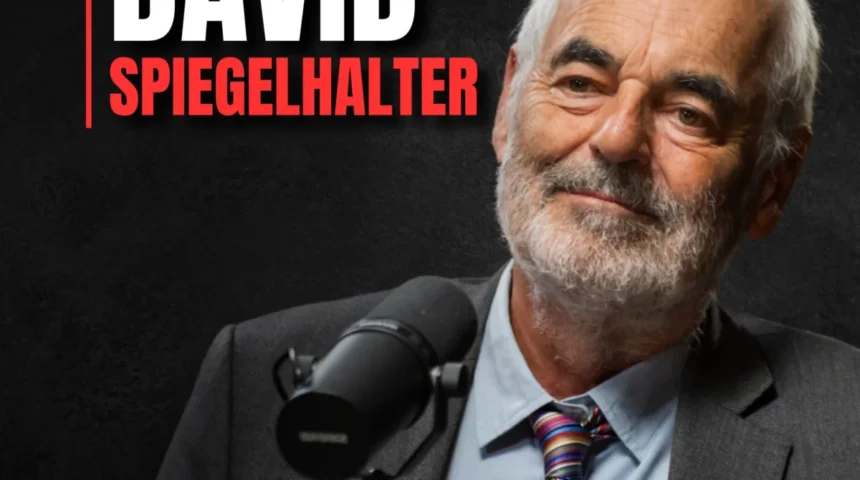
In an era defined by data-driven decision-making, relentless news cycles, and algorithmic forecasting, society has increasingly placed its faith in numbers. Yet, according to one of the world’s leading statisticians, this blind trust is fundamentally misplaced. Sir David Spiegelhalter, Chair of the Winton Centre for Risk and Evidence Communication at Cambridge University and author of The Art of Uncertainty, has spent decades analyzing how data is utilized—and frequently misused—across modern institutions. Having served on prominent public inquiries into mass murder, such as the Harold Shipman case, as well as systemic healthcare failures, Spiegelhalter brings a sobering perspective to the ways society interprets risk, probability, and objective truth.
In a wide-ranging discussion, Spiegelhalter breaks down the mechanics of numerical manipulation in the media, explaining why "objective truth" is often a flawed concept and detailing how individuals can protect themselves against confirmation bias. From the mathematical algorithms that helped catch Britain’s most prolific serial killer to the psychological divide between rigid forecasters and agile "super-forecasters," the conversation lays bare the hidden machinery behind the statistics that shape public policy, media narratives, and everyday life.
The Weaponization of Numbers and Media Manipulation
At the heart of Spiegelhalter’s critique is a stark warning: listeners and readers should immediately distrust virtually any statistic encountered in the news. This skepticism is not born of cynicism, but of a deep understanding of how simple linguistic tricks can radically alter human perception without changing the underlying mathematical reality. By shifting the framing of a number, identical statistics can be made to sound either terrifyingly catastrophic or reassuringly mundane.
Spiegelhalter demonstrates that the mechanics of numerical manipulation are rarely about outright fabrication; rather, they rely on selective presentation, emotional framing, and the exploitation of human cognitive vulnerabilities. When media outlets or political bodies present data, they often lean into the public’s pre-existing inclinations. Consequently, confirmation bias does the heavy lifting, allowing individuals to cherry-pick numbers that validate their worldviews while dismissing contradictory evidence. Spiegelhalter argues that this dynamic undermines the pursuit of objective truth, reducing complex probabilistic realities into simplistic, polarized talking points designed to provoke emotional reactions rather than foster genuine understanding.
Lessons from Public Inquiries: From Shipman to Healthcare Failures
Spiegelhalter’s expertise extends far beyond theoretical mathematics into the grim reality of forensic data analysis. Reflecting on his involvement in public inquiries, including the investigation into serial killer Harold Shipman, he highlights the critical role that mathematical algorithms and statistical monitoring could have played in detecting abnormal patterns far earlier. By analyzing mortality rates and practice data, statistical surveillance tools have the capacity to flag anomalies that might otherwise remain hidden beneath institutional blind spots and professional courtesy.
However, these historical inquiries also reveal the institutional resistance to uncertainty. Whether examining systemic healthcare failures or evaluating public safety records, official bodies often struggle to communicate risk transparently. The instinct to project absolute confidence frequently overrides the necessity of acknowledging ambiguity, leaving institutions vulnerable to catastrophic failures of trust when their absolute predictions inevitably fall short.
COVID-19, Vaccine Messaging, and the Cost of Fear-Mongering
The tension between institutional certainty and statistical reality was tested on an unprecedented global scale during the COVID-19 pandemic. Spiegelhalter reflects candidly on sitting in the middle of the fiercely polarized scientific and political arguments of that era, examining what the public fundamentally misunderstood regarding public health interventions, viral transmission, and vaccine efficacy.
One of the most critical missteps, according to Spiegelhalter, was the rigid and simplistic messaging surrounding the vaccines. The ubiquitous mantra that the vaccines were "safe and effective" lacked the necessary nuance required for a sophisticated public health campaign. While technically accurate in broad terms, absolute terminology creates a fragile foundation for public trust. When breakthroughs occurred or rare adverse events materialized, the gap between the promised certainty and the complex reality severely eroded public confidence.
Furthermore, Spiegelhalter expresses deep concern over the psychological toll of government messaging during the crisis, stating that he cannot forgive the degree of fear-mongering deployed to secure compliance. By analyzing the data behind lockdowns, localized interventions, and demographic risk factors, he points out that children, for instance, have statistically never been safer from the virus, yet they bore an immense psychological and social cost due to blanket risk-mitigation strategies. The government’s tendency to throw its considerable weight behind authoritarian fear tactics rather than transparent, risk-based communication created long-lasting damage to the relationship between science, governance, and the citizenry.
The Psychology of Forecasting: Hedgehogs Versus Foxes
To understand why some analysts consistently make accurate predictions while others fail spectacularly, Spiegelhalter looks to the mental frameworks that govern human thought. Citing the classic psychological distinction between "hedgehogs" and "foxes," he explains the traits that separate terrible forecasters from elite super-forecasters. Hedgehogs tend to know one big thing, viewing the world through a rigid ideological lens and forcing complex data to fit their predetermined narratives. Foxes, on the other hand, know many things, drawing from diverse sources, continuously updating their beliefs in the face of new evidence, and remaining deeply comfortable with ambiguity.
This dichotomy is increasingly relevant as society transitions into an era dominated by artificial intelligence and automated modeling. Spiegelhalter addresses the rise of AI "black boxes" across healthcare, weather forecasting, and corporate business planning. While machine learning models possess unprecedented capacity to process vast arrays of variables—ranging from localized crowd predictions at sporting events like Real Bedford matches to complex models attempting to predict human mortality—they also introduce new layers of opacity.
As algorithms increasingly dictate everything from medical diagnoses to financial markets, the fundamental question remains whether AI will ultimately replace statisticians or merely redefine their role. Spiegelhalter touches on the broader cultural and economic projections surrounding artificial intelligence, including high-profile speculations such as Elon Musk’s estimates on AI development timelines. Yet, true to his statistical training, Spiegelhalter emphasizes that whether evaluating the probability of an AI milestone or the likelihood of a global health crisis, the core challenge of modern society is not the absence of data, but the cultivation of intellectual humility in the face of persistent uncertainty.

Related News