TÜV Labs Put Braiins OS to the Test: How Custom Firmware Boosts Bitcoin Mining Efficiency
In the high-stakes world of industrial Bitcoin mining, fluctuating hashprices can quickly turn profitable operations into a tight margin squeeze. When market conditions shift and revenues tighten, miners cannot always rely on external market forces to protect their bottom line. Instead, operators must look inward, optimizing their hardware infrastructure to extract maximum value from every watt of electricity consumed. While numerous software developers claim their custom firmware can enhance hardware performance, the industry has long demanded rigorous, verifiable proof under scientific conditions. To address this demand for empirical validation, recent independent testing conducted at a globally recognized certification facility has provided hard data on how aftermarket firmware can fundamentally alter mining economics.
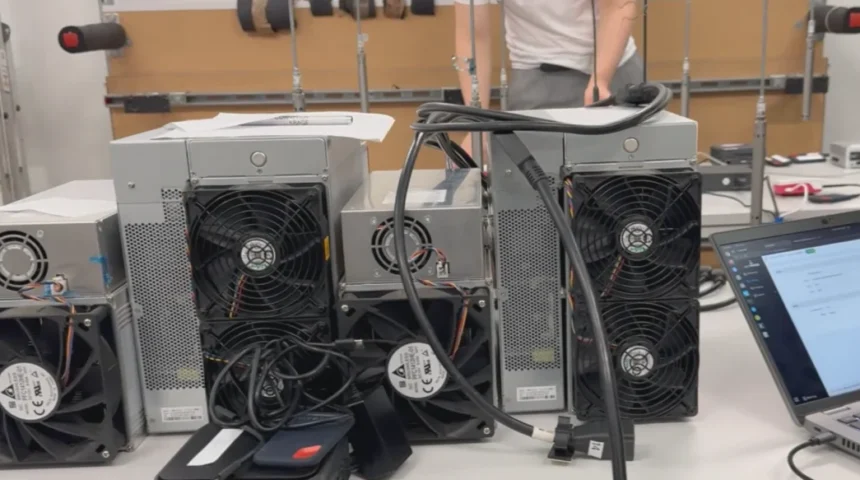
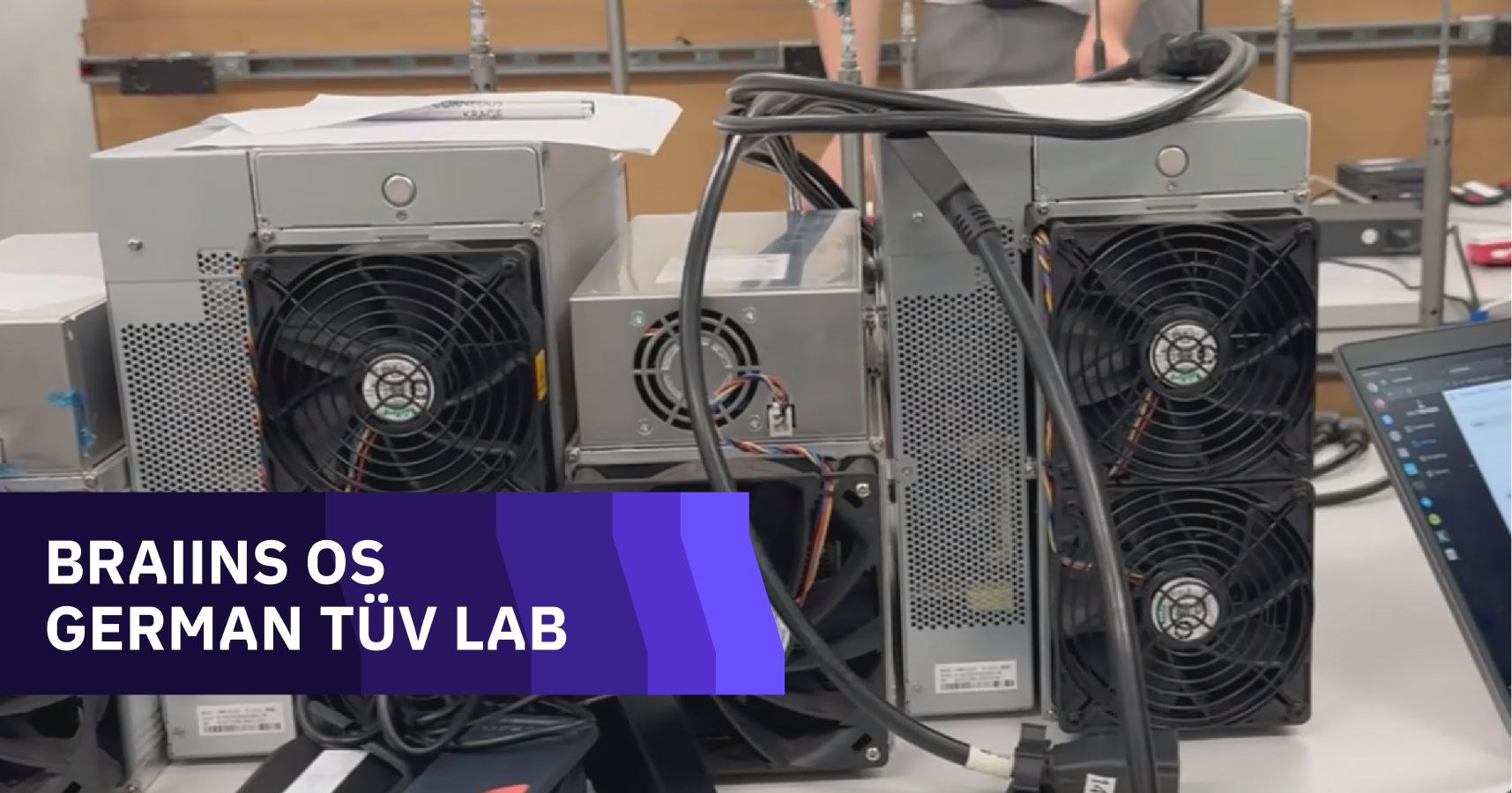
Subjected to the rigorous oversight of TÜV — the globally renowned Technical Inspection Association specializing in product testing and safety certification — Braiins OS was recently put through a series of controlled evaluations. Conducted inside a specialized thermal chamber at the TÜV SÜD energy laboratory in Germany, the testing regime was designed to eliminate external environmental variables and precisely measure power consumption and hash rate performance. By deploying real hardware in a scientifically controlled environment, the evaluation sought to move past marketing claims and provide the Bitcoin mining community with unbiased, laboratory-certified metrics regarding efficiency optimization.
Why Independent Verification Matters in ASIC Mining
For decades, TÜV has served as an authoritative benchmark for product testing across industrial machinery, automotive components, and advanced electronics. Bringing this level of institutional rigor to the cryptocurrency mining sector represents a significant shift toward professionalization. In an industry where hardware performance directly dictates operational survival, claims of efficiency gains made by software developers must withstand strict scrutiny.
Testing mining firmware in a standard facility often introduces noise from ambient temperature fluctuations, grid instability, and cooling variances. By moving the evaluation to TÜV SÜD’s advanced energy lab in Germany, researchers were able to isolate the performance of the software itself. Inside the controlled thermal chamber, every watt drawn and every terahash generated could be recorded with absolute precision, offering an unfiltered look at how custom code interacts with physical Application-Specific Integrated Circuit (ASIC) chips.

Pushing Real Hardware to the Limit in Controlled Conditions
The evaluation focused on two widely deployed ASIC mining models: the Antminer S19k Pro 120T and the Antminer S19j Pro 104T. To establish a reliable benchmark, the test sequence began by running both machines on their standard, manufacturer-provided stock firmware. This baseline established the performance standard against which all subsequent custom firmware trials would be measured.
Following the baseline phase, the hardware was subjected to testing using Braiins OS under two distinct operational paradigms: a fixed power target measured in watts and a fixed hashrate target measured in terahashes per second. Across every single test scenario, the results demonstrated that custom firmware could extract superior efficiency metrics compared to the default factory settings.

For the S19k Pro 120T, the stock firmware yielded an average performance of 122.4 terahashes per second while drawing 2,835.3 watts of power. When the machine was transitioned to Braiins OS with a designated power target of 2,766.9 watts, it maintained a comparable output of 122.6 terahashes per second, delivering a 2.62% improvement in overall efficiency. When a specific hashrate target of 121.7 terahashes per second was configured within the custom software, the machine achieved the output while consuming only 2,695.2 watts, resulting in a 4.46% efficiency boost.
The performance divergence was even more pronounced with the S19j Pro 104T model. Operating on stock firmware, the unit delivered an average of 102 terahashes per second while consuming 3,080 watts. When configured with Braiins OS and a power target of 2,847.7 watts, the machine output increased to 106 terahashes per second, representing a substantial 12.47% efficiency boost. When tested against a fixed hashrate target of 101.1 terahashes per second, the custom firmware reduced power consumption to 2,883.3 watts, yielding a 5.89% efficiency gain. These findings underscore that regardless of whether an operator prioritizes reduced electricity expenditure or targeted hash rate output, custom firmware consistently unlocks greater operational efficiency.

The Mechanics of Autotuning: Why Stock Firmware Falls Short
The fundamental reason custom firmware outperforms factory settings lies in how hardware manufacturers design ASIC chips. Mass-produced chips inherently possess slight physical and electrical variations due to manufacturing tolerances. Despite these distinct individual traits, stock firmware applies a generalized, uniform approach to voltage and frequency across the entire hash board. This conservative strategy ensures stability across the weakest chips, but it leaves considerable performance unrealized on stronger silicon that could easily handle higher frequencies or operate at lower voltages.
Autotuning solves this structural inefficiency by analyzing the individual characteristics of the chips within the mining rig. Instead of treating every component identically, an autotuning algorithm maps the capability of individual chip domains, adjusting voltage and frequency dynamically. This granular control allows the hardware to operate closer to its true physical limits.

Mining operations generally pursue one of two strategic adjustments beyond standard factory configurations: overclocking or underclocking. Overclocking involves pushing hardware to consume more power in exchange for a higher hashrate output, a strategy that traditionally incurs an efficiency penalty as chips are driven harder. Conversely, underclocking intentionally reduces power consumption to maximize efficiency, extracting a higher relative hashrate per watt than factory specifications allow.
Advanced autotuning systems optimize both strategies. By mapping chip performance accurately, the software ensures that whether an operator chooses to push for maximum output or scale back to conserve energy, the hardware operates at peak thermodynamic and electrical efficiency. This granular approach not only improves daily profitability but also reduces thermal stress, contributing to an extended hardware lifespan.

Implications for Industrial and Home Miners
In the competitive landscape of Bitcoin mining, operational margins are often measured in fractions of a percent. Over the lifespan of a mining fleet, the cumulative difference between running unoptimized stock firmware and an advanced custom operating system can dictate whether an enterprise remains profitable through market downturns or is forced to curtail operations.
Efficiency gains translate directly into reduced operational expenditure on electricity, lower thermal loads on cooling infrastructure, and prolonged hardware durability. As difficulty adjustments continue to challenge miners worldwide, extracting every available satoshi from existing capital investments has become paramount. The empirical data provided by the TÜV SÜD evaluation indicates that utilizing specialized firmware is no longer merely an optional enhancement for tech-savvy operators, but a foundational component of modern mining efficiency.

Related News