US AI Capital Expenditure Projected to Approach $1.2 Trillion by Decade’s End, New JPMorgan Report Reveals
Artificial intelligence is developing on a massive scale and at an accelerated pace, reshaping global technology markets, corporate strategies, and capital allocation frameworks. By the end of the decade, annual artificial intelligence capital expenditure in the United States is expected to near US$1.2 trillion under a baseline scenario, according to a comprehensive new report published by JPMorgan Asset Management. This remarkable level of structural investment is projected to support ongoing reinvestment, drive continued growth in AI end-user demand, and cement expectations of long-term financial viability across the sector.
The report outlines distinct economic trajectories for the technology over the coming years. In a more bullish "sustained demand" scenario, total annual spending could climb up to roughly US$1.4 trillion per year by 2030. This optimistic outlook assumes a persistently positive growth story for foundation models, agentic AI, robotics, and potentially other emerging modalities that would push peak capital expenditure higher and necessitate an elevated level of ongoing investment well into the future. Beyond rising raw demand for artificial intelligence capabilities, this scenario implies higher levels of operational productivity for end users and robust profitability for upstream AI suppliers.
In both the baseline and bullish scenarios, AI spending is expected to experience a phase of normalization and moderate decline towards the end of the decade. Under the baseline scenario, annual capital expenditure would stabilize at roughly US$800 billion per year starting in 2034. Meanwhile, in the optimistic scenario, outlays would gradually descend from their 2030 peaks throughout the decade, settling at just a little over US$1 trillion by 2040.

By contrast, the JPMorgan report also models a more pessimistic "overcapacity" scenario. This alternative outlook assumes that returns to AI providers could eventually weaken due to intensifying price competition, insufficient end-user demand, ongoing difficulties in effectively monetizing AI services, the technological obsolescence of heavy capital investments, or a rising cost of capital. In this more cautious scenario, spending would peak at about US$1.1 trillion in 2028 before dropping sharply to approximately US$500 billion by 2033, remaining subdued through 2040.
Despite varying timeframes, speeds, and overall economic variations across these projections, all three modeled scenarios point to a massive, near-term surge in artificial intelligence investments. By 2028, total annual AI capital expenditure in the United States is projected to reach approximately US$1.1 trillion to US$1.2 trillion, representing a steep increase from roughly US$850 billion in 2026.
The State of the AI Cycle
At present, the unfolding artificial intelligence boom closely aligns with historical capital investment patterns observed in past technological revolutions. The JPMorgan Asset Management report notes that the current cycle is successfully navigating through Phase 1, characterized by foundational invention, and Phase 2, defined by rapid capital investment growth.

As underlying foundation models and specialized semiconductor chip technology continue to advance rapidly, user growth accelerates, and substantial financial capital keeps flowing into the ecosystem. Crucially, this development process has remained self-sustaining up to this point. Massive consumer and enterprise adoption metrics underscore this momentum. ChatGPT, the flagship generative artificial intelligence chatbot developed by OpenAI, reports approximately 1.2 billion weekly active users. Simultaneously, Google’s Gemini platform claims upwards of 1 billion monthly active users.
As competition among major AI model providers intensifies, entirely new use cases are emerging on a regular basis. This evolution is particularly visible as modern corporations transition toward the adoption of agentic AI—systems capable of autonomous reasoning and multi-step execution.
Data from the Boston Consulting Group (BCG) Applied AI Index, which surveyed more than 1,300 top corporate executives across more than 20 distinct industry sectors, reveals that a notable share of global firms already have agentic AI deployed directly in production environments. However, that proportion varies widely from one industry to another. Technology, telecommunications, and banking currently lead the commercial landscape, boasting adoption rates of 76%, 62%, and 61%, respectively. By contrast, more traditional and capital-intensive sectors such as power and utilities, as well as chemicals, trail behind significantly, both registering adoption rates of just 36%.

Europe’s Evolving AI Ecosystem
Examining regional trends beyond the United States and China, the JPMorgan report observes that Europe has not taken a leading role in developing foundational AI infrastructure models, yet the continent remains a critical and influential participant on the global stage.
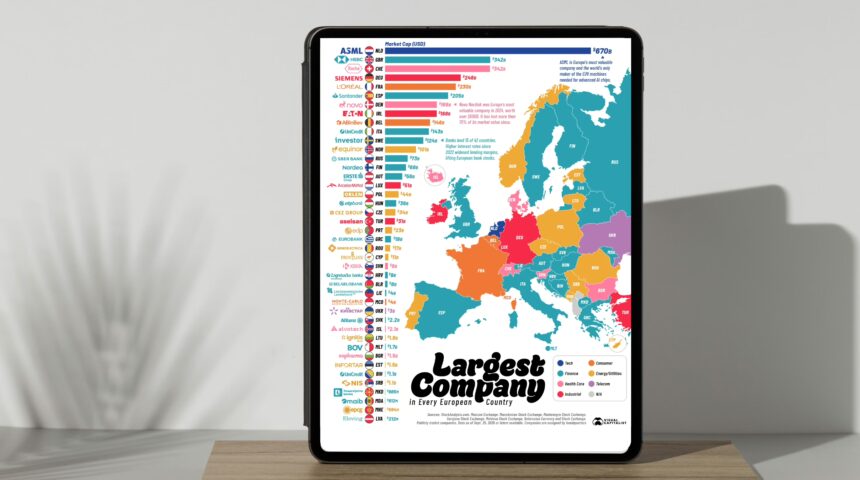
In the semiconductor manufacturing sector, the Netherlands-based firm ASML occupies a unique and indispensable position. The company develops and manufactures sophisticated photolithography machines used globally to produce integrated circuits. ASML stands as the largest supplier to the broader semiconductor industry and remains the world’s exclusive manufacturer of extreme ultraviolet lithography machines, which are absolute prerequisites for fabricating the most advanced semiconductor chips in existence. Backed by a market capitalization exceeding US$600 billion, ASML proudly stands as one of the most valuable corporations in Europe.
Although Europe has not yet produced dominant global leaders in the foundational AI infrastructure layer, the region is rapidly emerging as a significant and vibrant hub for specialized AI applications. According to a collaborative research report published by McKinsey and Boardwave, European AI startups are increasingly focusing their efforts on the application layer of the technology stack. These firms are building highly specialized software designed to understand complex industry workflows, integrate seamlessly inside existing enterprise systems, and automate intricate tasks across demanding operating environments. As a result, these European startups are drawing substantial investor attention and capital.

In 2018, total European AI application funding stood at a modest 11% of US funding levels. By the first half of 2026, that proportion had climbed dramatically to 44%. Absolute European AI application funding reached €6.8 billion during this period, matching the total amount raised across the entirety of 2024 and positioning the full year of 2026 to comfortably surpass the €8.1 billion raised throughout all of 2025.
This investment trend coincides with the rapid rise of a fresh cohort of homegrown artificial intelligence leaders across Europe. These emerging champions—including companies such as Helsing, Legora, and Wayve—average just five years since their initial founding, yet they already rank comfortably among the top 100 European technology companies by valuation.
Helsing, a prominent defense artificial intelligence company based in France, commands a valuation of US$18 billion. Legora, a collaborative artificial intelligence platform designed specifically for legal professionals based in Stockholm, currently serves more than 1,200 organizations and 100,000 legal practitioners across multiple international markets. Meanwhile, Wayve, a UK-based autonomous driving startup, has secured substantial backing from a consortium of major global technology and automotive stakeholders, including SoftBank, Microsoft, Nvidia, Uber, Mercedes-Benz, and Nissan.

Related News