EU Watchdog Exposes Widespread Use of Dark Patterns, Addictive App Design, and Misleading Finfluencer Marketing

The rapid digitization of retail financial services across Europe has unlocked unprecedented access to capital markets, allowing millions of everyday citizens to manage investments, trade assets, and monitor portfolios from the palm of their hands. However, this technological leap has introduced a darker, less regulated underbelly. According to a comprehensive new study published by Finance Watch, an independent European non-governmental organization serving as a vital public-interest counterweight to private financial lobbies, manipulative design practices, addictive application features, and unregulated finfluencer promotions have become widespread throughout the European Union.
These sophisticated psychological mechanisms systematically undermine consumers’ ability to make clear, informed, and autonomous financial decisions. By exploiting cognitive biases and human vulnerabilities, financial institutions and digital platforms are able to steer retail investors toward choices that maximize corporate profits while exposing customers—particularly vulnerable demographics—to significant financial detriment. The findings have ignited fresh urgency among consumer advocates, prompting strong calls for aggressive legislative and regulatory intervention across the bloc.
The study, meticulously executed by research firm the Behaviouralist between April and June 2026, evaluated 24 prominent financial institutions, analyzing their official websites and mobile applications across four European Union member states. The investigation revealed an extensive reliance on so-called "dark patterns" and addictive user-interface mechanics specifically engineered to provoke impulsive decision-making and exploit well-documented cognitive vulnerabilities.
Dark patterns, frequently referred to in technology and UX design circles as deceptive user experience patterns, encompass a wide array of interface tactics purposefully crafted to trick online users into undertaking actions that run counter to their personal best interests. Within the high-stakes domain of retail financial services, these calculated design choices can subtly mislead ordinary consumers into high-risk investment decisions, incurring severe capital losses while enriching the platform provider.
Most Prevalent Manipulative Design Tactics
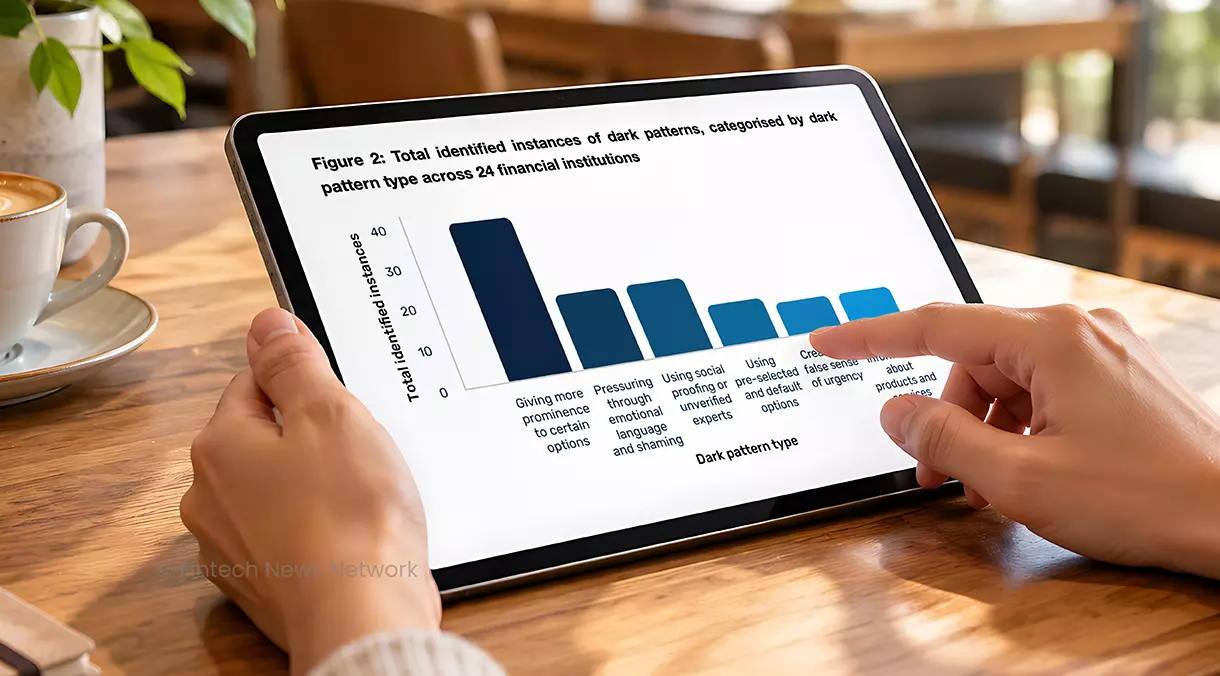
Among the various manipulative design features uncovered across the analyzed websites and mobile applications, the single most prevalent tactic involved the artificial manipulation of visual hierarchy. Researchers observed 40 distinct instances where interfaces deliberately gave greater prominence to specific options when prompting consumers to make financial choices. This specific form of dark pattern routinely steers customers toward options that deliver optimal profitability for the firm rather than serving the genuine financial needs of the user.
Prominent examples of this visual steering included dynamic lists of trending investment products featured prominently on user dashboards. These interfaces ranked financial assets according to opaque or predefined criteria, effectively funneling user attention toward specific instruments. Another variation involved recommendation engines that artificially amplified products generating higher fee structures for the institution, a practice identified 19 times within the sample group.
Beyond visual manipulation, financial institutions frequently leveraged emotional language and psychological shaming to nudge consumers toward desired outcomes, recording 19 separate instances. A favored mechanism within this category was loss-aversion framing. Digital banners and notifications actively shamed users into purchasing specific retail investment products by emphasizing the imminent dangers of inaction.
Common messaging tactics included alarming prompts such as queries asking whether users knew their money was actively losing value, alongside assertions that runaway inflation would continuously erode their purchasing power. These platforms frequently positioned investing not as an opportunity for wealth creation, but as a mandatory defensive measure against inevitable poverty. In several cases, interactive calculators projected catastrophic personal losses for users who chose not to invest, weaponizing psychological anxiety to force immediate transactional behavior.
Social proofing and the deployment of unverified expert or institutional opinions constituted another major category of manipulation, likewise observed 19 times in the study. Platforms utilized misleading analyst recommendations, dubious star ratings, and manufactured expert commentary designed to short-circuit critical evaluation among retail investors. By invoking perceived authority figures, these interfaces effectively dismantled user skepticism and critical analysis.
The study highlighted particularly concerning examples of isolated analyst recommendations stripped of all necessary context. This practice generated a potent authority bias effect, systematically removing uncertainty, risk warnings, and essential caveats that would otherwise support a balanced, deliberate decision-making process.
Another deeply troubling discovery involved curated pages displaying investment ideas attributed loosely to legendary investors such as Warren Buffett or Bill Gates. These features cynically exploited public admiration and behavioral biases, enticing retail investors into purchasing specific market products that bore little to no actual connection to the cited financial icons.
Furthermore, pre-selected or default options appeared in 11 instances, predominantly within fast-paced trading applications, while critical product information—such as vital disclosures regarding inherent risks—was deliberately obscured in nine cases. These calculated omissions directly impair a consumer’s capacity to evaluate products objectively, drastically increasing the likelihood of purchasing completely unsuitable financial instruments.
Complementing these deceptive layouts was the frequent generation of a false sense of urgency. Identified in nine instances, tactics included time-limited offers, ticking countdown timers, and artificial deadlines designed to pressure retail users into executing trades and financial commitments far more rapidly than prudence would dictate.
Addictive Design Features and the Role of Finfluencers
The investigation extended beyond static website layouts, uncovering widespread reliance on addictive design mechanics explicitly engineered to exploit psychological vulnerabilities, prolong user engagement, and foster compulsive trading habits across European mobile applications.
Most notably, the incorporation of real-time retail investment product performance updates within mobile trading apps was identified 19 instances. By confronting users with constant, hyper-reactive market fluctuations, these applications continuously nudged retail participants toward executing impulsive trades while aggressively weaponizing standard cognitive biases.
Concurrently, the research scrutinized the burgeoning influence of financial influencers, commonly known as finfluencers. Investigators analyzed the content characteristics, primary messaging strategies, risk communication protocols, monetization structures, commercial disclosures, and behavioral techniques of 15 high-profile financial content creators based in Spain, Germany, Hungary, and Czechia. These individuals were selected due to their substantial audience reach, high visibility, and strong platform engagement metrics.
The findings revealed that roughly 54% of the 59 individual pieces of finfluencer content examined were framed ostensibly as educational material rather than explicit commercial advertisements. Many of these creators routinely claimed to impart essential financial literacy that traditional educational institutions and legacy banking systems failed to provide.
Despite projecting an aura of financial authority, not a single creator in the studied sample held a formal financial advisory license or any recognized regulatory credential. None of the evaluated influencers explicitly presented themselves as certified financial advisers. Instead, creators relied heavily on personal anecdotes regarding past investment experiences, unverified claims of entrepreneurial success, citations of popular literature, lessons learned from personal mistakes, and vague references to mainstream media or generic financial experts.
This dynamic presents profound systemic risks for everyday consumers. The vast majority of these popular content creators lack the formal competence required to discuss complex financial matters, and many maintain undisclosed commercial ties or financial interests in the specific products they promote to their followers.

A particularly alarming behavioral pattern identified among these finfluencers involved using social media platforms as top-of-funnel marketing mechanisms to channel unsuspecting audiences into exclusive private or monetized spaces. Platforms such as Patreon, Discord servers, dedicated online courses, academies, and paid membership programs were frequently utilized under the guise of offering advanced financial education.
Inside these closed, paid communities, the boundaries between education, direct marketing, and unregulated investment advice blurred dangerously. In worst-case scenarios, offerings marketed as benign educational tools devolved into outright financial scams, leaving retail participants with zero regulatory recourse.
The dangers of unregulated online promotion are not merely theoretical. Regulatory authorities globally have increasingly targeted egregious actors operating in this space. In the United States, a prominent social media influencer was sentenced to six years in prison in April 2026 after orchestrating a sprawling $20 million real estate Ponzi scheme alongside related tax fraud. The perpetrator had aggressively promoted these fraudulent investments across major social media channels, including Facebook and YouTube, frequently dangling unrealistic return rates exceeding 30%.
Meanwhile, European authorities have begun mounting coordinated cross-border defenses. In the United Kingdom, a synchronized week of enforcement action targeting illegal finfluencer activity in June 2025 involved nine international regulatory bodies. That concerted crackdown yielded three arrests, six criminal proceedings, 11 targeted cease-and-desist warnings, 50 warning list alerts, and 650 formal social media content takedown requests.
Addressing Malpractices
The cumulative findings underscore a profound regulatory dilemma. While the ongoing digitalization of retail financial services offers undeniable economic benefits—chiefly through expanded market access, lower transaction friction, and unprecedented convenience—it simultaneously introduces severe, novel risks capable of eroding public trust in capital markets and the wider financial architecture.
In response to these systemic vulnerabilities, Finance Watch has formulated a robust policy roadmap tailored to the European Union’s upcoming Digital Fairness Act. The organization advocates for a comprehensive, explicit prohibition within the Unfair Commercial Practices Directive against deceptive design features and dark patterns that manipulate consumer choice architecture.
Furthermore, Finance Watch urges regulators to mandate that digital platforms disable by default any user-interface feature capable of triggering addiction-like behavior, such as excessive push notifications or hyper-frequent market alerts. The organization also calls for a complete prohibition on finfluencer-driven advertising and commercial marketing of retail investment products.
Finally, the NGO recommends instituting mandatory registration and formal licensing requirements for any financial influencers engaging in the instruction of financial literacy skills. These prospective licensing frameworks should enforce baseline competency standards, including verified financial knowledge and rigorous record-keeping obligations, to ensure effective ongoing supervision and regulatory enforcement.
These policy recommendations arrive against a backdrop of mounting regulatory concern regarding interface manipulation. Previous research published by the European Commission revealed that dark patterns have permeated the digital landscape extensively, with 97% of the 75 most popular consumer websites and applications operating within the European region deploying at least one manipulative design feature. Commonly documented infractions included hidden material information, false visual hierarchies, preselection traps, persistent nagging, intentionally convoluted cancellation pathways, and forced account registrations.

Related News