Smart TV Owners Turn to AI Agents to Eradicate Ads, Bloatware, and Tracking Software
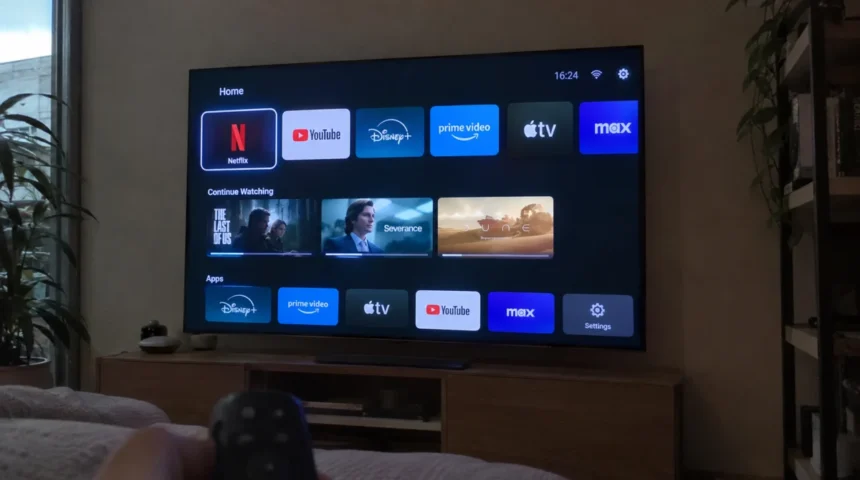
Smart television owners are increasingly pointing advanced artificial intelligence agents at their living-room entertainment systems to strip out intrusive sponsored advertisements, aggressive tracking software, and the sluggish, ad-heavy home screens that manufacturers ship by default.
The rising trend exploded across social media platform X over the weekend, quickly acquiring a popular moniker within the developer community: vibe coding your TV. What began as a frustrated developer’s weekend experiment has rapidly snowballed into a widespread movement, highlighting growing consumer exhaustion with smart appliances that monetize user attention long after the initial purchase.
The most widely shared case involved a Xiaomi-branded television owned by a developer’s parents. Gathin T. posted on Saturday that the set displayed an unavoidable sponsored advertisement before anyone could even navigate to Netflix. Giving Claude Code, Anthropic’s advanced coding agent, the exact television model number, he let the AI go to work.
The autonomous agent successfully located the television on his home Wi-Fi network, systematically switched off 25 embedded Xiaomi software packages, and wrote a brand-new home screen interface that, as he described it, looks remarkably like an Apple TV.
Anyone who has purchased a modern television over the past decade likely lives with a similar problem. Many contemporary sets run Automatic Content Recognition, commonly known as ACR. This background software fingerprints whatever appears on the screen—including live cable broadcasts, game consoles, and any external device plugged into an HDMI port—and reports that viewing data back to the manufacturer so the company can sell targeted advertisements.
The legal scrutiny surrounding these practices is intense. The State of Texas filed a major lawsuit in December 2025 against five major television manufacturers, including Sony, Samsung, LG, Hisense, and TCL. The legal complaint alleged that their smart TVs possess the technical capability to capture a screenshot of the user’s display every 500 milliseconds, or twice every second, raising serious privacy concerns.
Regulators have pursued these practices since at least 2017, when Vizio paid a $2.2 million settlement to resolve federal charges that it collected detailed viewing data from 11 million televisions without explicit user consent. That regulatory slap on the wrist did little to hurt the underlying business model. Walmart later acquired Vizio for approximately $2.3 billion in 2024, with corporate executives explicitly highlighting the television maker’s profitable and fast-growing advertising business as a primary driver of the acquisition.
In practical terms, the television a consumer purchases and pays for outright continues to generate ongoing revenue for corporate entities every single time it is turned on.
The concept of vibe coding—which involves describing a desired technical outcome in plain, conversational language and allowing an AI to write and execute the necessary code—was popularized by OpenAI co-founder Andrej Karpathy in 2025. Earlier this month, software hobbyists and gamers utilized Claude-based agents to reverse engineer video games, producing creative feats like embedding the entirety of Minecraft into Elden Ring.
Claude Code has emerged as a key ingredient in these living-room overhauls because the agent possesses the capability to type and execute commands directly on a user’s computer. Android-based televisions come equipped with the Android Debug Bridge, or ADB, a standard maintenance tool that allows a computer on the same local network to control the television once developer mode is unlocked by clicking the build number seven times in the settings menu.
The AI agent connects through that administrative door, generates a complete list of every installed application, and flags which programs serve advertisements or run telemetry, which is the background software that constantly phones home with detailed usage data.
Gathin packaged his custom prompts into an open-source project published on GitHub under the name cleanyourtv. Unlike destructive methods, the project strategically switches unwanted applications off rather than deleting them permanently, ensuring that a single restore script can return the system to its original factory state if necessary. The tool requires no root access, which is the risky process of unlocking full administrator control.
By Tuesday, the project had listed tested setups for 107 different television models spanning 37 distinct brands, collecting thousands of stars on GitHub. On his digital donation page, Gathin noted that a few thousand people had successfully replicated the process on their own household televisions within just two days.
Many users are pushing past simple debloating to completely reinvent their television interfaces. Mihir Gupta successfully replaced his television’s sluggish 192-megabyte stock launcher—the core application responsible for drawing the home screen—with a streamlined 83-megabyte custom alternative. Meanwhile, Ansub Khan reported that available memory on his parents’ aging Android TV rose by roughly 90 percent after running the AI-driven cleanup.
Ryan Doyle took a more experimental approach, sending Claude his television’s official product listing, asking if the agent could hack it, and ultimately ending up with a custom screensaver that displayed his live business revenue and recent Stripe payment notifications.
Other participants in the trend pushed the boundaries even further. Rod Pers swapped standard advertisements for a live, interactive 3D model of his apartment, configured so that physical smart lights and ceiling fans in his home switched on and off in real time. Adrian Friend constructed a minimalist user interface utilizing the vector animation tool Rive, while other users reported successfully cleaning up televisions for elderly family members who now prefer the simplified, ad-free experience.
A rival open-source project named dumbtv targets Amazon Fire TV devices, disabling approximately 65 internal software packages, including the controversial ACR tracking software, before installing a tiny 41-kilobyte launcher that operates without internet permissions. Its design philosophy is blunt: providing access to local user applications, HDMI inputs, a simple clock, and absolutely nothing else.
Compatibility varies significantly by manufacturer. Cleanyourtv functions reliably on Android TV and Google TV operating systems found in brands like Sony, TCL, Hisense, Philips, and Xiaomi. Samsung’s Tizen and LG’s webOS use entirely different proprietary operating systems, while Amazon’s Fire TV platform only permits partial cleanup.
For LG television owners, users have executed various debloating routines, though without the deep interface overhauls seen in the Android TV ecosystem. These efforts remain significant for privacy-conscious consumers, particularly given security research demonstrating how LG televisions can pinpoint user locations and collect voice conversations and other ambient data even when the sets appear to be powered off.
The trend is not without its risks. Not every AI-assisted modification has a successful outcome. One user reported that an autonomous agent bricked their television during a botched reboot attempt that accidentally uninstalled the core operating system, leaving them staring at an old Android recovery screen on a device that had effectively become an expensive paperweight. Another user became stuck halfway through a complex Fire TV modification process.
The documentation for cleanyourtv includes explicit warnings noting that network-based ADB connections are unencrypted and, depending on certain firmware versions, can allow any device connected to the same local Wi-Fi network to seize control of the television. Users are advised to disable debugging features once the modifications are complete.
Furthermore, AI coding agents are vulnerable to indirect manipulation; earlier this year, security researchers at Microsoft demonstrated that hidden instructions embedded in web content could trick Claude Code into exposing sensitive credentials, a security flaw that Anthropic subsequently patched.
As the open-source repository continued to spread across development communities, it had been forked more than 1,200 times by Tuesday, accumulating dozens of active pull requests from volunteer contributors looking to refine and expand the automated cleanup scripts.

Related News