What the NFL and Wall Street Can Teach Investors About Risk Management and Late-Cycle Realities
By RIA Team | October 14, 2026 | 6 min read
Diversification is often misunderstood as merely a tool for dampening volatility, but at its core, it is the deliberate practice of accepting a lower potential return to reduce structural risk and significantly increase the likelihood of reaching long-term financial goals. A striking parallel to this principle recently played out on the gridiron, offering a clear illustration of how misjudging risk in pursuit of maximum gain can jeopardize an otherwise secure position.

During a high-stakes National Football League matchup, the Tampa Bay Buccaneers held a commanding 24-10 lead over the Dallas Cowboys with just 8 minutes and 36 seconds remaining in the contest. Positioned comfortably ahead and facing a fourth-and-goal from the Cowboys’ one-yard line, the Buccaneers coaching staff confronted a strategic fork in the road. They could opt for a low-risk field goal to secure a three-point cushion, or they could gamble on a touchdown to push for a seemingly insurmountable lead.
The Buccaneers ultimately elected to go for the touchdown. While they managed to hold on for a narrow 24-16 victory, the decision sparked immediate post-game debate. Buccaneers head coach Todd Bowles candidly addressed the questionable play-calling during his press conference, acknowledging that he knew taking the three points was more than sufficient to win the game. Yet, by pushing for a higher score, the team nearly turned a near-certain victory into a tense, precarious finish.
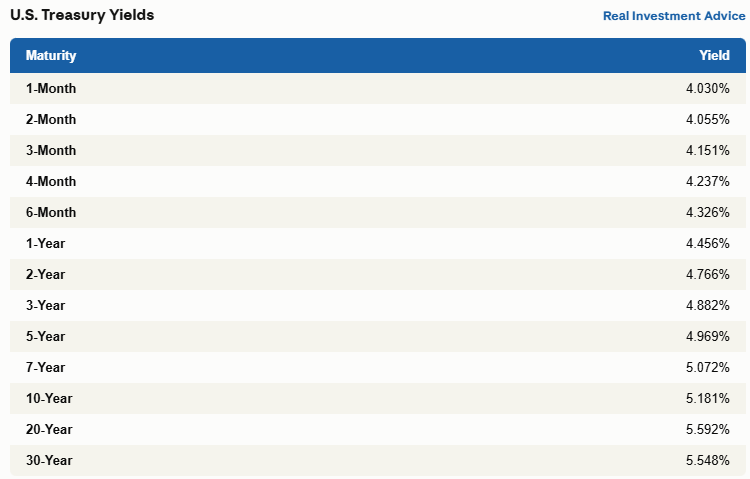
Individual investors face this exact strategic dilemma in today’s financial markets. For instance, a five-year Treasury note currently offers an attractive baseline return of 5%, with total potential returns climbing to roughly 9.4% if prevailing yields happen to fall by a full percentage point. Under this fixed-income scenario, yields would have to surge by a significant 116 basis points before a five-year buyer experiences any capital loss. Furthermore, investors who hold the bond all the way to maturity completely lock in that 5% annual yield. While equities may ultimately outperform fixed income over the long run, an investor who is already well ahead in the race to fund their retirement does not need to chase maximum margins or squeeze every last drop of alpha out of the market. Instead, their primary objective shifts from aggressive accumulation to capital preservation—simply put, they need to avoid losing.
This perspective is by no means an instruction to liquidate equities and flee entirely to the safety of bonds. Rather, it underscores the importance of properly calibrating your stock-and-bond asset allocation to account for evolving market risks and potential returns. Striking the right balance provides investors with a vastly superior statistical chance of winning the ultimate game: meeting their comprehensive financial objectives.
What To Watch Today
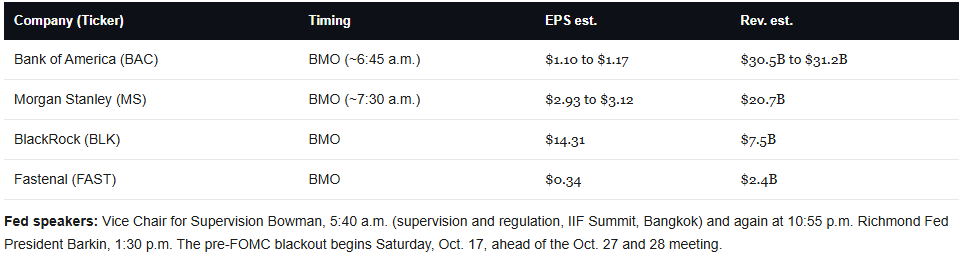
As the trading week progresses, market participants are keeping a close watch on a densely packed schedule of corporate earnings releases and critical macroeconomic data points. The ongoing earnings reporting season is rapidly shifting from headline-grabbing mega-cap technology names to foundational pillars of the broader economy, providing a granular look at corporate health, consumer resilience, and commercial credit conditions.
Market Trading Update
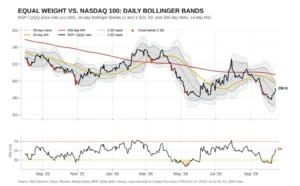
Recent market analysis highlights how narrow leadership from a handful of mega-cap stocks has pushed the equal-weight index to a three-year relative low. This divergence explains why portfolio managers have actively trimmed gains from outperforming tech giants and rotated capital into lagging market sectors. Tuesday’s major bank earnings reports placed one of those key laggards—the financial sector—under the microscope, revealing a corporate narrative far more split than the headline numbers initially suggested.
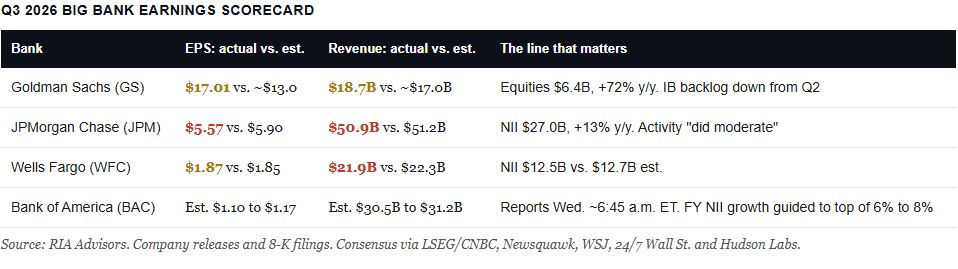
Goldman Sachs delivered blowout quarterly results, reporting earnings of $17.01 per share against Wall Street consensus estimates hovering near $13. A primary driver of the beat was a remarkable 72% year-over-year surge in equities trading revenue. Conversely, JPMorgan Chase posted a rare earnings miss, coming in at $5.57 per share compared to expectations of roughly $5.90. During the earnings call, Chief Executive Officer Jamie Dimon conceded that trading activity and corporate dealmaking had moderated somewhat during the quarter. Meanwhile, Wells Fargo managed to squeak past earnings expectations with $1.87 per share, though both overall revenue and net interest income came in somewhat soft.
A clear dichotomy has emerged within the financial sector. Institutions heavily tied to institutional trading desks, mergers and acquisitions, and capital markets financing are experiencing a temporary boom, while traditional commercial lenders continue to grind through thinner net interest margins. When Wall Street’s trading desks dramatically outpace Main Street’s traditional loan books, market historians note that investors are usually closer to the end of an economic cycle than the beginning. Reinforcing this late-cycle dynamic, Goldman Sachs disclosed that its investment banking backlog declined toward the end of June. Because that forward-looking pipeline is shrinking, it signals potential moderation in corporate advisory fees ahead.
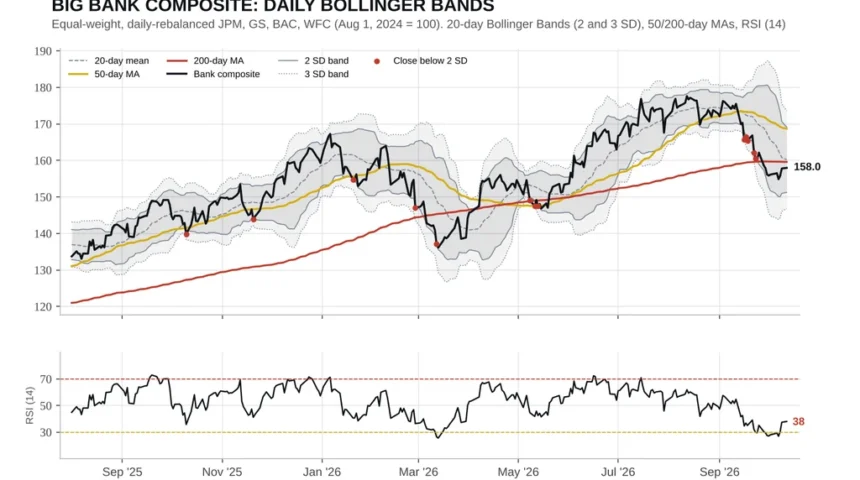
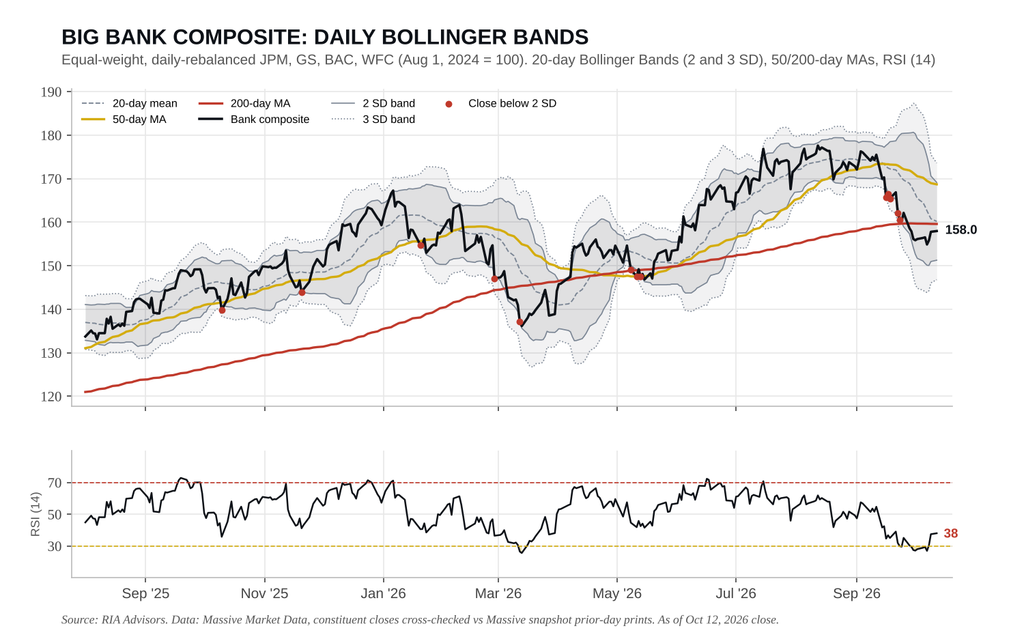
Skeptics frequently question why bank stock prices have effectively gone nowhere if these major institutions are posting near-record financial quarters. The answer lies in market timing; Wall Street had already priced the good news in by the middle of summer. An equal-weight composite index tracking major financial institutions including JPMorgan, Goldman Sachs, Bank of America, and Wells Fargo peaked on August 12 and subsequently pulled back significantly. The composite currently sits comfortably below its 50-day moving average and hovers just beneath its 200-day moving average, with relative strength index readings reflecting an oversold condition following a sharp dip.
Rather than arguing with technical price levels, disciplined market participants respect key moving averages as definitive boundaries. Within aggressive equity growth models, portfolio managers have selectively added to financial holdings ahead of earnings, favoring capital-markets-oriented firms over pure lenders while maintaining strict stop-loss orders just beneath recent swing lows. Such is the inherent nature of late-cycle earnings reports: the most impressive quarterly figures frequently arrive right before management issues more cautious guidance.
Banks Kick Off Earnings Season
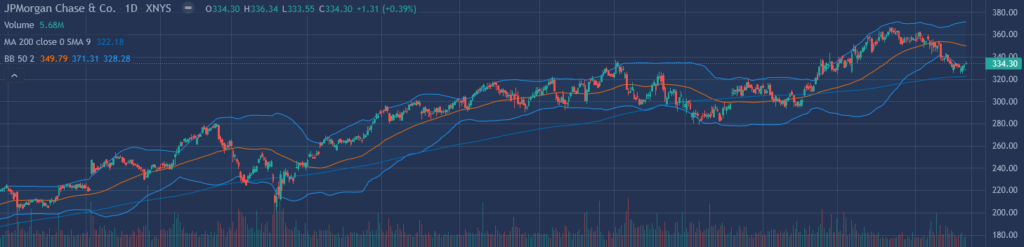
JPMorgan’s notable earnings miss on Tuesday showcased the complex mechanics of modern banking balance sheets. While the firm reported $5.57 per share against expectations of $5.90, its shares actually advanced in subsequent trading. The underperformance was entirely driven by accounting markdowns within its corporate investment portfolio resulting from higher bond yields and wider credit spreads, rather than any weakness in its core consumer or commercial loan books. Outside of the per-share earnings headline, the bank’s operational performance remained robust, featuring a 13% increase in net interest income and a quarterly net income of $15.3 billion, representing a 6% year-over-year gain.
Underlying credit metrics across the institution improved across the board. Provisions for credit losses fell by 19% compared to the same period last year, dropping to $2.7 billion. This reduction signals management’s underlying confidence in the health of its loan portfolio, an optimism reinforced by a drop in net charge-offs to $2.2 billion from $2.4 billion in the previous quarter and $2.6 billion a year earlier. Furthermore, credit card services experienced a notable drop in net charge-off rates, falling to 2.91% from 3.34% in the prior quarter and tracking well below management’s previous full-year guidance.

Goldman Sachs similarly impressed investors by posting an earnings per share figure of $17.01, handily beating the $13.07 consensus estimate. Total revenues advanced by 23%, spearheaded by the aforementioned surge in equities trading. The firm did, however, allocate a $368 million loss provision primarily driven by specific impairments on wholesale loans, mirroring a broader institutional trend.
A closer examination of these reports reveals that credit quality is not deteriorating at the consumer level. Credit card losses are actually declining at JPMorgan, which remains the nation’s largest card issuer. Instead, emerging credit concerns are increasingly concentrated at the commercial and wholesale levels, prompting major financial institutions to cautiously build up capital reserves against commercial real estate and corporate loan exposures.
CPI Preview
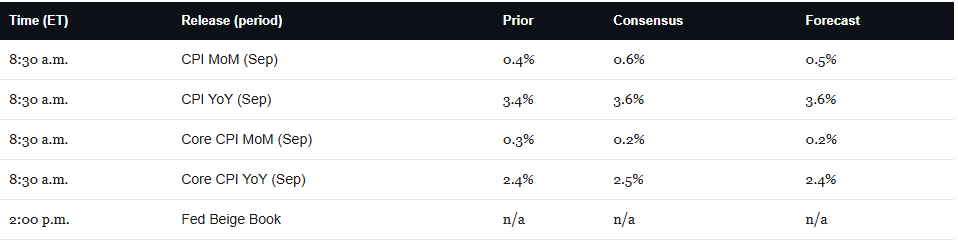
The monthly Consumer Price Index report serves as a major market catalyst, potentially dictating the policy path of the Federal Reserve at its upcoming monetary policy meeting. Wall Street economists entered the data release anticipating headline consumer inflation of 0.5% on a monthly basis and 3.6% annually, with core inflation expected to print at 0.2% monthly and 2.4% annually.
Federal funds futures markets have largely priced out expectations of an imminent interest rate hike. Implied probabilities for an October rate increase have receded significantly from levels seen weeks prior, following a cooler core Personal Consumption Expenditures price index reading and softer-than-expected monthly employment reports marked by substantial downward revisions to prior job gains.
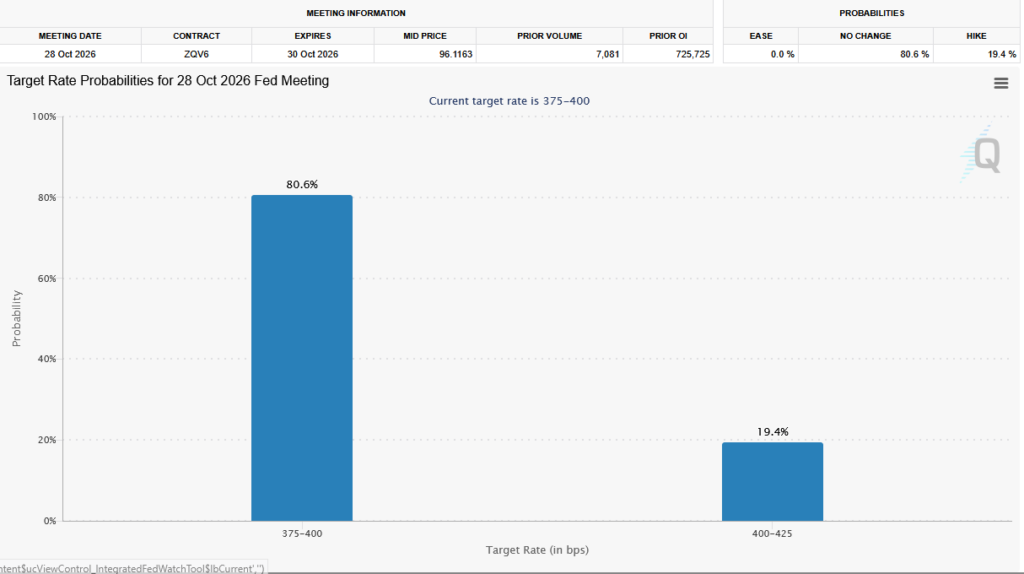
A core CPI print that meets or falls below consensus expectations would likely cement market sentiment and validate an anticipated rate pause by central bankers at the October meeting, shifting any subsequent rate-hike debates further out toward December. Conversely, a hotter-than-expected core print running at 0.3% or higher could disrupt prevailing interest rate projections, validating hawkish policymakers who argue that additional monetary tightening may still be necessary to completely subdue inflationary pressures. Despite anticipated high headline CPI readings largely driven by fluctuations in global energy prices, market participants and Federal Reserve officials are expected to look through commodity-driven volatility in favor of underlying core trends.

Related News