CoreWeave Debt Pressures Mount as AI Infrastructure Financing Faces a Reckoning
By RIA Team
October 16, 2026
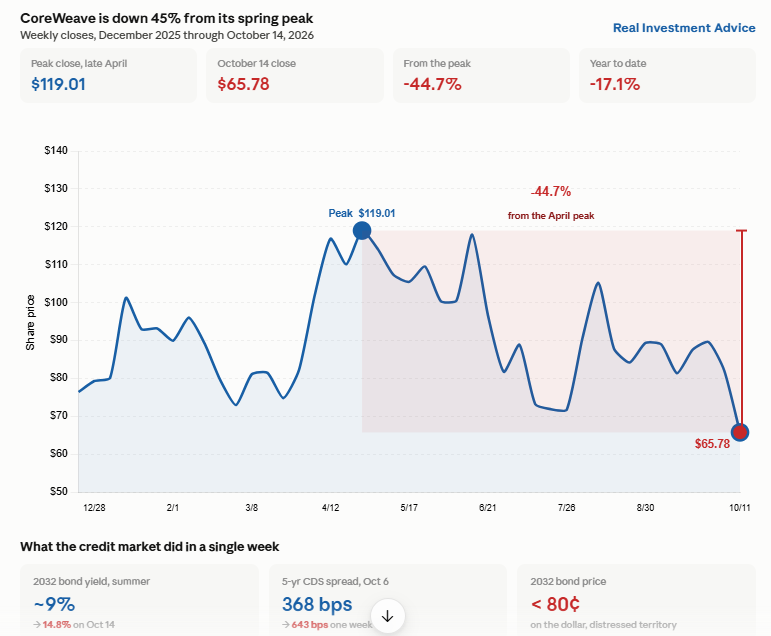
The cracks in the architecture of the artificial intelligence boom are beginning to widen, and nowhere is that more apparent than in the turbulent markets for neocloud debt and equities. CoreWeave, one of the high-flying specialized cloud providers powering the modern AI landscape, has seen its shares tumble by nearly 50% since April. The downward trajectory took an alarming turn on Wednesday, when the stock cratered another 15% in a single session.

More concerning to institutional credit markets than the equity sell-off, however, is the severe distress visible in CoreWeave’s debt instruments. The company’s 9.625% notes maturing in 2032 recently traded hands for less than 80 cents on the dollar, pushing their implied yield to nearly 15%. For context, those same notes were yielding below 10% just days earlier. Compounding the alarm, the company’s five-year credit default swap (CDS) spreads nearly doubled within a single week, surging from 368 basis points on October 6 to 643 basis points. Based on these surging CDS spreads, the market now prices in an approximate 35% probability that the company could default on its obligations within a five-year window.
The timing of these rapidly escalating funding costs presents a profound structural dilemma. CoreWeave carried roughly $35 billion in total debt alongside $5.5 billion in cash at the close of June, with combined debt and lease obligations hovering near $52 billion. The neocloud provider faces $4.4 billion in debt maturities through the remainder of this year, followed by another $6.2 billion coming due in 2027. With borrowing costs hovering around 15%, refinancing that debt load is likely no longer economically feasible. Meanwhile, issuing new equity to raise capital remains a deeply unattractive option given the severe downward momentum of the company’s share price.
Despite the mounting financial pressures, leadership remains publicly steadfast. CEO Mike Intrator recently addressed employees in an internal communication, asserting that management is confident in a robust backlog that more than supports all outstanding debt obligations, pointing specifically to $104.2 billion in contracted revenue. While an order backlog represents a formidable source of future revenue, market analysts note that it may not convert to cash rapidly enough to service immediate liquidity needs.
The mounting anxiety surrounding CoreWeave is part of a broader reassessment of the neocloud business model. Recent commentary from prominent IT advisory firm Gartner added fuel to the fire, warning that more than 80% of neocloud providers, including CoreWeave, could cease independent operations by 2030. As financial headwinds intensify, market observers are increasingly left wondering whether a corporate white knight—such as premier chip designer Nvidia—might eventually step in to orchestrate a rescue.
What To Watch Today
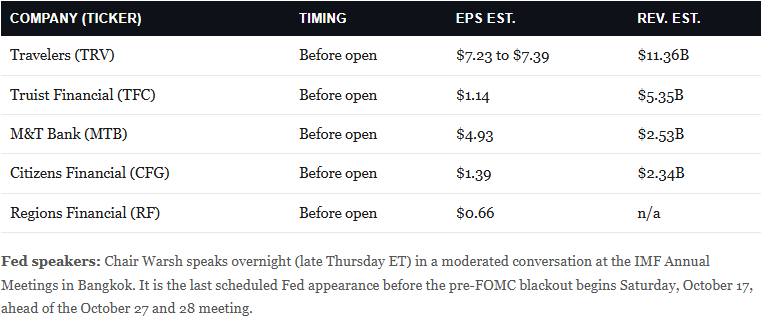
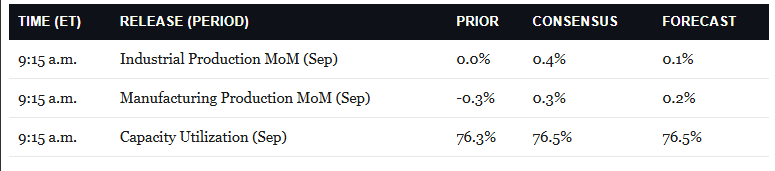
As markets digest the broader implications of the neocloud distress, attention turns to the ongoing corporate earnings reporting season and a busy economic calendar that threatens to test the resilience of equity valuations.
Market Trading Update
The broader equity market is navigating a delicate fundamental environment. Recent discussions have centered on the stark earnings divergence within the banking sector, pitting high-flying trading desks against traditional lenders. Furthermore, the persistent narrowness of market leadership has left equal-weight indexes lingering near three-year relative lows. The central question for investors is whether underlying fundamentals can sustain the broad market rotation that began earlier in the month.
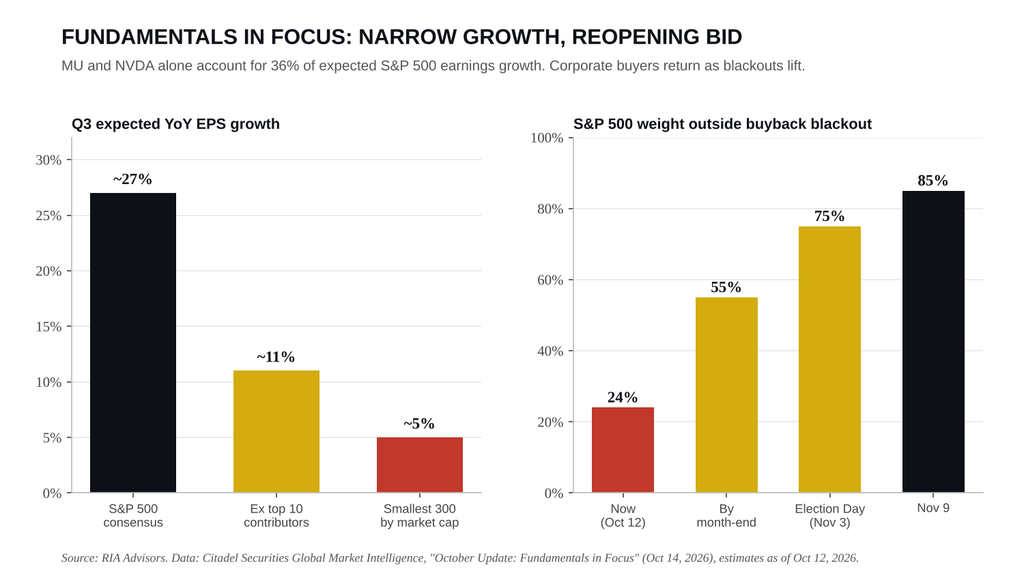
On the positive side, consensus expectations point to approximately 27% S&P 500 earnings growth for the third quarter, representing the third-highest hurdle entering a reporting season since 2010. Historically, companies have beaten pre-season estimates in 19 of the last 20 quarters, with estimates actually ticking up 1.6% heading into the reporting window. Additionally, corporate share buybacks are poised to resume as blackout periods lift. Only 24% of index weight remains restricted from buybacks, a figure projected to climb to 55% by month-end and reach 85% by November 9.
However, a closer look at the composition of that growth reveals underlying vulnerability. Micron and Nvidia alone account for 36% of expected earnings growth, with the top ten contributors responsible for roughly two-thirds of the total. Stripping those top ten names away drops overall growth to approximately 11%, while the smallest 300 companies in the index are expected to post a modest 5% earnings increase. This fundamental disparity explains why equal-weight portfolios have struggled over recent months.
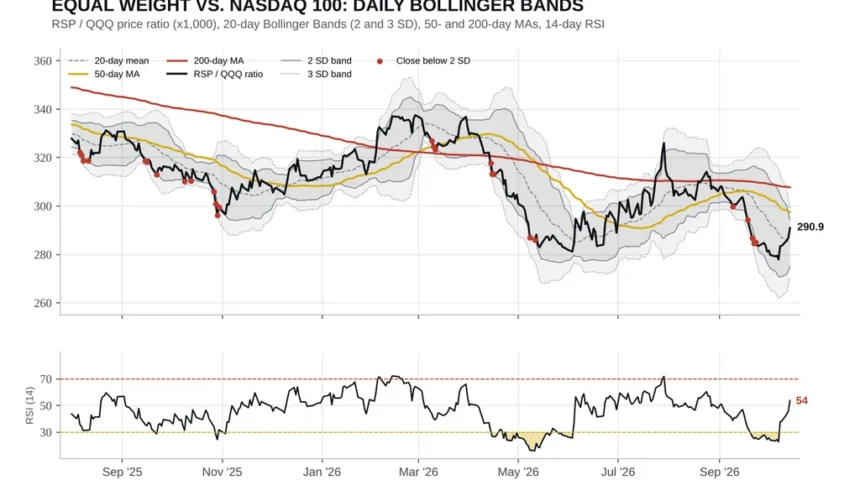
Market ratios have reflected this tug-of-war. The equal-weight to tech-heavy index ratio slid roughly 11.5% from late August to its October 7 low, touching levels not seen since April 2000. Although the ratio has since bounced by 4.7%—with the Relative Strength Index (RSI) climbing from below 30 to 54—it still sits below both its 50-day and 200-day moving averages, distinguishing the recent movement as a technical bounce rather than a definitive trend change.
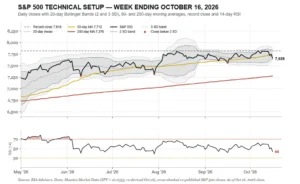
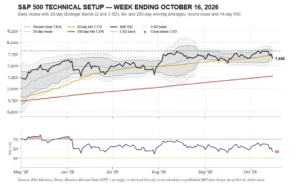
Mid-week trading introduced further complications when a hotter-than-expected September Consumer Price Index (CPI) print triggered a sharp pullback, knocking the S&P 500 down 1.08% and the Nasdaq 100 down 2.02%. That decline abruptly ended a streak of more than 50 consecutive sessions without a 1% daily drop. Concurrently, retail investors poured $2.6 billion into semiconductor equities last week, marking a 96th-percentile reading in sentiment extremes. When retail capital concentrates heavily in the few specific names carrying the entire market’s earnings math, any stumble in those leaders impacts both the broader index and retail portfolios simultaneously.
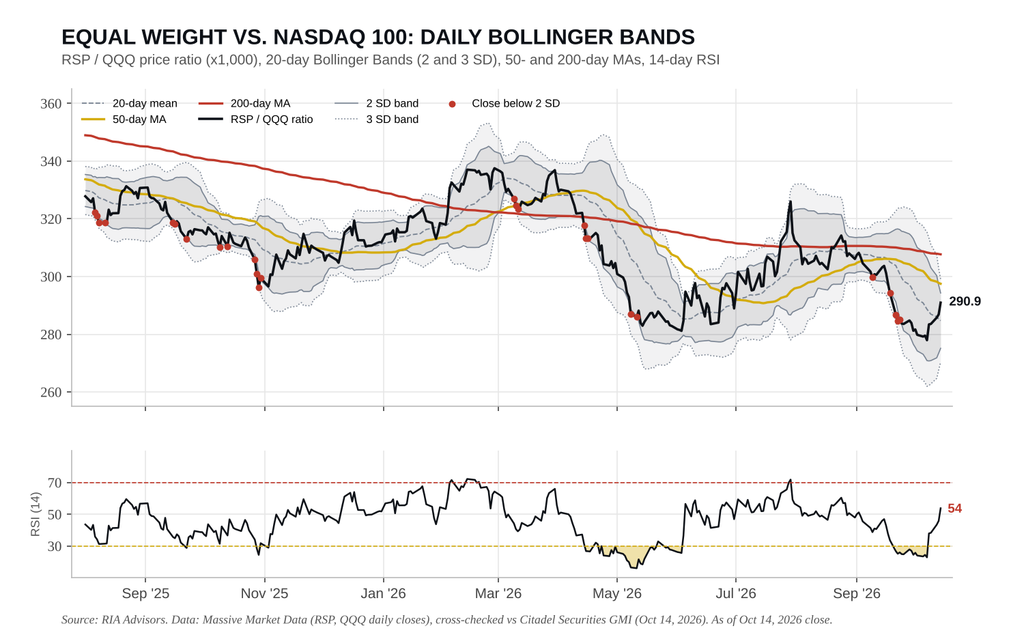
Market historians often recall Bob Farrell’s seventh rule of investing, which notes that markets are structurally strongest when breadth is wide and weakest when narrow. Historical analogs suggest that fewer than half of similar technical rebounds from extreme relative lows manage to sustain their momentum over the subsequent month. Prudent risk management under these conditions involves trimming overextended mega-cap exposure to target weights while selectively adding to lagging groups on technical pullbacks rather than chasing upward momentum.
The Other Side Of The CoreWeave AI Trade
While CoreWeave’s financial distress illustrates the acute bear case for certain segments of the artificial intelligence trade, the earnings report from Taiwan Semiconductor Manufacturing Company (TSMC) underscores the enduring bull case. As the world’s largest contract chipmaker, TSMC manufactures the advanced processors engineered by tech giants like Nvidia, Apple, and AMD. Its shares trade primarily on the Taiwan Stock Exchange, with American Depositary Receipts listed on the NYSE.

TSMC posted third-quarter revenue of $46.72 billion, comfortably beating consensus estimates of $45.7 billion and marking a 41.1% increase year-over-year. The company reported a robust gross margin of 66.4% alongside a 68.7% surge in net income. Furthermore, its revenue guidance for the fourth quarter, pegged between $52.3 billion and $54.3 billion, easily outpaced analyst expectations.
Despite these stellar fundamental metrics, broader chip stocks retreated, still weighed down by the contagion effect of the CoreWeave narrative. International markets registered sharp declines in sympathy, with South Korea’s Kospi dropping 8% to trigger temporary trading halts, Japan’s Nikkei falling nearly 5%, Taiwan’s Taiex losing 3%, and TSMC shares pulling back 2%.

The overarching takeaway from the juxtaposition of CoreWeave and TSMC is that end-user demand for underlying semiconductor technology remains extraordinarily robust. Instead of a wholesale repricing of structural chip demand, the market is actively repricing the speculative debt financing structures supporting the broader AI infrastructure buildout and evaluating which industry participants possess the balance sheet strength to survive.
PPI And Retail Sales Support Another Rate Hike
Macroeconomic data released during the week further complicated the monetary policy outlook. September headline Producer Price Index (PPI) rose 1.3%, more than double the 0.5% consensus forecast and lifting the annual inflation rate to 6.3% from 5.6%. This marks the largest yearly gain since May 2022, heavily influenced by surging energy costs, including diesel prices that climbed more than 70% over the previous year. Even when stripping out food, energy, and trade services, core PPI rose 0.5% on a monthly basis and 5.0% annually, outpacing the 0.2% monthly estimate.
Concurrently, retail sales rose 0.8%, topping the anticipated 0.4% gain. However, a deeper examination reveals that the expansion was heavily driven by gasoline expenditures. Excluding automobiles and gasoline, retail sales advanced by a modest 0.2%. The retail control group, which feeds directly into gross domestic product calculations, inched up just 0.1%. Because both figures lagged behind the prevailing rate of inflation, real consumer spending on non-energy goods and services actually contracted in September.
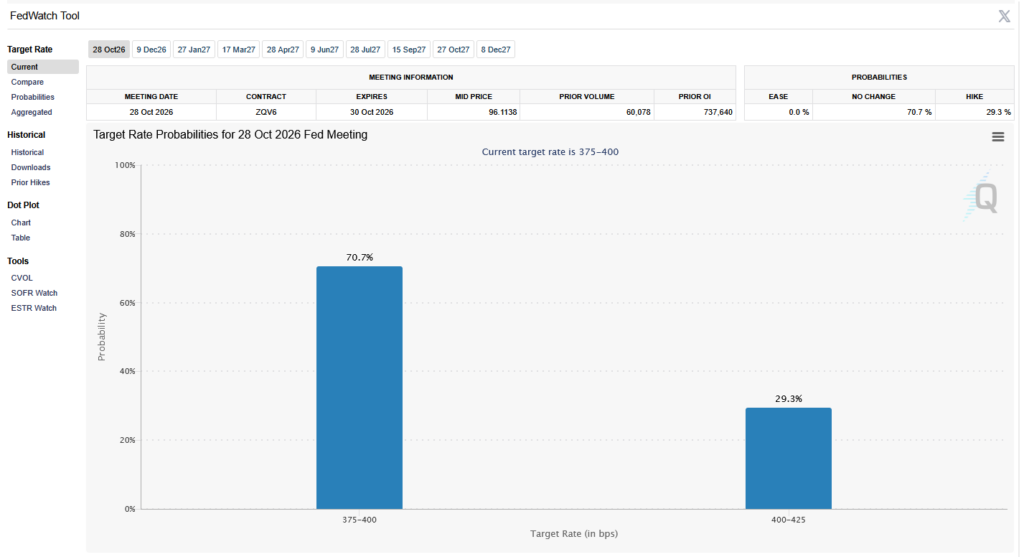
This combination of sticky consumer price inflation, surging producer costs, and consumer resilience propped up solely by energy inflation presents a challenging backdrop for the Federal Reserve. With upcoming policy meetings on the horizon, market participants are weighing whether persistent inflationary pressures will force further monetary tightening, even as fed funds futures continue to price in a relatively low probability of near-term rate hikes.

Related News