Stock-Bond Correlation: Oil Broke the Hedge, but History and Fundamentals Suggest Oil Will Fix It
By Lance Roberts
October 24, 2026 — 19 min read

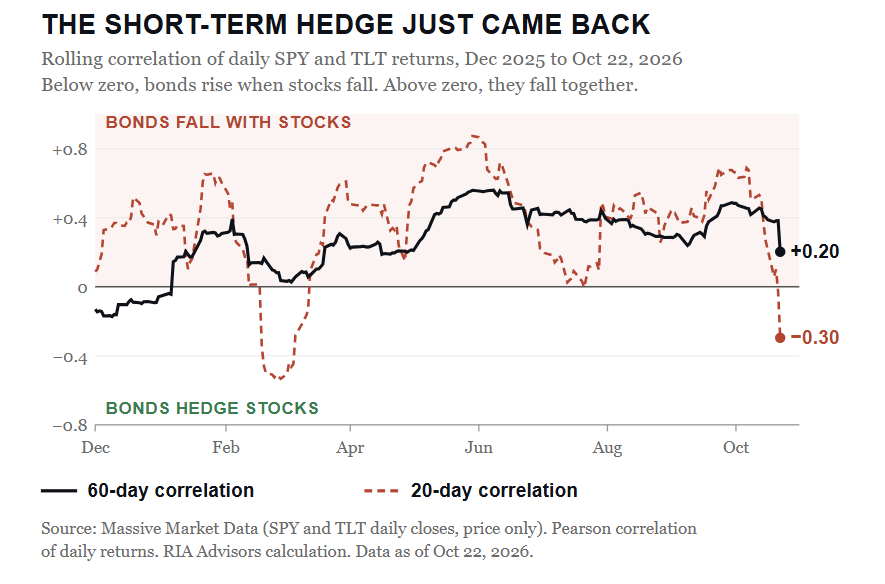
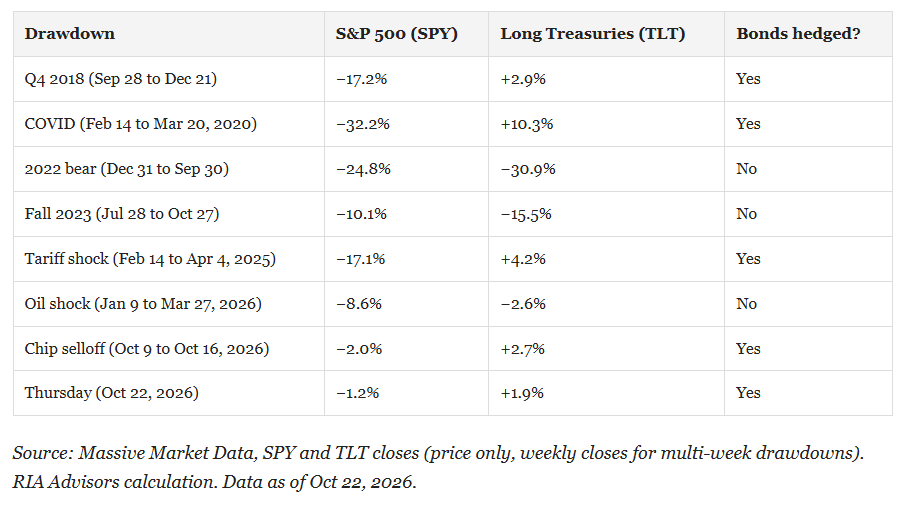
The stock-bond correlation has broken twice in four years, and on both occasions, the underlying culprit was inflation driven by the supply side. When that specific brand of inflationary pressure eventually fades, the traditional defensive hedge predictably returns. Last week provided the financial markets with their first tangible look at that dynamic reasserting itself.
Market Brief: Earnings Season Opens on a Raised Bar
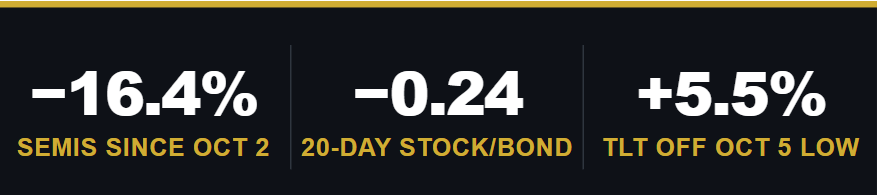
The headline narrative behind this week’s technology sector rout quickly fixed on Meta. The social media giant posted a strong earnings beat, but followed it with a startling disclosure: it had experienced its first cash outflow in more than a decade as heavy capital expenditures on artificial intelligence outpaced cash inflows. Furthermore, Meta announced a two-for-one stock split alongside an issuance of non-voting shares designed to help fund its sprawling infrastructure buildout. The market reaction was swift. Meta shares dropped 7% on Thursday, dragging the Philadelphia semiconductor index down by 6.7%. The Nasdaq Composite suffered its worst single-day performance since early June.
By Friday, rising commodity pressures compounded the strain as Brent crude settled at $116.72 per barrel, marking a fresh six-month high. Despite the turbulence, the S&P 500 finished the week at 7,623.68, down a modest 0.4% for its second consecutive weekly loss. The Dow Jones Industrial Average, insulated from the tech-heavy selloff, managed a gain of about 1.4%.

Investors relying solely on mainstream headlines might easily conclude that Meta’s cash flow statement shattered the broader artificial intelligence narrative overnight. In reality, the selloff did not require Meta to trigger it; the market simply required a catalyst, and Meta conveniently supplied one.

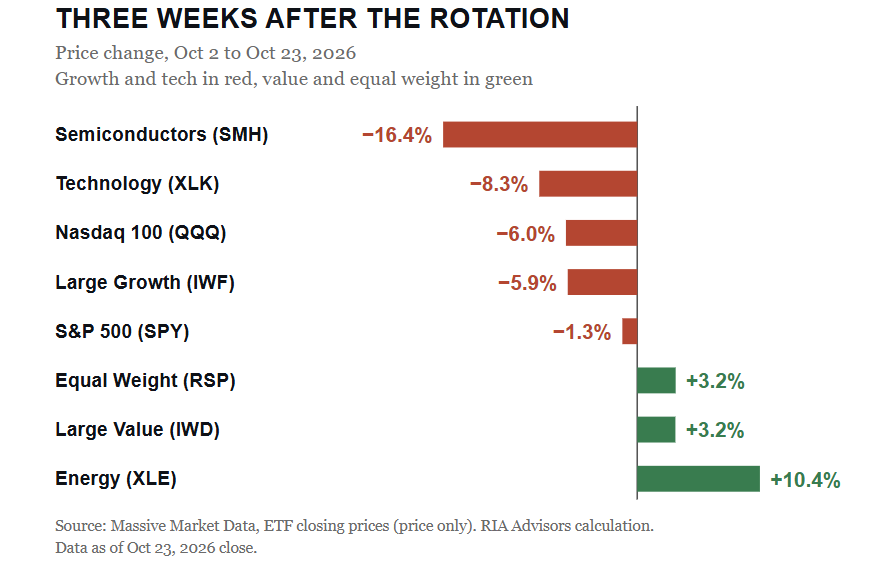
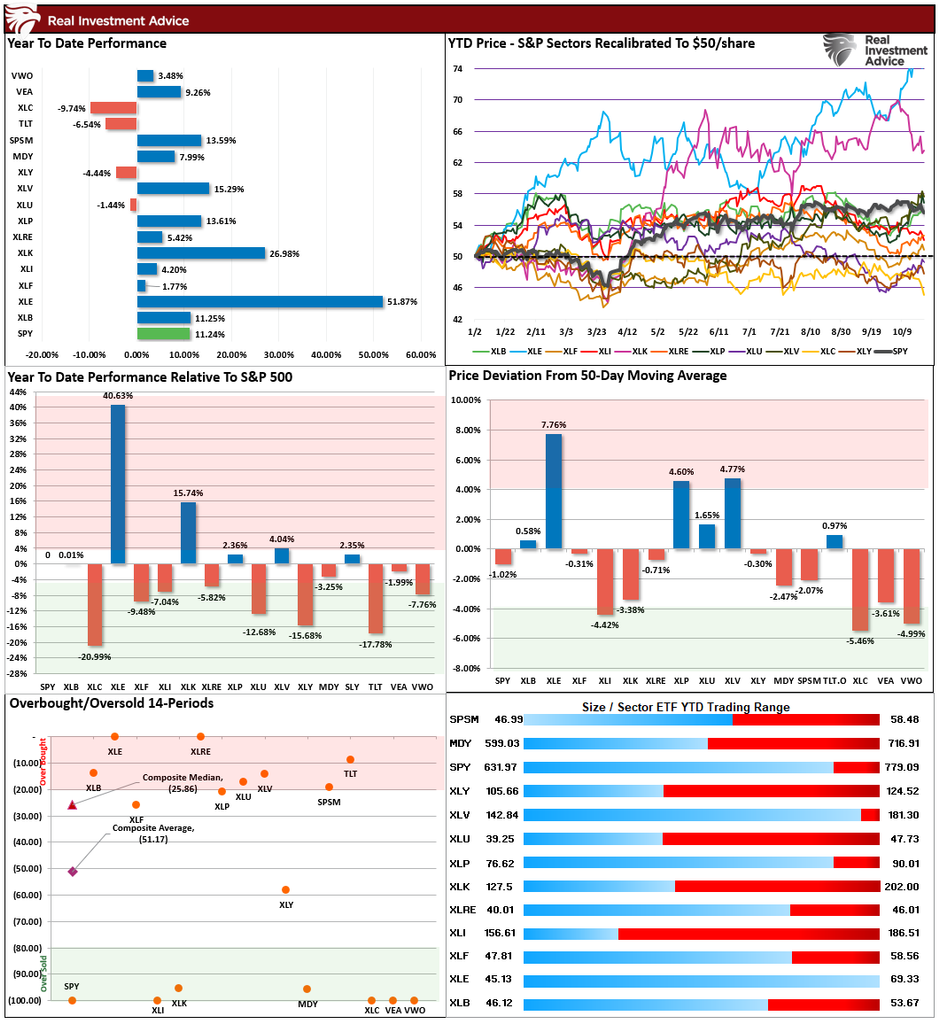
The structural setup for a pullback had been clearly visible weeks prior. Earlier in the month, technology allocations sat comfortably in the 96th percentile of the past five years, leaving the sector severely overbought. Recognizing those extreme technical divergences, portfolio managers rebalanced sector rotation models toward value-oriented equities while systematically taking profits in high-flying growth factors. On October 2, the technology sector ETF traded more than 7% above its 50-day moving average, accompanied by a relative strength index near 69. Semiconductors traded more than 10% above their respective 50-day average. Per classic market principles, stretched valuations eventually revert to their historical means, frequently doing so much faster than market participants anticipate.

Since that initial rotation, technology and semiconductor exchange-traded funds experienced notable contractions, while equal-weight indices, large-cap value, and energy sectors posted meaningful gains. This movement reflects a healthy market rotation rather than a broad, indiscriminate liquidation of risk assets.
As the correction deepened, technology valuations began approaching more reasonable territory, though not yet reaching absolute washout extremes. Cross-asset indicators showed the 10-year Treasury yield hovering near 4.99% following a notable bond market rally, while the Cboe Volatility Index closed at 19.70 and expectations for an imminent Federal Reserve rate hike softened. Such is the nature of cyclical rotations: they often feel like a localized crisis in the sectors experiencing profit-taking, and a permanent solution in the sectors capturing capital, right up until positioning flips.
Technical Backdrop: MACD Turns Up Just Below the Record
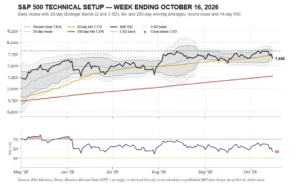
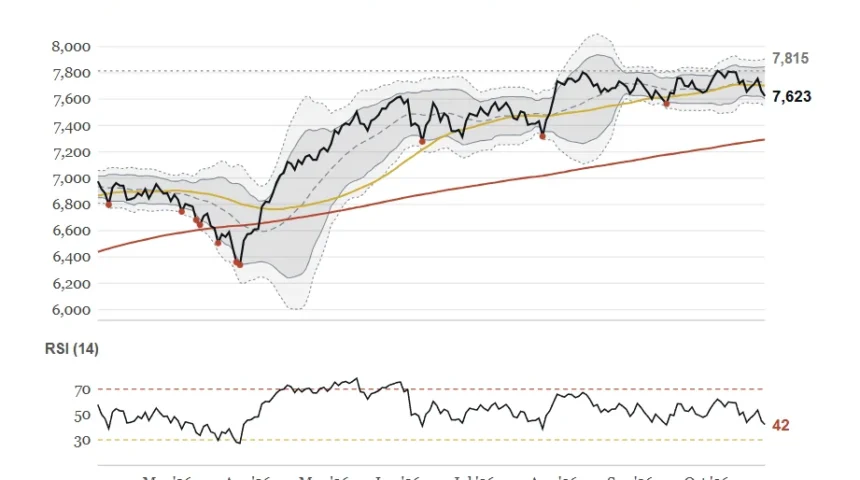
The S&P 500 closed out the week just 2.4% below its record close recorded earlier in the month near 7,815. The index currently rests just beneath its 50-day moving average and directly upon its 100-day moving average, while maintaining a comfortable cushion above its longer-term 200-day moving average. Consequently, the primary macro uptrend remains entirely intact. Furthermore, Friday’s close landed just above the lower two-standard-deviation Bollinger Band, a technical threshold that previously marked short-term market troughs across the year.

Market momentum indicators continue to validate the ongoing selling pressure. The 14-day relative strength index sits in neutral territory while continuing to edge lower, and the moving average convergence divergence indicator has slipped below its signal line, establishing a short-term sell signal that typically caps near-term rallies until a bullish crossover materializes. Crucially, these momentum readings have not yet reached oversold extremes on the headline index, indicating that the broader market has not completed the corrective process experienced by the technology sector.
Sector breadth paints a complementary picture. While a handful of defensive sectors extended their gains, leadership groups became heavily crowded trades, whereas lagging sectors established potential setups for a durable rebound. Upcoming macroeconomic releases and heavy corporate earnings reports will ultimately determine whether this technical support holds firm. With a substantial portion of the S&P 500 set to report earnings alongside a critical monetary policy announcement, the market sits at an important technical crossroads. If key support levels hold and major technology firms demonstrate tangible returns on their artificial intelligence investments, oversold growth shares possess ample room for a powerful relief rally. Conversely, a decisive break below major moving averages would likely invite a deeper test of late-summer lows.

Key Catalysts Next Week
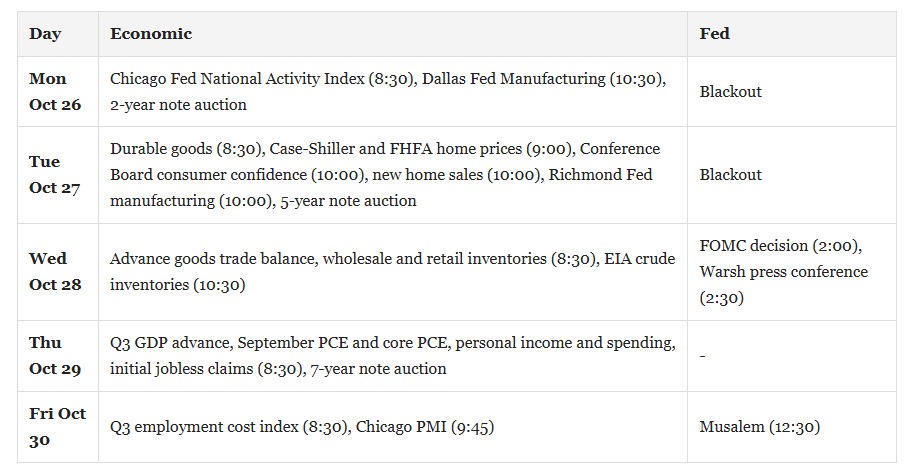
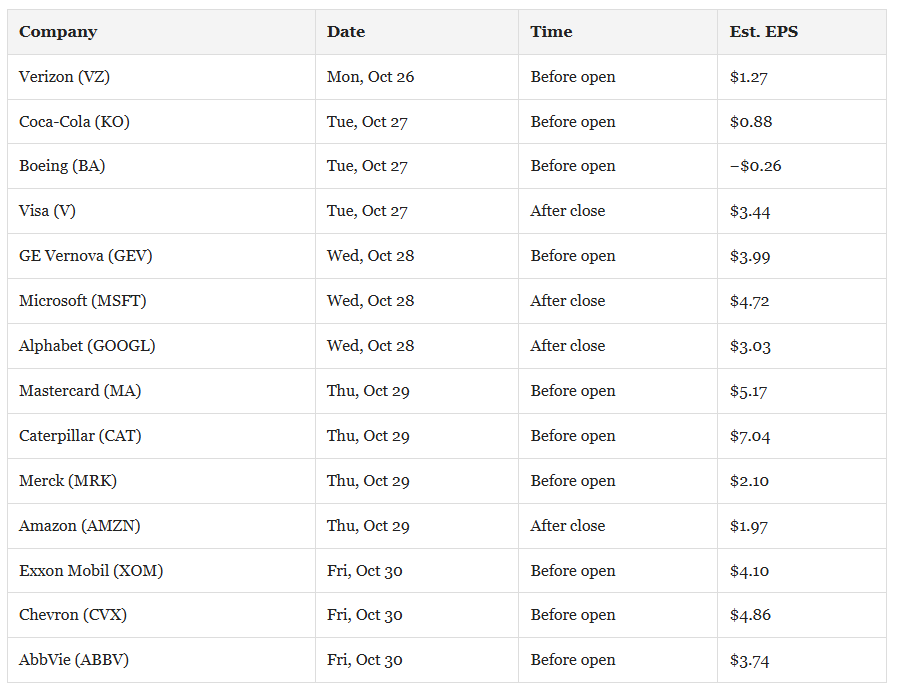
The upcoming week delivers one of the busiest stretches of the corporate earnings calendar, colliding directly with a high-stakes Federal Reserve policy meeting. Nearly half of the S&P 500 by market capitalization is scheduled to report quarterly financial results, with several mega-cap technology stalwarts releasing numbers within a compressed 24-hour window. Following Meta’s recent disclosures, market scrutiny has intensified. Investors are no longer merely asking whether major corporations are spending aggressively on artificial intelligence infrastructure; they demand immediate proof that those capital outlays are generating measurable cash flows. The broader market has demonstrated that it is currently unwilling to extend the benefit of the doubt.
Concurrently, the Federal Reserve will announce its latest monetary policy decision, accompanied by the traditional post-meeting press conference. Financial markets widely anticipate a pause in interest rate adjustments following previous adjustments, though market pricing remains sensitive to subtle shifts in central bank rhetoric. Persistent commodity price pressures and elevated energy costs complicate the policy outlook, raising the possibility that higher long-term bond yields could persist if inflation metrics surprise to the upside.
Economic data releases later in the week will provide a comprehensive snapshot of consumer health, economic momentum, and persistent cost pressures. Third-quarter gross domestic product estimates, personal consumption expenditures inflation metrics, and employment cost index readings will offer crucial clarity on whether inflationary impulses are steadily filtering through to broader labor costs. If underlying wage growth remains contained, the argument supporting temporary supply-side inflation gains traction, bolstering the case for a more accommodative monetary policy stance over the medium term.
Stock-Bond Correlation: Oil Broke the Hedge, and Oil Will Fix It
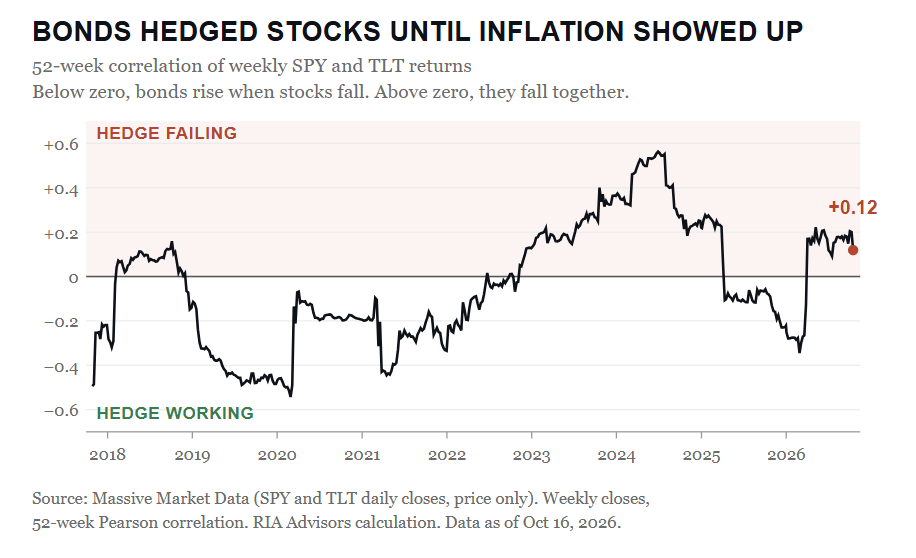
A recurring source of frustration for asset allocators in recent years has been the occasional breakdown of the traditional stock-bond correlation. In a classic balanced 60/40 portfolio, fixed-income allocations are designed to appreciate when equities experience severe drawdowns, cushioning overall portfolio volatility. For decades, this inverse relationship functioned reliably. However, the resurgence of inflationary pressures in the post-pandemic era fundamentally altered cross-asset dynamics.
Research published by Federal Reserve economists highlights that the historical negative correlation between U.S. stock returns and changes in the 10-year Treasury yield flipped during periods of acute inflation. When price stability gives way to persistent inflation, bonds and equities frequently decline in tandem, confounding investors who rely on fixed income as a foolproof portfolio insurance policy. This phenomenon was vividly illustrated during the market downturns when traditional balanced portfolios experienced synchronized losses across both asset classes.

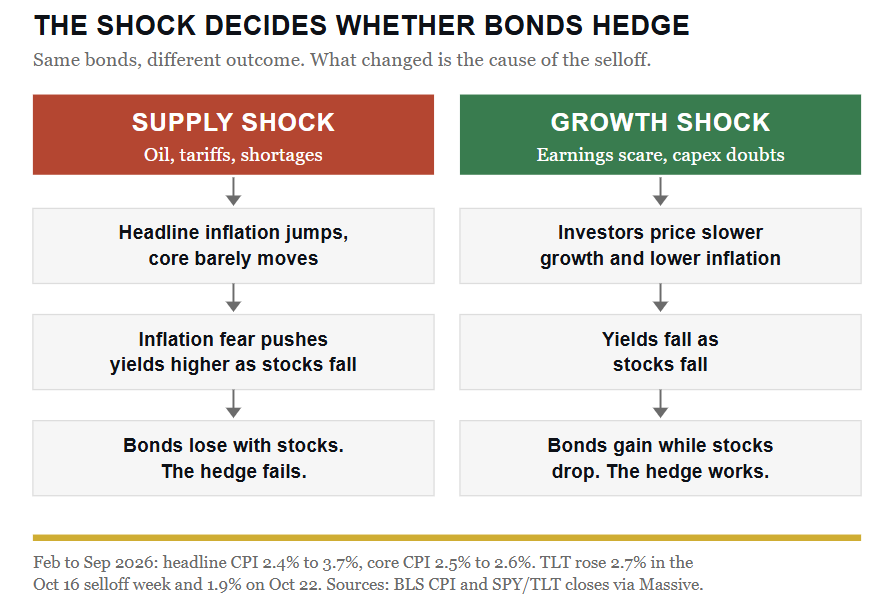
However, historical analysis reveals an important nuance that critics of fixed income frequently overlook: when inflationary pressures subside, the traditional hedging property of bonds reliably returns. The core issue lies in distinguishing between the root causes of inflation. Inflation driven by supply-side shocks—such as sudden spikes in global energy prices—tends to burn itself out organically because it is not accompanied by a corresponding rise in disposable consumer income. When gasoline and utility costs surge without a matching increase in wages, consumers are forced to curtail discretionary spending elsewhere. This demand destruction eventually cools economic activity, choking off the very price spikes that initiated the cycle.

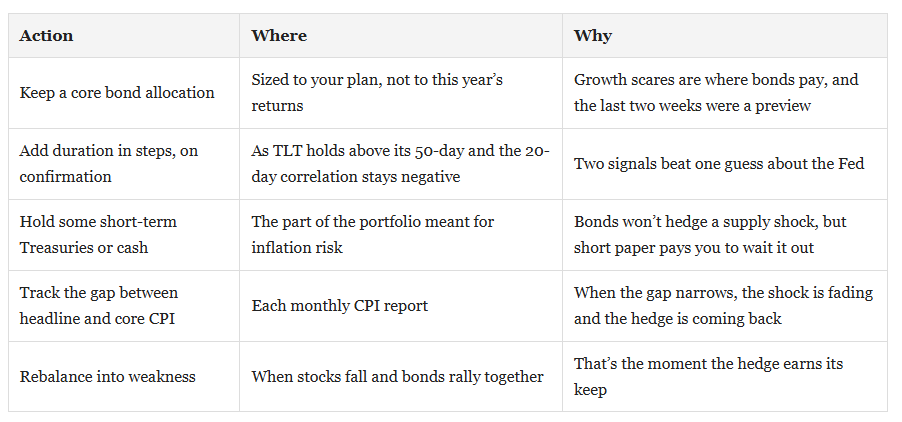
Consequently, long-term government bonds do not serve as a direct hedge against raw inflation; rather, they act as an effective hedge against the economic slowdown and growth damage that severe supply-side inflation eventually triggers. As the current energy shock eventually moderates and economic growth normalizes, the historical negative correlation between equities and fixed income is expected to reassert itself, restoring the protective function of the bond sleeve within a diversified portfolio framework.
Market participants navigating the current environment are encouraged to maintain a disciplined, risk-managed approach. Rather than abandoning traditional portfolio diversification out of frustration with recent performance, investors should ensure that asset classes are properly sized for their specific roles, allowing fixed income to fulfill its primary mandate of buffering against growth shocks while remaining mindful of ongoing technical developments across global equity and debt markets.

Related News