ARK Invest and Glassnode Release Comprehensive Report Mapping Bitcoin, Ethereum, and Solana on the Decentralization Spectrum
The perennial debate over whether a blockchain is truly decentralized or centralized often suffers from a false binary. In practice, decentralization is not a simple either-or proposition; rather, it is a nuanced spectrum shaped by every architectural choice a network makes. From block sizes to complex staking models, every design decision positions a blockchain somewhere along this spectrum, and every position entails a specific set of operational and security tradeoffs.
To bring quantitative clarity to this ongoing discussion, investment management firm ARK Invest and blockchain data platform Glassnode have released a joint report titled The Decentralization Spectrum: Design Tradeoffs In Digital Assets. The comprehensive study examines the world’s three largest blockchain networks—Bitcoin, Ethereum, and Solana—through four core design features: auditability, security, governance, and ownership. By applying a rigorous six-dimension scoring framework built on data from Glassnode and a wide range of external network sources, the report maps out where each network genuinely stands.
One Spectrum, Four Design Features
Decentralized and centralized architectures weight fundamental design features in drastically contrasting ways. A fully auditable network allows any participant to independently verify the underlying ledger by simply running a full node. Meanwhile, a distributed consensus mechanism raises the real-world coordination costs that any malicious adversary must bear to compromise the system. Furthermore, community-driven governance precludes unilateral upgrades by select factions, while widely dispersed ownership prevents any insider group from dominating critical decision-making processes.
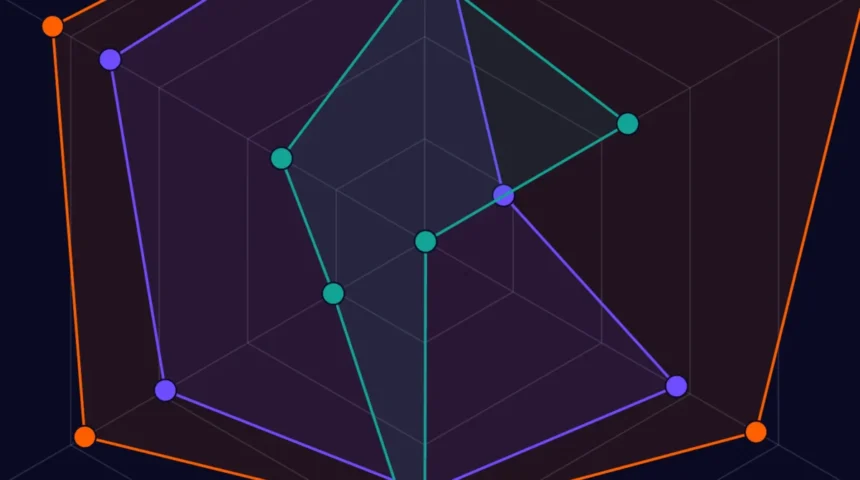
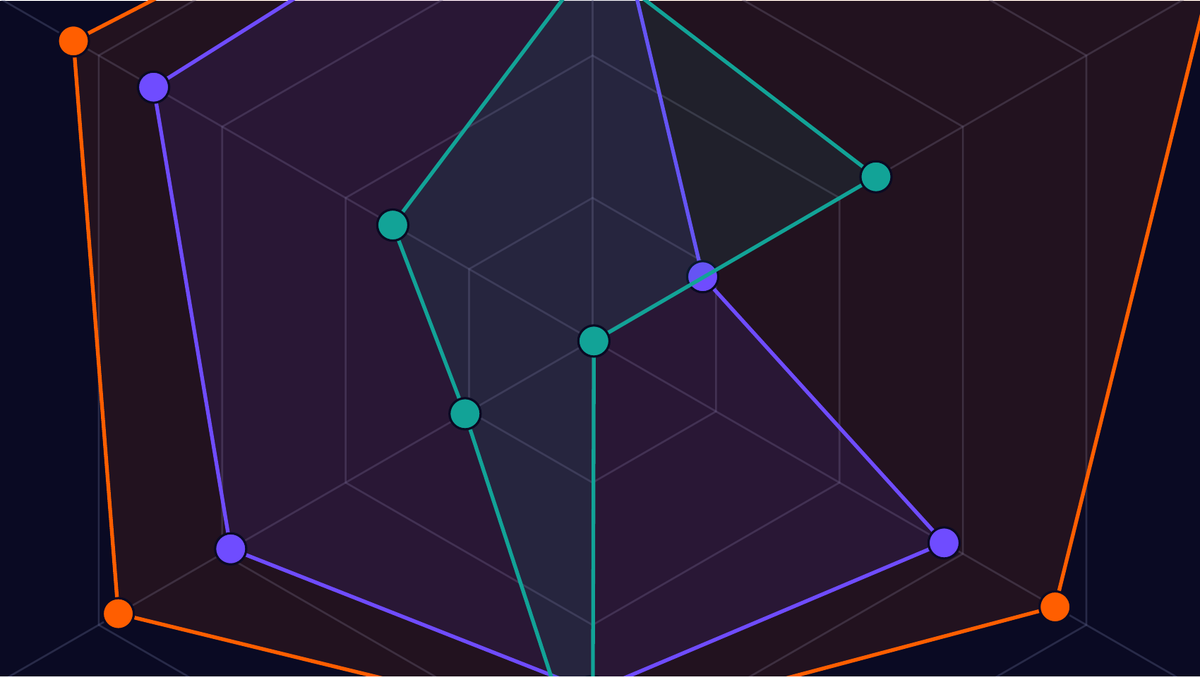
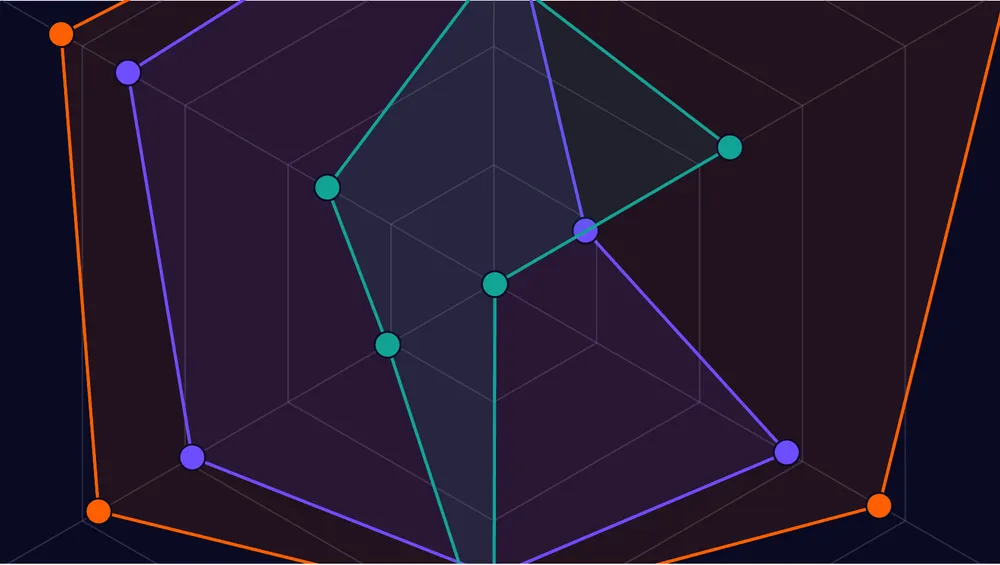
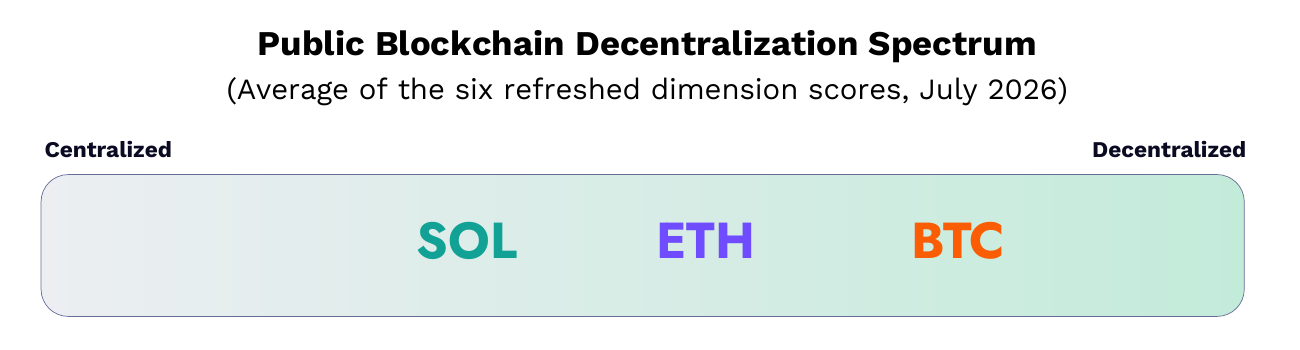
When the report aggregates and averages the scores across all six dimensions, the "Big Three" blockchains fall into a clear, distinct order along the spectrum. No single network manages to dominate every category, highlighting the inherent engineering compromises required to build scalable distributed systems. Bitcoin emerges as the leader in auditability, ownership distribution, and geographic resilience. Ethereum occupies a balanced middle ground, while Solana deliberately trades certain degrees of decentralization for maximized performance and rapid coordination speed.
Who Really Controls Block Production?
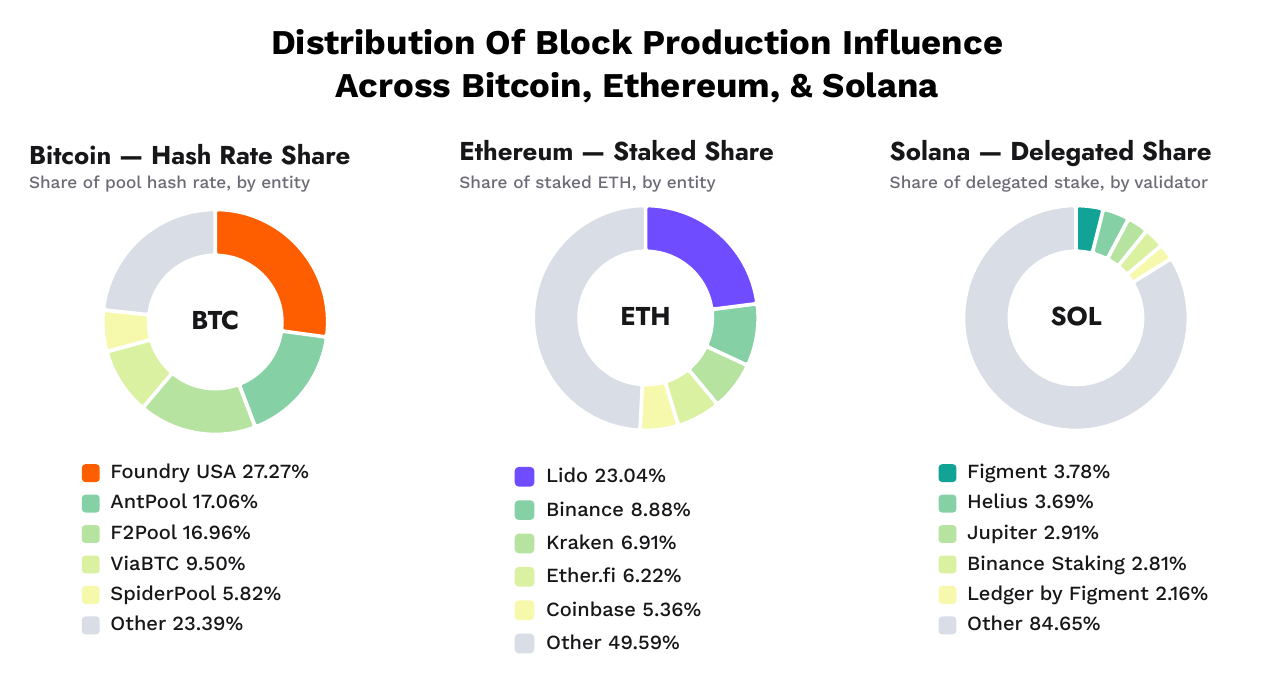
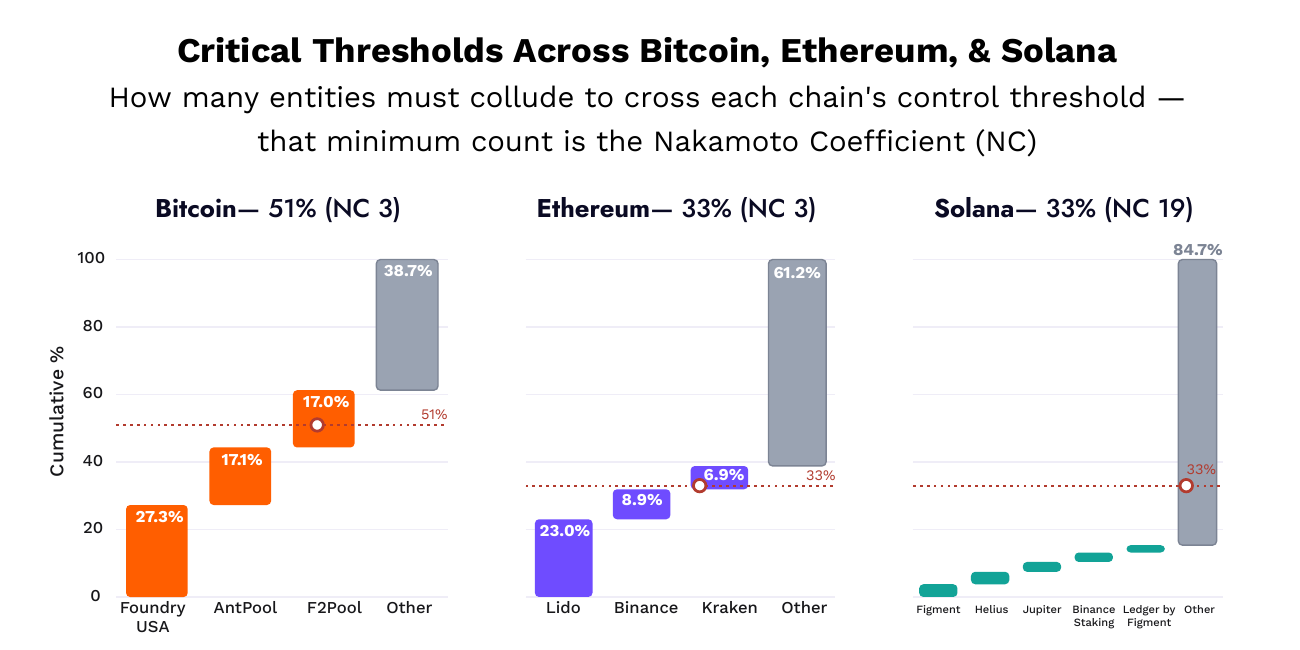
At the heart of network security lies a fundamental question: how many independent parties would need to actively collude in order to alter the historical ledger? To answer this, the report evaluates multiple variables, including the concentration of hash rates and staked capital, the capital required to acquire a 1% stake in each network, exit fluidity, and client diversity.
The findings challenge several common assumptions held across the crypto industry. For instance, both Bitcoin and Ethereum cross their critical control thresholds with just three operating entities each, whereas Solana requires 19 entities, though mining pools and complex delegation structures introduce significant nuance to these figures. Exit fluidity also varies dramatically between proof-of-work and proof-of-stake models. A Bitcoin miner can effectively exit a 1% network position in roughly 30 seconds simply by powering down their physical hardware. By contrast, unstaking an equivalent position on Ethereum can take weeks under network stress, illustrating how different architectural choices impact capital mobility.
The Geography of Decentralization
The physical location and hosting environment of network infrastructure play a crucial role in determining how resilient a blockchain is against coordinated coercion, regulatory pressure, or localized infrastructure failures. Bitcoin boasts the most evenly distributed node footprint among the three, with an estimated 63% of its nodes operating behind the privacy-enhancing Tor network.
Ethereum relies heavily on traditional cloud service providers, with Amazon Web Services (AWS) alone hosting roughly 20% of its total node infrastructure. Solana, by design, runs virtually all of its network infrastructure within high-performance institutional data centers to optimize speed and throughput. The ARK Invest and Glassnode report maps out these regional distributions, hosting environments, and provider concentrations in detail, offering a clear picture of where physical vulnerabilities might lie.
Six Dimensions, One Scorecard
The quantitative core of the joint research evaluates each network across six distinct metrics: ownership distribution, exit fluidity, network verification overhead, critical resilience threshold, blockchain reconstruction overhead, and geographic and provider resilience.
Bitcoin’s architectural choices optimize for censorship resistance and verifiable trust, yielding the highest scores in auditability, ownership dispersion, and physical node resilience. Ethereum’s modular approach and staking ecosystem balance flexibility and security across the middle of the spectrum. Solana prioritizes high throughput and low latency, accepting higher hardware requirements and data center concentration to achieve rapid execution speeds. A detailed methodology appendix included in the report documents the mathematical formulas and parameters behind every calculated score.
Read the Full Report
Different blockchain use cases inherently tolerate varying risk profiles. A high-throughput consumer payment network and a high-value institutional settlement layer occupy entirely different positions on the decentralization spectrum for good reason. The full report from ARK Invest and Glassnode explores every design feature and all six quantitative dimensions in depth. It includes thorough examinations of node economics, governance case studies ranging from Bitcoin’s SegWit upgrade to Solana’s SIMD-228, and comprehensive supply distribution data across all three networks.
Disclaimer: This report does not provide any investment advice. All data is provided for information and educational purposes only. No investment decision shall be based on the information provided here and you are solely responsible for your own investment decisions.

Related News