White Evangelical Support for Trump Slips But Remains Crucial Ahead of High-Stakes Midterm Elections
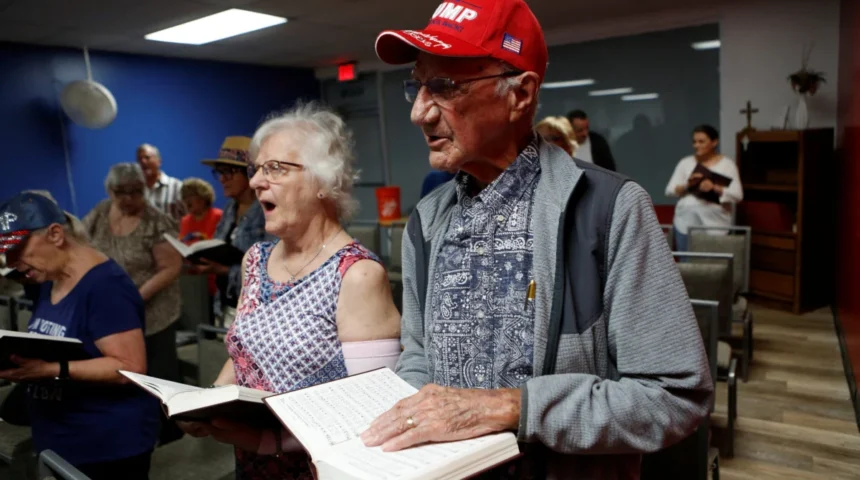
A new nationwide poll indicates that while white evangelical Protestant voters continue to outpace other demographic groups in their backing of United States President Donald Trump, their support has noticeably slipped since he assumed office for his second term in January 2025.
The survey, released this month by the Reuters news agency and research firm Ipsos, reveals that Trump’s approval rating among white evangelicals has tumbled to 63 percent. This represents a significant decline from the 77 percent support he enjoyed at the time of his second presidential inauguration.
This downward shift mirrors a broader erosion of public backing for the administration, coinciding with Trump’s overall approval rating dropping to an all-time low of 31 percent across the American electorate.
Historically considered one of the most reliable pillars of the Republican base, white evangelicals represent a vital demographic for the party. Their shifting sentiment could prove decisive during the upcoming midterm elections on November 3, when right-wing candidates will attempt to defend their narrow majorities in Congress.
Currently, Democrats remain widely favored by political analysts to take control of the US House of Representatives. Furthermore, Democratic chances of flipping the US Senate are increasingly growing, driven largely by widespread public discontent over economic affordability and the ongoing US-Israeli war on Iran. Despite these headwinds, political experts note that Republicans are heavily counting on their core conservative base to counter the surging momentum that Democrats are currently displaying at the polls.
Seeking to galvanize this crucial demographic, President Trump traveled to South Carolina on Wednesday for a high-profile campaign rally. Located firmly within the southern region known as the "Bible Belt," South Carolina is an area where exit polls during the 2024 presidential primary found that roughly six in ten Republican voters identified as white evangelicals.
Trump comfortably carried the state by nearly 18 percentage points during the 2024 presidential election. However, recent polling data indicates a dramatically tighter race this cycle, showing Republican Senate candidate Darline Graham holding only a narrow lead over her Democratic challenger, Annie Andrews, with just two weeks remaining before the midterm vote.
True to form for many of his campaign appearances, Trump used his South Carolina speech to focus heavily on social and cultural issues that deeply resonate with conservative Christians, including policies concerning transgender individuals. During the rally, the president referenced Andrews using an anti-transgender slur to attack her platform.
"She’s a fanatical transgender activist," Trump told the cheering crowd, despite the fact that Andrews has generally taken a more moderate stance on the issue within the broader Democratic Party framework. "How the hell do you run in South Carolina? Am I in a different state?"
White evangelicals have long served as a cornerstone of Trump’s political coalition. According to a survey by the Public Religion Research Institute (PRRI) and a validated-voter analysis conducted by the nonpartisan Pew Research Center, white evangelicals accounted for nearly a third of Trump’s winning coalition in the 2024 general election. Overall, approximately 80 percent of white evangelical voters cast their ballots for Trump in that race, even though the demographic makes up about 13 percent of the total US population.
Throughout his political career, the US president has successfully maintained robust support from key evangelical leaders despite weathering a series of personal and political scandals that critics argue directly contradict the conservative moral values espoused by the faith community. Trump has consistently denied allegations of sexual misconduct and extramarital affairs that have followed him across his time in public life.
Beyond key battlegrounds like South Carolina, evangelical voters in Midwestern states such as Iowa and Kansas, as well as southern strongholds like Texas, are expected to play a decisive role in determining whether the Republican Party can successfully retain its hold on the US Senate.
In an interesting dynamic this cycle, prominent Christian faith leaders are actively challenging Republican incumbents in several top-tier congressional races. These include figures such as Adam Hamilton, a pastor from the United Methodist Church running in Kansas, and James Talarico, a Presbyterian seminarian running for office in Texas. Political observers note that both Hamilton and Talarico officially represent mainline Protestant denominations rather than white evangelical ones, highlighting a complex religious landscape in these key races.
At the same time, voting trends among white evangelicals remain distinct from other evangelical communities in the United States. For instance, Black Protestant evangelicals—who historically served as a vanguard of the American civil rights movement—have consistently remained a reliable and steadfast Democratic voting bloc.
Nevertheless, when compared to the broader American electorate and other specific demographic groups, overall support for Trump among white evangelicals remains notably strong. Reuters noted in its analysis that white evangelicals were the singular demographic group tracked by the firm that managed to surpass 60 percent support for Trump as the country entered the final stretch of the midterm election cycle.
Moreover, the drop in support among this specific group was somewhat less pronounced than the decline in Trump’s overall presidential approval rating. While his backing among white evangelicals tumbled by 14 percentage points, Americans overall saw a 16-point decline in approval over the same timeframe.
As the nation approaches the November 3 polls, it remains entirely unclear whether these shifting attitudes toward the president will ultimately depress conservative voter turnout during a midterm election cycle in which Trump’s own name does not appear on the ballot.

Related News