Mastering Bitcoin Mining Efficiency: How Dynamic Clock Speed Management and Advanced Firmware Combat Shifting Energy Markets
As the macroeconomic landscape of cryptocurrency mining grows increasingly complex, the era of the "set-and-forget" mining operation has firmly drawn to a close. In an industry dictated by volatile hashprices, fluctuating electricity costs, and a widening technological gap between older and newer hardware generations, operational agility has become the ultimate differentiator between profit and loss. Modern Bitcoin mining demands a sophisticated approach to hardware management, pushing operators to look far beyond factory settings and embrace dynamic optimization strategies tailored to real-time market conditions.
At the core of this operational shift is clock speed management, a crucial strategy that involves adjusting the operating frequency of ASIC mining chips to strike an optimal balance between computational performance and energy consumption. The fundamental economic reality of ASIC mining is governed by a strict physical trade-off: higher clock speeds increase hashrate but severely degrade electrical efficiency, while lower clock speeds conserve energy and enhance efficiency at the expense of raw output. Intelligent miners harness this dynamic to fine-tune their operations, adapting swiftly to changing energy prices, grid constraints, and miner capabilities without relying on static configurations.
Understanding Clock Speed Management and Hardware Diversity
The diversity of hardware deployed across modern mining facilities further complicates this balancing act. Bitcoin mining fleets are rarely homogenous; they often comprise a patchwork of legacy machines, such as the older generation Antminer S19 series, operating alongside cutting-edge hardware like the Antminer S21 Pro and S21 XP. Because these various models operate within vastly different optimal efficiency ranges, running every machine at standard factory configurations is an invitation to sub-optimal performance and wasted capital. Depending on local electricity rates, facility managers frequently find that downclocking older, less efficient hardware or aggressively overclocking newer, highly efficient models yields substantially better financial returns than uniform deployment.
To navigate this hardware spectrum, operators categorize their strategies based on the generation of the machinery. Older models, such as the Antminer S19j Pro and MicroBT Whatsminer M30s, are prime candidates for downclocking. By reining in their performance, operators can avoid generating unprofitable hashrate during periods of elevated energy prices, thereby unlocking a path to profitability for older-generation units that would otherwise face mandatory shutdowns. Mid-generation models, including the Antminer S19 XP and Whatsminer M50s, require a more adaptive, case-by-case approach where profitability is tightly coupled with custom firmware capabilities and local energy costs. Conversely, newer models like the Antminer S21 Pro and Whatsminer M60s are ideal for overclocking when power costs are exceptionally low, allowing miners to maximize their return on investment by wringing every possible terahash out of state-of-the-art silicon.
Breakeven Efficiency: Navigating the Hashprice Landscape
With the hashprice holding at approximately $0.055 per terahash per day as of late May 2025, a mining operation’s financial viability depends heavily on how efficiently its equipment converts electrical power into secure blockchain hashrate. This relationship is starkly illustrated when comparing the nameplate efficiencies of common ASIC models against the performance enhancements unlocked by advanced alternative firmware solutions such as Braiins OS.
Factory stock firmware typically leaves significant performance potential untapped. By utilizing advanced autotuning engines to calibrate voltage and frequency settings at the individual chip level, alternative firmware solutions allow miners to operate closer to their physical potential. These efficiency gains are predominantly achieved through intelligent downclocking. Because power consumption scales with the square of voltage, even a modest reduction in operating voltage yields a disproportionately large improvement in Joules per terahash performance.

For legacy machines like the Antminer S9, factory efficiency sits at a heavy 98 Joules per terahash, but optimization can drive that figure down to 70 J/TH, representing a 29 percent improvement. Similar performance gains extend across the board: the Antminer S17 improves from 45 down to 31 J/TH, the standard S19 drops from 34 to 26 J/TH, and the S19j Pro moves from 30 to 23.5 J/TH. Even newer generations see notable enhancements, with the S21 improving from 17.5 to 15.4 J/TH, and the S21 XP refining its efficiency from 13.5 down to 11.9 J/TH. These granular improvements provide crucial economic headroom as market conditions tighten.
When mapping these efficiency metrics directly against electricity prices, the boundary between profit and loss becomes sharply defined. At a hashprice of $0.055/TH/day, older hardware quickly becomes a liability as local power costs climb. While virtually all machines remain profitable under zero-cost or extremely low-cost electricity regimes, rising power rates impose severe limitations on less efficient models. For instance, while an Antminer S9 operating on stock firmware becomes unprofitable once electricity crosses $0.03 per kilowatt-hour, running the same machine on optimized firmware can sustain profitability up to $0.05/kWh. Similarly, mid-tier and newer models enjoy extended operational windows under optimized firmware configurations, allowing facilities to weather rising power expenses that would otherwise force unoptimized competitors offline.
Mitigating Price Spikes and Leveraging Intelligent Autotuning
Despite the deployment of highly efficient hardware and advanced firmware, periods inevitably arise when escalating electricity prices threaten to render entire mining fleets unprofitable. This vulnerability is particularly acute for industrial miners operating under index-priced contracts, where electricity supply agreements tie wholesale power rates directly to real-time or day-ahead market fluctuations. During periods of peak demand or grid stress, wholesale power prices can experience extreme upward spikes, threatening to decimate operational margins within minutes.
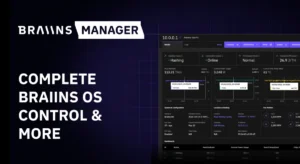
To safeguard against these unpredictable market shocks, advanced mining operations increasingly rely on automated curtailment strategies. Utilizing platforms like Braiins Manager, operators can establish customized strike price thresholds for each specific miner model in their facility. When real-time power prices exceed a miner’s calculated profitability threshold, the system automatically pauses hashing operations, protecting the business from burning through capital during high-cost intervals. Once wholesale power prices normalize and return to acceptable ranges, the management platform automatically brings the miners back online, ensuring that hardware only operates when financial conditions are favorable.
Beyond automated curtailment, the integration of intelligent autotuning represents a fundamental leap forward in mining firmware architecture. When operators establish specific power or hashrate targets, sophisticated autotuning algorithms automatically calibrate voltage and frequency parameters for every individual hashing chip across the deployment. This chip-level calibration ensures that every unit achieves the absolute peak of performance and energy efficiency for its designated target, eliminating the need for tedious manual adjustments or trial-and-error configurations.
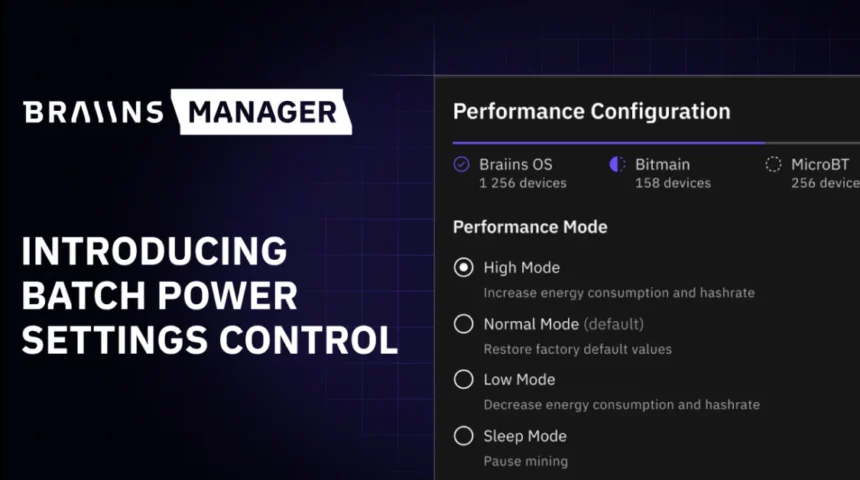
While traditional stock firmware typically limits performance adjustments to rigid preset modes—often restricted to a binary choice between low and high clock speeds—advanced third-party firmware provides the granular control necessary to adapt to dynamic market environments. Features such as custom power and hashrate targets, dynamic performance scaling, and comprehensive batch configuration tools empower modern mining operations to maintain total oversight of their infrastructure. By combining the granular chip-level control of advanced firmware with centralized cloud management platforms, Bitcoin miners possess the essential tools required to optimize their operations minute-by-minute, securing profitability in an increasingly competitive global market.

Related News