The Gen Z Gambling Epidemic: How Online Betting is Reshaping a Generation’s Financial Future
By Lance Roberts | October 9, 2026
Something changed this summer. Bank of America, which routinely monitors money moving across its customers’ accounts, discovered that roughly 5% of its customers sent cash directly to an online betting platform in July. Even more concerning, the total number of active bettors surged by 40% since January. The phenomenon widely termed the Gen Z gambling epidemic has officially stopped being a quiet media headline and transformed into a powerful, quantifiable trend line. First-time bettors in June and July arrived at more than triple the pace seen at the start of the year. This shift should serve as a stark warning to parents, educators, and financial advisors alike: roughly one in five of these young users now openly categorizes their mobile sports betting as “investing.”
The Turning Point Nobody Voted On
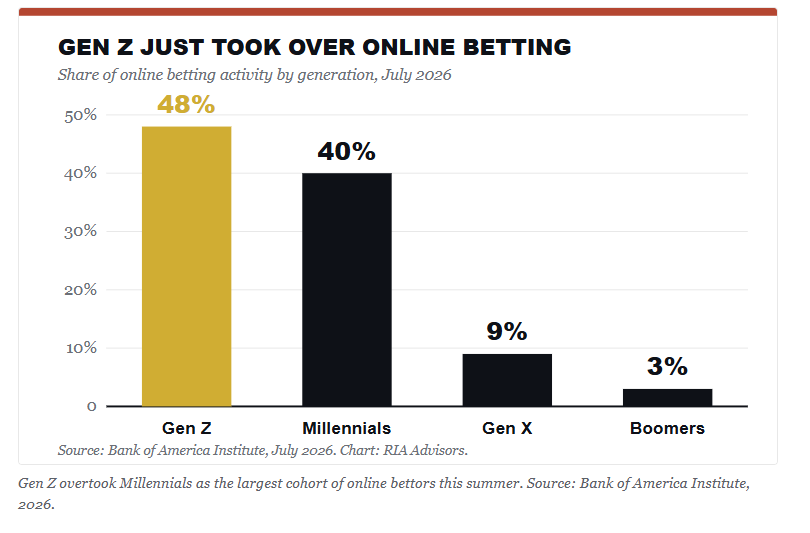
When broken down by generation, demographic data shows that Gen Z and Millennials now account for a staggering 88% of all online betting activity. Gen X trails far behind at a mere 9%, while Baby Boomers barely register on the platforms. As recently as this past spring, Millennials made up the largest share of this demographic pie. However, once Gen Z surpassed them, Bank of America analysts officially designated the shift as a major structural turning point. A turning point represents the precise moment when a risky behavior transitions from the exclusive domain of early adopters into the default cultural norm for an entire generation.

Crucially, this is not a story about poverty or lack of resources. The engagement metrics split almost evenly across income brackets, with 37% coming from lower-income brackets, 34% from middle-income earners, and 29% from higher-income households. The common thread binding these young adults together has very little to do with their baseline earnings. Instead, it is fueled by a shared, pervasive conviction that the traditional pathways to building wealth are firmly closed, and that the financial "house" wins in the traditional stock market anyway. Under this logic, young people feel they might as well play the house on their smartphones.
To a generation raised entirely in the shadow of central bank interventions, zero-day options trading, and hyper-connected community forums, the stock market often feels indistinguishable from betting on a Sunday football game. This sentiment is entirely understandable after years of volatile market cycles and rising living costs. Yet, classic market wisdom warns that exponential speculative manias always run further than expected before they inevitably break. This cycle is simply minting a brand-new iteration of an age-old psychological trap.
The Oldest Vice, The Newest App
To understand the scale of the issue, consider the toll exacted across the American population. Roughly 2.5 million U.S. adults currently meet the clinical thresholds for a severe gambling disorder in any given year. Another 5 to 8 million carry milder forms of problem gambling, while approximately 20 million report experiencing at least one warning sign multiple times over the course of a year. Despite these numbers, only about one in ten ever seeks professional help, representing one of the lowest treatment rates for any recognized addiction. Furthermore, only 39% of Americans currently view gambling addiction as "very serious," compared to 62% who express that level of concern regarding drug addiction, meaning society is severely underrating the threat in real time.
Disapproval of gambling is hardly a modern invention. Historical restrictions and moral condemnations date back to ancient Rome, ancient China, the Jewish Talmud, Islam, and Buddhism. In ancient Egypt, habitual gamblers could be sentenced to hard labor. Even the soldiers standing at the foot of the cross famously cast lots for Christ’s garments. Ancient scriptures warned not specifically about the mechanics of dice, but rather about the spiritual and emotional dangers of loving money and seeking shortcuts to wealth.
The Book of Proverbs puts the concept plainly, noting that wealth acquired through get-quick schemes quickly disappears. Islamic traditions explicitly name the practice "maysir" and condemn it as a destructive temptation. Puritan Massachusetts outright banned gambling, and Benjamin Rush, a prominent Founding Father and signer of the Declaration of Independence, warned explicitly that gambling inexorably leads to poverty and wretchedness.
When examined objectively, every major society and philosophical tradition throughout human history that has thought deeply about money has arrived at the exact same conclusion: rewards that are untethered from productive work can cause profound harm to both individuals and communities. While modern skeptics may wish to dismiss these historical and religious precedents, contemporary scientific research continues to validate those ancient instincts. Long-term health cohort studies tracking individuals into middle age have consistently found that disordered gambling reliably predicts significantly worse financial and occupational outcomes decades later, alongside sharply elevated rates of mortality and suicide.
Why The Machine Is Built To Win
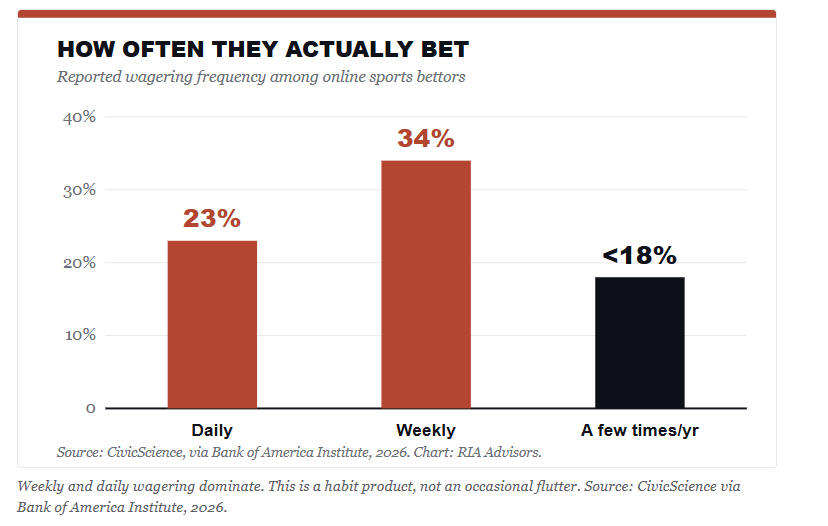
An examination of frequency reveals the true nature of these modern platforms. One-third of surveyed respondents state that they place wagers on a weekly basis, while nearly a quarter bet on a daily schedule. Fewer than one in five fit the traditional profile of the once-a-year Super Bowl bettor. This level of regular engagement mirrors the behavioral profile of a high-retention social media application rather than a casual lottery ticket purchase.
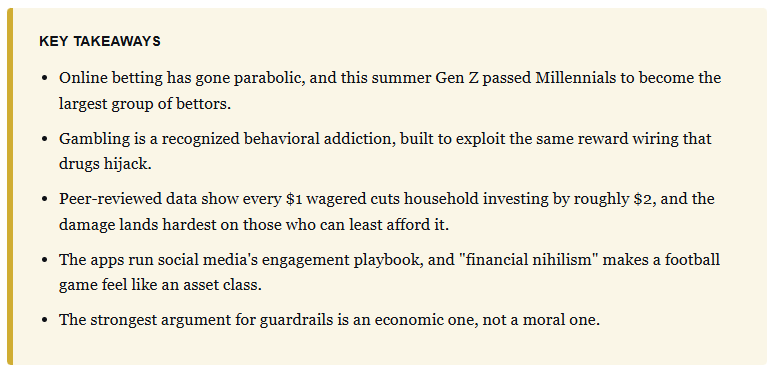
In 2013, the American Psychiatric Association made a quiet yet radical shift by moving gambling out of the impulse-control category and placing it directly alongside alcohol and cocaine use disorders, marking it as the first behavioral addiction formally recognized by medicine. The human brain does not fundamentally distinguish whether a rush of dopamine originates from a chemical substance or a digital screen; the exact same ventral striatum lights up during a sports bet as it does during substance consumption.
Platform designs heavily exploit this neurology through features like the "near-miss." Much like a slot machine that displays two matching symbols and a miss, a failed parlay pays out zero, yet it fires the exact same reward circuits in the brain as a major jackpot. This psychological trap keeps users glued to their devices. Combined with the "illusion of control"—the false belief that studying team rosters grants a reliable edge—the product is meticulously tuned to human biology. Complex parlays, which offer the worst mathematical odds for the bettor while carrying the fattest profit margins for the house, are aggressively promoted by the applications.

While most casual users will not spiral into clinical addiction, the subset that does faces catastrophic consequences. Gambling disorder carries the highest suicide rate of any recognized addiction, with roughly one in five severe sufferers attempting to take their own life.
Every Dollar Bet Is A Dollar Not Invested
The digital delivery systems of online sportsbooks have fundamentally rewired how young people allocate their attention and financial resources. App developers utilize targeted push notifications, bonus bets, no-sweat promotions, and dedicated VIP hosts to maintain user engagement, while athletes and social media influencers close the loop directly inside personal feeds.
Underneath this commercial apparatus lies the pervasive cultural narrative of financial nihilism. A growing share of Gen Z feels entirely priced out of traditional milestones like homeownership, leading to stark survey results. Northwestern Mutual found that 73% of Americans who feel financially behind believe speculative bets will help them catch up faster than traditional saving. Among Gen Z respondents, that figure climbs to nearly 80%.
While the economic hopelessness felt by young adults is a very real reaction to modern cost-of-living pressures, the explosion of mobile betting is not merely a symptom of that despair—it is an engineered mechanism that accelerates it.
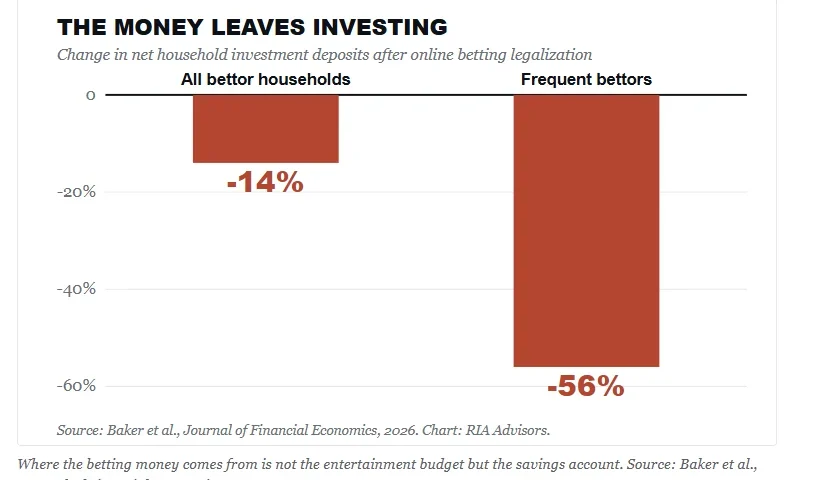
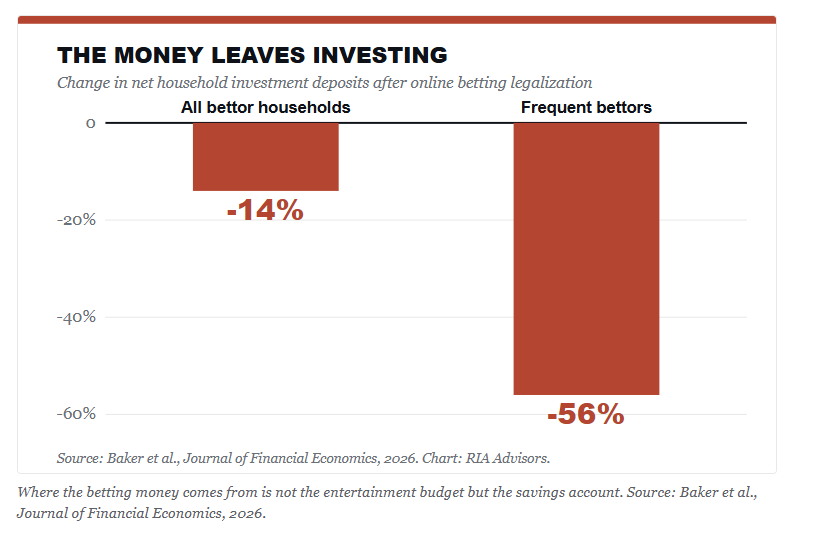
Some defenders argue that mobile betting is simply an expensive form of entertainment, akin to buying a ticket to a movie or a concert. However, empirical financial research paints a different picture. A comprehensive study published in the Journal of Financial Economics tracked household bank accounts following the legalization of online sports betting and discovered that gambling expenditures do not come out of discretionary entertainment budgets; instead, they come directly out of household savings. Every dollar wagered cuts net investment by roughly two dollars. Brokerage deposits fell across all bettor households, with frequent bettors seeing deposit declines of over half.
Separate research from UCLA further demonstrates that the broader balance sheet deteriorates rapidly in regions where online betting becomes readily accessible. Credit scores tend to fall, debt sent to collections rises, and personal bankruptcies climb. Less capital flows into long-term savings vehicles, while more money is funneled toward collection agencies.
Furthermore, the basic mathematics of sports betting heavily favor the house. At standard pricing structures, a bettor must win approximately 52.4% of their wagers simply to break even over the long term. Only about 3% of sports bettors clear that hurdle across extended periods, meaning roughly 95% ultimately lose money. Yet, when surveyed, a full third of regular bettors stubbornly insist that they come out ahead. This persistent gap between subjective belief and mathematical reality forms the core of the sports betting business model.
How To Know If You Are The Product
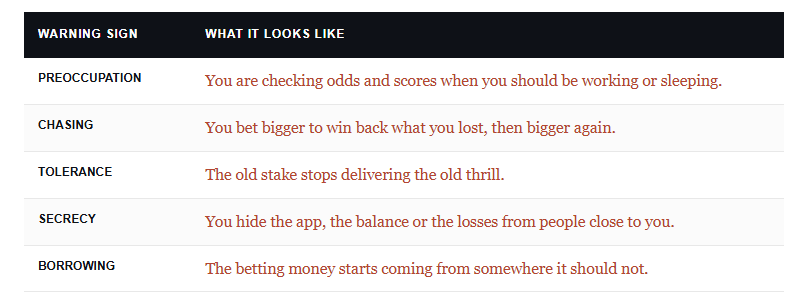
Clinical professionals utilize simple diagnostic screening tools to evaluate whether casual betting has crossed the line into a problematic behavior. The two-question Lie/Bet screen asks individuals if they have ever needed to lie to people about how much they gambled, or if they have ever felt the need to bet more and more money. An affirmative answer to either question signals a need for deeper self-reflection.
When similar diagnostic checklists are applied to modern brokerage accounts, the "investing" delusion becomes apparent. If an individual’s trading activity is characterized by constant chasing of losses, high-leverage speculation, and emotional decision-making, it has quietly transitioned from investing into active gambling.

Fortunately, problem gambling behavior responds well to intervention when addressed early. The recovery process relies heavily on human connection, as isolation allows compulsive behaviors to grow in the dark. Cognitive behavioral therapy targets the specific psychological distortions reinforced by digital applications, while support groups like Gamblers Anonymous offer long-standing peer recovery frameworks.
Resources such as the National Problem Gambling Helpline are available for free via call, text, or chat for anyone seeking confidential support. Breaking the cycle of secrecy is often the most critical initial step toward recovery.
The Case For Guardrails Is Economic, Not Moral
While regulatory debates often center around moral arguments, the most compelling case for introducing guardrails into the online betting industry is fundamentally economic. As economist John Maynard Keynes famously observed in 1936, when the capital development of a country becomes a by-product of the activities of a casino, the job is likely to be poorly done.

Three primary economic realities support this perspective. First, the financial losses generated by problem gambling are not restricted to private individuals; they impose massive external costs on society through public health treatment, lost workplace productivity, family breakdown, and rising bankruptcy rates—none of which are paid for by the gambling operators booking the wagers.
Second, the industry’s profitability relies heavily on its most distressed users. High-margin products like multi-leg parlays are specifically designed around near-miss mechanics that extract maximum capital from vulnerable players. A business model whose economic health depends disproportionately on harming its most vulnerable customers represents a systemic market failure rather than a functioning free market.
Third, the capital that young people divert into digital sportsbooks represents the foundational wealth needed for long-term financial security and retirement. A generation that saves less and accumulates higher unsecured debt loads will eventually place a heavier burden on public safety nets, turning private sportsbook revenues into a collective societal cost.
While the gaming industry argues that legalization successfully pulled wagering away from unregulated offshore bookmakers that historically funded criminal enterprises—while simultaneously generating vital state tax revenues and jobs—those arguments have limits. The primary policy goal of displacing the illegal market was intended to reduce social harm, not aggressively expand the overall customer base through smartphone applications.
Legislative measures like the proposed SAFE Bet Act aim to establish sensible floors on advertising, mandate affordability checks, and restrict algorithmic targeting that preys on vulnerable users. Other nations have already implemented concrete steps, such as capping maximum stakes and reining in aggressive promotional bonus offers.
These regulatory guardrails do not shut down the industry entirely; rather, they prevent mobile betting apps from being hyper-tuned to exploit the neurological vulnerabilities of citizens least equipped to absorb heavy financial losses. Without adequate guardrails, an entire generation risks learning the hard way that the house always wins—one parlay at a time.

Related News