REITs, Narrow Market Breadth, and Consumer Resilience: Navigating a Record-Breaking Yet Divergent Equity Landscape
By RIA Team
October 8, 2026
7 min read
The financial markets continue to chart a fascinating course of contrasts, highlighted by record-setting headline indices running alongside stark underlying divergences. As the autumn trading season progresses, investors are weighing the impact of stubborn Treasury yields against shifting sector momentum. While heavyweight technology stocks continue to drive major benchmarks to unprecedented heights, rate-sensitive corners of the market, such as Real Estate Investment Trusts (REITs), are grappling with a complex macroeconomic backdrop. Understanding how these moving parts interact is essential for navigating today’s unique portfolio management environment.

Over the past six months, the 10-year Treasury yield climbed by nearly a full percentage point, placing heavy downward pressure on interest-rate-sensitive assets. Real Estate Investment Trusts paid a notable price during this period. The State Street Real Estate ETF (XLRE) remained essentially flat, while the broader S&P 500 marched forward with an impressive 18% gain. This divergence highlights a persistent market reality: higher yields are influencing REIT valuations far more directly than underlying corporate equity performance.
This dynamic raises a critical question for portfolio managers and active investors: Are REITs a compelling equity sector to accumulate if bond yields have finally peaked and are poised to decline? To evaluate this opportunity, market analysts examined the correlations between XLRE’s top holdings and 2-year, 5-year, and 10-year Treasury yields, while also evaluating recent relative performance against the S&P 500 and various real estate subsectors.
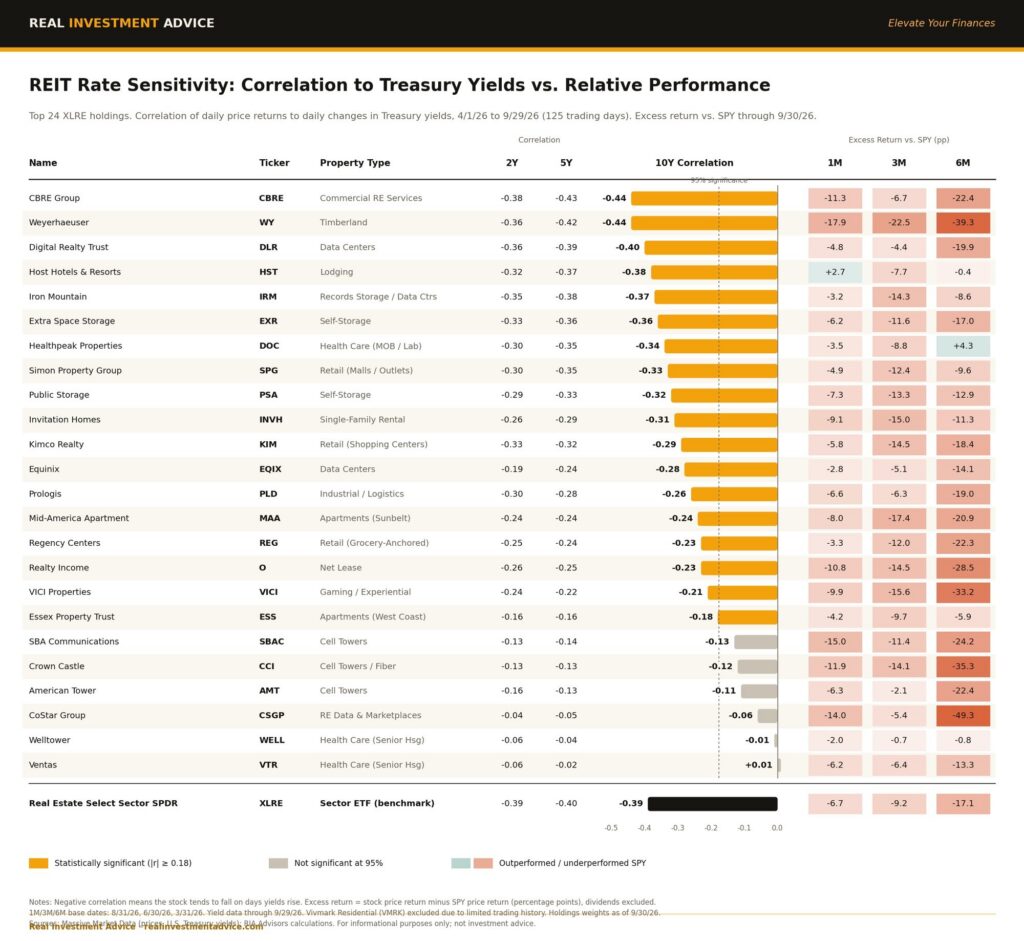
The broad takeaway from this analysis is that while it is easy to attribute poor performance entirely to the surge in bond yields, rate sensitivity is far from uniform across individual real estate stocks. Rates certainly matter, but they explain only a portion of the recent price action. With most correlations ranging between -0.2 and -0.4, external variables such as specific property types, fundamental earnings growth, and underlying balance sheet strength played a significant role in driving performance divergence within the sector itself.
What To Watch Today
As market participants parse sector performance, corporate earnings and economic data releases continue to dictate daily sentiment. Earnings calendars are populating with reports that will provide deeper insight into corporate margins and demand trends heading into the final stretch of the year. Simultaneously, a busy economic calendar featuring key inflation, labor, and housing indicators will offer fresh clues regarding the Federal Reserve’s upcoming policy trajectory.

Market Trading Update
Recent market commentary has focused heavily on the short-squeeze setup within small-cap equities, particularly the Russell 2000, which stands as a likely first stop for any broad-based momentum squeeze. Beyond small caps, market breadth signals across the rest of the tape warrant close observation. Observers are asking whether a meaningful broadening rotation is finally reaching beaten-down sectors like real estate, health care, financials, and utilities.
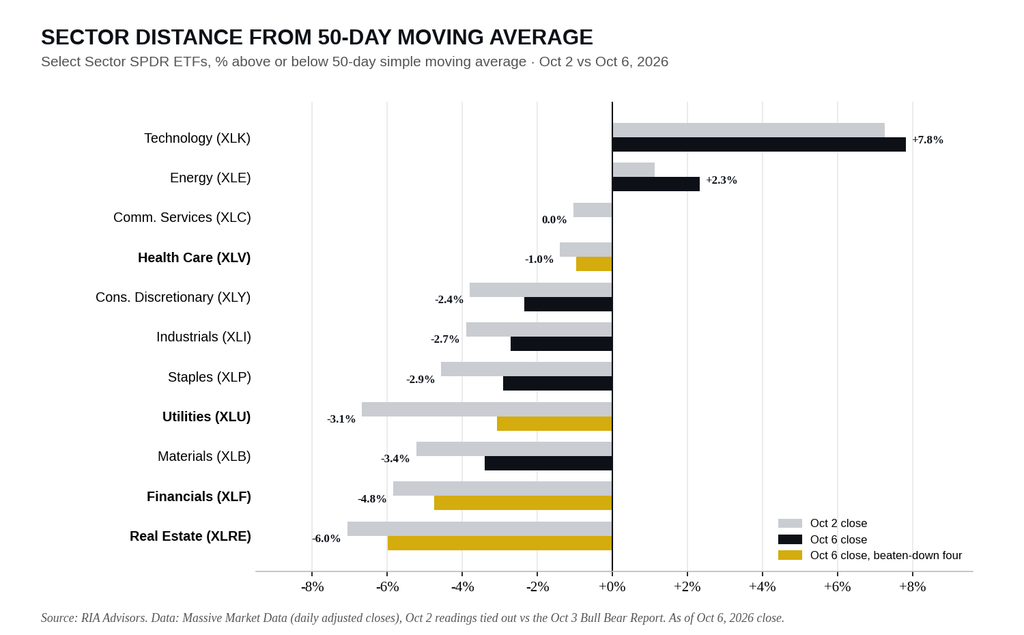
The headline figures tell a story of stark concentration. The S&P 500 recently closed above the 7,800 threshold for the first time, marking a fresh all-time record. Yet, depending on the specific measurement used, fewer than a third of its constituent members are trading above their respective 50-day moving averages. Such milestones represent a market standing on very few shoulders.

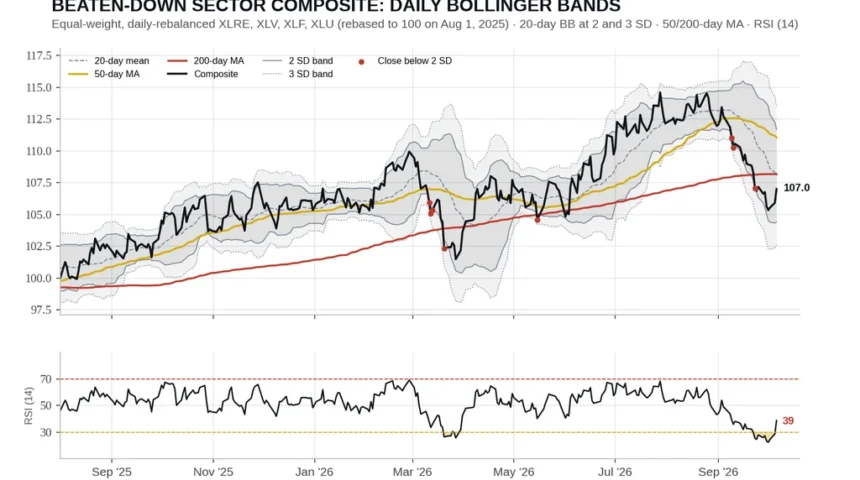
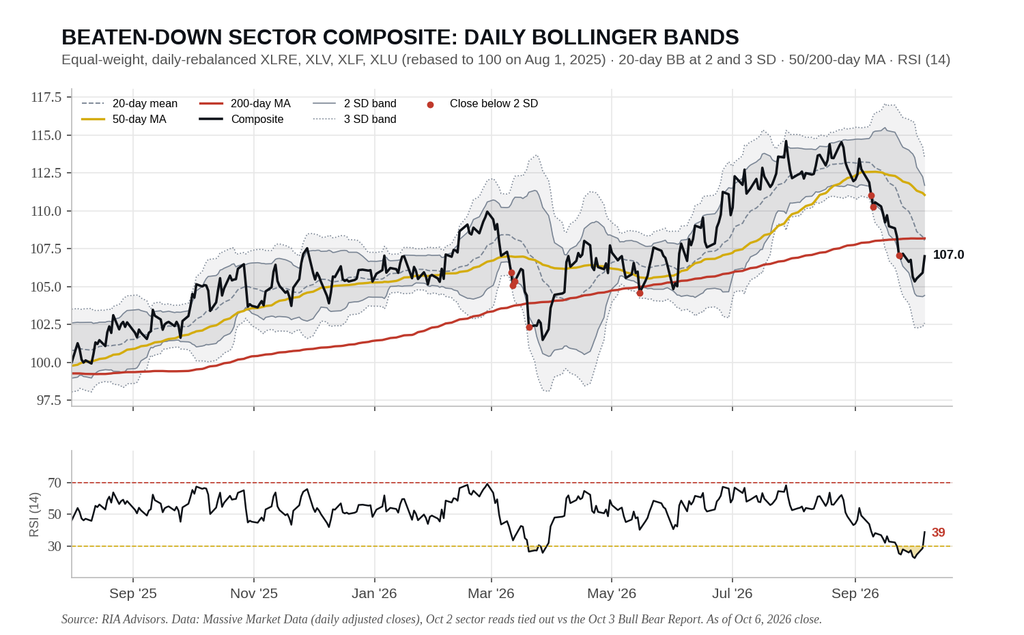
However, signs of underlying improvement have begun to emerge. Previously lagging sectors that sat well below their 50-day moving averages have begun to narrow the gap. Utilities, for instance, posted strong back-to-back gains to cut their deficit significantly, while health care moved to the cusp of reclaiming its moving average. The equal-weight blend of real estate, utilities, financials, and health care experienced deep oversold readings following a challenging September, with relative strength index (RSI) metrics touching their lowest levels since early 2025 before staging a technical recovery.
Despite these encouraging bounces, technical analysts emphasize that a bounce is not automatically a trend change. The composite sector laggards still sit below their key 50-day and 200-day moving averages. Furthermore, the ratio comparing equal-weight to market-cap-weighted S&P 500 performance remains under pressure, reflecting a market environment where laggards and leaders bounce in tandem without shifting the broader structural leadership.
Market history reminds us that equities are strongest when participation is broad and weakest when leadership concentrates into a handful of names. While breadth does not necessarily need to be pristine for a headline rally to continue, participation must eventually improve for gains to prove durable. The swing factor remains the bond market. With the 10-year Treasury yield hovering near elevated levels, rate-sensitive sectors require a sustained move downward in yields to establish a lasting recovery.
Within professional asset allocation models, disciplined investors avoid chasing premature bounces. Laggard sectors must prove their momentum before receiving fresh capital allocations, while outperforming technology holdings are periodically rebalanced to fund tactical rotations only when technical conditions justify the shift. In equity markets, cheap assets can frequently remain inexpensive until long after investors commit capital.
NVDA Booms While Breadth Continues To Narrow
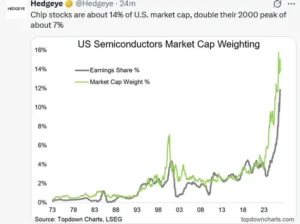
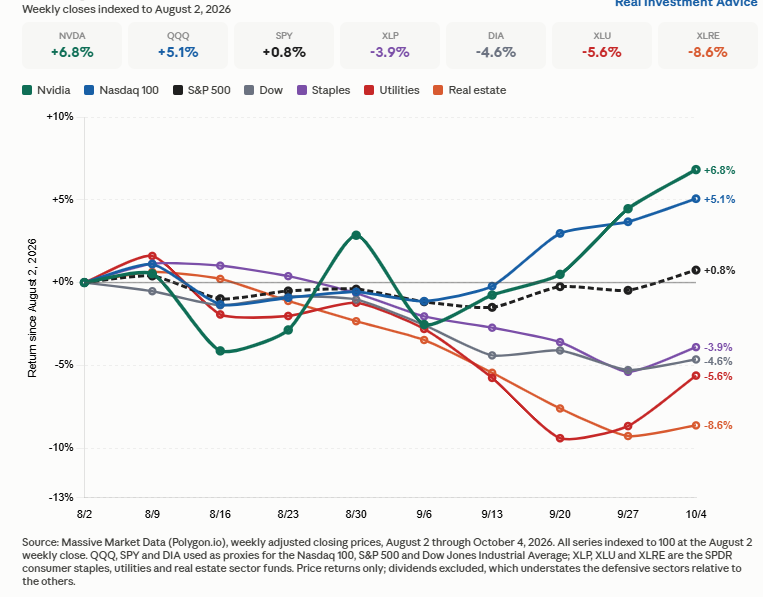
The divergence between mega-cap technology and the rest of the market remains stark. Nvidia recently reached new all-time highs, with its market capitalization rapidly approaching historic milestones. Concurrently, the S&P 500 notched another record close. While these developments generate optimistic headlines, they reveal little about the health of the broader underlying equity ecosystem.
Since the beginning of August, technology heavyweights have posted strong gains, with the Nasdaq Composite following closely. The S&P 500 has managed modest gains by balancing outsized technology returns against persistent weakness across interest-rate-sensitive sectors like real estate and utilities. Analysts note that while sectors like REITs are eventually due for a period of relative outperformance, a durable rotation may require a stabilized bond market and lower yields before taking full effect.

Worried Consumers Keep Spending: Here’s Why
For nearly four years, economic forecasters have anticipated that American consumers would eventually curtail their spending. Sustained inflation, the most aggressive Federal Reserve tightening cycle in decades, and elevated borrowing costs should theoretically weigh heavily on household balance sheets.
To a certain extent, these pressures are clearly reflected in consumer sentiment surveys. The University of Michigan Consumer Sentiment index sits near multi-decade lows, while the Conference Board Consumer Confidence Index has retreated to levels not seen in over a decade. Yet, despite widespread pessimism, real personal consumption expenditures (PCE) have continued to expand at a steady pace.
To understand this ongoing resilience, researchers have developed comprehensive Consumer Health Index models combining granular data on personal income, labor market dynamics, credit availability, spending habits, and price trends. Comparing consumer financial capacity against actual outlays reveals critical insights into the sources of modern spending power and its long-term durability.
Trading Rules With Desktop Printout
Achieving consistent, long-term success in portfolio management requires strict adherence to disciplined risk parameters. Incorporating established trading rules helps investors manage market volatility and protect capital across changing economic cycles. Subscribing to daily market commentaries ensures that investors receive timely updates and strategic insights before the opening bell each trading day.

Related News