Custom Mining Firmware and Autotuning Redefine Bitcoin Mining Efficiency and Profitability

As the global Bitcoin mining industry continues to mature, operators are increasingly looking beyond out-of-the-box hardware solutions to maintain profitability. Every ASIC (Application-Specific Integrated Circuit) Bitcoin miner arrives from the factory running a stock operating system, known as firmware, provided directly by the hardware manufacturer. While these stock firmwares are entirely sufficient to get machines up and running, industry observers note that they are fundamentally engineered by hardware companies rather than specialized software developers. This operational gap has opened the door for advanced aftermarket custom firmware solutions designed to extract the absolute maximum performance, efficiency, and longevity from mining hardware.
Specialized aftermarket firmware platforms, such as Braiins OS, are engineered specifically to optimize Bitcoin miners across multiple operational parameters. Beyond raw hashrate output, these custom systems excel at sophisticated temperature management and hardware control. Effective thermal management remains a critical pillar for maximizing machine uptime, particularly during challenging summer months when ambient heat places immense strain on mining infrastructure. Because maximum uptime directly correlates to maximum profitability, industrial and independent miners alike are turning to software-driven optimizations to protect their bottom lines in an increasingly competitive market.
Autotuning Improves Your BTC Mining Profitability
At the heart of modern firmware optimization is the concept of autotuning, a technology designed to account for the physical realities of semiconductor manufacturing. Every ASIC chip is fundamentally unique due to microscopic variations that occur during production. In the intricate process of creating these processors at single-digit nanometer scales, minor fluctuations in voltage, temperature, and material composition across the semiconductor die can create noticeable differences in individual circuit performance. When dealing with dimensions measured in individual atoms, even minute imperfections and alignment inconsistencies can impact how efficiently a circuit operates.
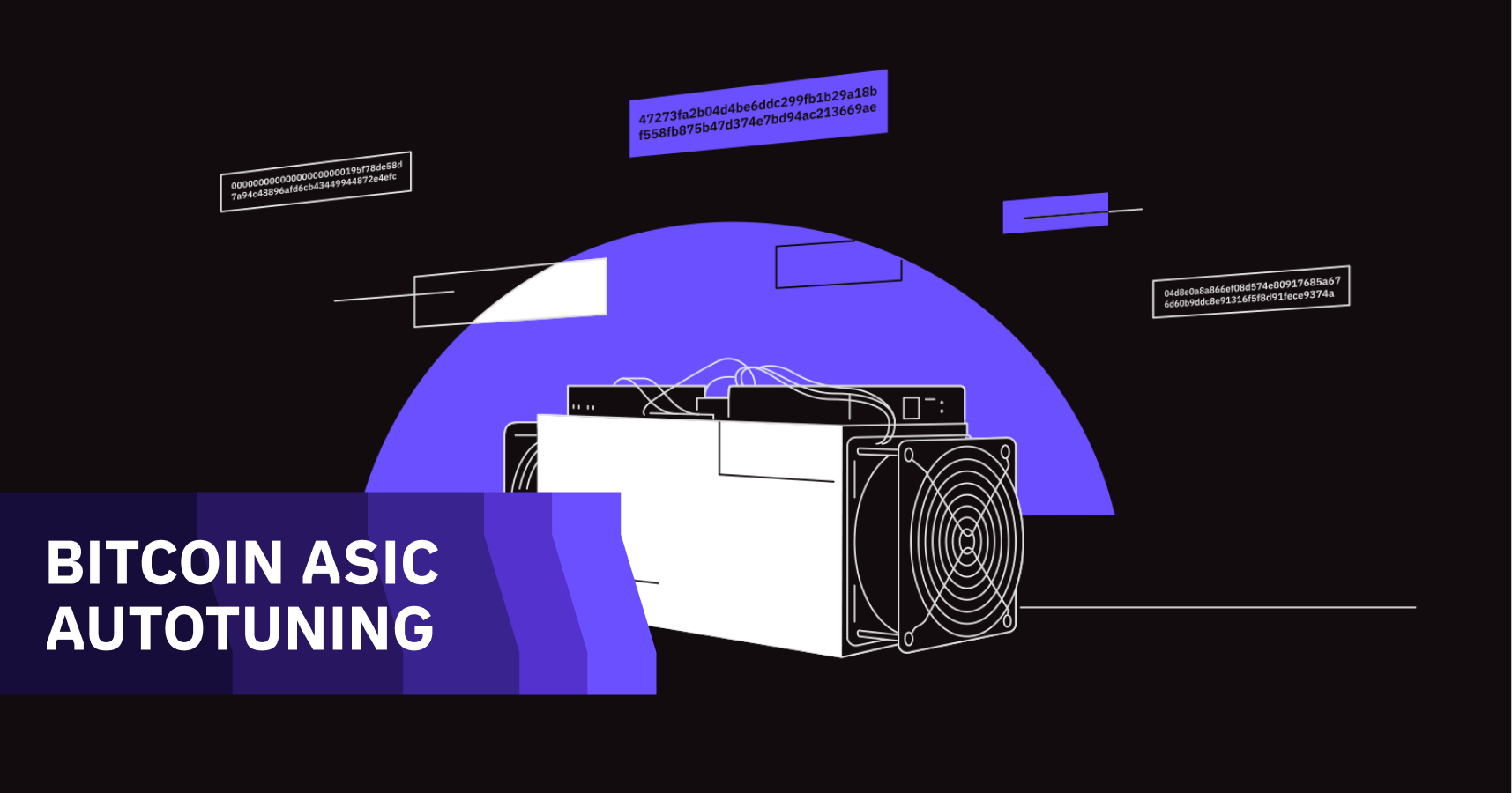
Advanced aftermarket firmware can thoroughly analyze and map the distinct performance characteristics of every individual chip housed within a Bitcoin miner. By identifying these nuanced variations, the software can dynamically maximize the total hashrate of the machine while strictly adhering to a predetermined power target. This granular level of control transforms a monolithic piece of hardware into a finely tuned instrument, ensuring that the entire mining unit operates at peak economic efficiency regardless of external market conditions or electricity costs.
Optimizing Mining Chips for Increased Mining Efficiency
The mechanical execution of autotuning relies on workload distribution across the hundreds of individual processing units typically found inside a modern ASIC miner. A standard machine often houses upwards of 300 individual chips, each possessing slightly different electrical tolerances and processing capacities. Autotuning algorithms systematically evaluate these chips, identifying the stronger, more resilient components and assigning them the majority of the computational workload. Conversely, weaker or less efficient chips are allocated a lighter share of the processing burden.
This dynamic load-balancing results in a significant increase in total hashrate at the exact same power target, translating into a comprehensive efficiency boost for the entire hardware unit. Weaker chips do less work, while stronger chips perform more, allowing the machine as a whole to mine more efficiently. Ultimately, this means operators can mine more Bitcoin while consuming the exact same amount of energy. The entire autotuning process is remarkably swift, typically taking effect within approximately thirty minutes of implementation and allowing miners to maximize their operational efficiency with minimal downtime. Put simply, autotuning has emerged as a premier market feature for operators seeking to extract the highest possible return on investment from their existing hardware inventory.

ASIC Autotuning Complements Your Power Strategy
For any Bitcoin mining operation, electricity consumption represents the single largest operational expense, making power strategy the defining factor between long-term success and commercial failure. Autotuning fundamentally enhances this core financial strategy by delivering increased profits regardless of an operator’s chosen energy posture. Whether a facility operates at default power targets, implements an aggressive overclocking campaign, or adopts a conservative underclocking stance, algorithmic tuning consistently yields a higher volume of mined Bitcoin per kilowatt-hour consumed.
Rather than merely fitting alongside existing power management plans, autotuning effectively elevates and redefines the power strategy itself. In an intensely cutthroat industry where profit margins can fluctuate rapidly alongside the Bitcoin network’s difficulty adjustments and asset price volatility, such efficiency gains offer crucial financial relief. Comparative data between stock manufacturer firmware and advanced alternatives like Braiins OS consistently demonstrates substantial improvements in both raw hashrate delivery and energy efficiency metrics across flagship hardware models, reinforcing the utility of software-level optimization in professional mining environments.
ASIC Autotuning vs. Overclocking
A frequent point of discussion among mining operators involves the distinction between autotuning and traditional overclocking. While both methodologies serve to increase a machine’s hashrate output, they operate through fundamentally different mechanisms and carry distinct economic implications. Traditional overclocking forces all chips within a machine to work harder simultaneously, a process that inherently demands additional electrical energy and drives up operational costs. In contrast, autotuning achieves higher hashrates at the exact same power target by strategically reallocating workloads to favor the strongest chips on the board.

The core divergence lies in their resource utilization: autotuning delivers increased hashrate at a stable power target, whereas overclocking provides increased hashrate at a higher power consumption level. Despite the elevated energy costs and reduced relative efficiency associated with overclocking, it remains a popular and viable strategy for capturing maximum revenue during lucrative bull markets. Crucially, operators do not necessarily have to choose between the two approaches. Advanced firmware allows miners to apply autotuning principles to overclocked settings, maximizing efficiency even at elevated power thresholds. By integrating autotuning into an overclocking configuration, miners can capture the enhanced hashrate required during high-price environments while simultaneously mitigating the sting of higher electricity bills.
Conversely, the reality of market cycles means that Bitcoin miners are frequently forced to navigate prolonged bear markets where asset prices drop and profit margins compress or turn negative. During these challenging economic periods, meticulous monitoring and reduction of electricity expenses become paramount. A widely adopted countermeasure during market downturns is underclocking, where operators intentionally run their mining hardware at lower power targets to achieve higher overall energy efficiency. Empirical observation indicates that running two identical ASICs at a reduced power target of 2,000 watts each will almost certainly yield more mined Bitcoin than running a single unit at an intensive 4,000-watt setting.
While stock firmwares provided by manufacturers typically offer severely limited power-scaling options—often restricting users to a single lower power setting—aftermarket alternatives provide expansive flexibility. This allows operators to seamlessly execute tailored underclocking strategies supported by robust autotuning algorithms, ensuring optimal economic survival through cyclical downturns.

How to Install Our Custom Firmware to Increase Profitability Today
Industry professionals emphasize that adopting autotuning and advanced aftermarket firmware has become a fundamental component of any elite operational strategy in the contemporary Bitcoin mining sector. Omitting these software tools often leaves valuable satoshis on the table. Beyond basic autotuning, sophisticated firmware packages frequently incorporate supplementary performance features, such as dynamic performance scaling, which actively assists with thermal regulation, temperature control, and the long-term preservation of hardware lifespans.
Deploying customized operating systems onto existing mining hardware has been streamlined to ensure accessibility for both large-scale data center operators and independent home miners. The process typically begins with network-wide asset discovery using specialized administration toolkits to scan and identify connected mining units. Once the hardware is mapped, operators can seamlessly deploy the firmware updates directly to their machines. Educational resources, technical documentation, and community academies remain readily available for operators seeking deeper technical insights into optimizing their hardware fleets, reinforcing the overarching industry ethos that miners seeking to maximize their production choose specialized software solutions like Braiins OS.

Related News