Beyond the Hashrate: How Optimized Uptime Is Redefining Profitability in Bitcoin Mining
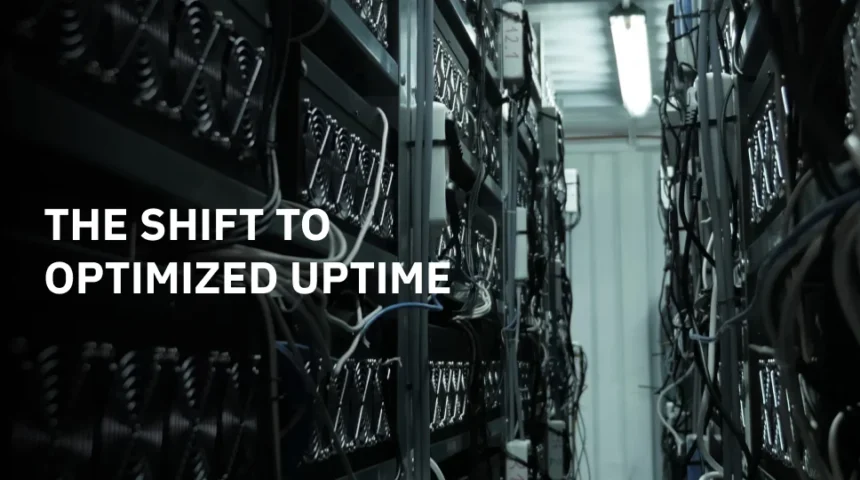
In the intensely competitive landscape of modern Bitcoin mining, overall profitability is rarely determined by raw processing power alone; rather, it is a delicate game of razor-thin margins. While the vast majority of commercial miners continue to focus heavily on their total hashrate as the ultimate badge of honor, a much quieter and more nuanced metric dictates whether that computational output actually translates into tangible revenue: uptime.
At its core, industrial-scale Bitcoin mining functions as a specialized business model designed to convert electricity and time into valuable hashes. However, seasoned operators understand that uptime is rarely a simple, binary metric that can be captured by a straightforward "on or off" switch. A mining rig might appear fully operational and connected from a remote dashboard while actually producing zero functional hashes due to an unexpected firmware crash, a persistent mining pool error, or aggressive thermal throttling. This operational reality is precisely why drawing a sharp distinction between basic connectivity uptime and true hashing uptime has become critical for facility managers.
The gap that frequently emerges between these two states reveals the true underlying health and efficiency of a mining operation. When analyzed correctly, this discrepancy can highlight substantial lost revenue stemming from unforeseen technical glitches and broader network instability. Alternatively, it can confirm that an entire fleet is successfully and strategically participating in local grid demand response programs by curtailing operations precisely when staying dark is far more profitable than burning expensive electricity. Ultimately, navigating, measuring, and managing that operational gap has emerged as the primary engineering challenge for modern enterprise optimization.
As the global Bitcoin mining industry integrates more deeply with complex energy grids and faces increasingly harsh environmental challenges across various geographic regions, the traditional definition of industrial "success" is rapidly shifting away from raw, continuous runtime toward a more sophisticated concept known as Optimized Uptime.
The Strategic Balance: Why More Uptime Isn’t Always Better
Historically, the overarching goal of every Bitcoin miner was refreshingly simple: keep the hardware running twenty-four hours a day, seven days a week, without exception. In the early eras of the industry, any minute spent offline equated to permanently lost revenue that could never be recovered. Today, however, sophisticated and enterprise-grade operations utilize strategic curtailment as an essential tool to protect their bottom lines. Modern mining profitability is dictated by a complex mathematical function balancing miner efficiency measured in Joules per Terahash, the prevailing hashprice, and local energy prices. When local energy costs spike dramatically during peak grid demand periods, it is frequently far more economical to voluntarily pause operations than to mine at a net financial loss.

Rather than treating downtime as an unmitigated failure, forward-thinking operators now view managed downtime as an active revenue stream and a critical risk-management strategy. This evolution requires advanced technological infrastructure capable of handling environmental challenges and volatile energy markets at the device and global fleet levels.
The Innovation of Dynamic Performance Scaling
Historically, mining hardware relied on a rigid, hard shutdown mechanism to prevent delicate hashboards from suffering catastrophic thermal damage when ambient temperatures soared or cooling systems faltered. To combat this crude limitation without sacrificing one hundred percent of production capacity during minor thermal events, Braiins introduced Dynamic Performance Scaling, commonly known as DPS, in June 2020.
Instead of forcing a complete and abrupt shutdown when hardware temperatures rise toward dangerous thresholds, DPS iteratively downclocks the mining rig, reducing its workload until it stabilizes at a safe and manageable operating temperature. Once environmental conditions improve and cooling efficiency is restored, the system automatically scales the performance back up to normal levels. This pioneering approach ensures that the facility continues mining—even if operating temporarily at a lower hash rate—rather than suffering total, unmitigated downtime. Over the years, this innovative feature has become an established industry standard that many other firmware providers have subsequently emulated across the sector.
While DPS successfully manages environmental and thermal challenges at the individual device level, modern enterprise operations require a broader suite of tools to handle complex, shifting power markets. To address this macro-level requirement, platforms like Braiins Manager provide the necessary energy intelligence for global fleet management, allowing operators to seamlessly participate in lucrative energy markets and grid stabilization programs without sacrificing overarching operational control.
Visualizing Uptime Metrics in Braiins Manager
To help mining operators navigate this increasingly complex operational landscape, Braiins Manager provides high-granularity uptime tracking that cuts through administrative ambiguity. These advanced metrics are fully filter-aware, allowing facility managers to analyze performance data by specific physical locations, energy providers, or custom-configured worker groups depending on their organizational structure.
The platform approaches operational health by calculating two vital layers of data. Worker system uptime focuses strictly on connectivity-level performance, addressing the fundamental question of whether a specific miner is actively reachable by the local network. Meanwhile, worker hashing uptime represents the classic operational metric, answering the more critical question of whether the reachable hardware is actually performing productive computational work.
Take Control of Your Fleet
Whether facility managers are actively mitigating thermal limits using Dynamic Performance Scaling or expertly navigating volatile regional energy markets through advanced energy intelligence features, modern management platforms provide the analytical depth needed to evaluate hardware utilization accurately. Having clear visibility into these metrics is fundamental for understanding overall system health, diagnosing technical bottlenecks, and ensuring that an industrial mining operation remains profitable regardless of broader market conditions or macroeconomic headwinds.
Industry participants looking to refine their operational strategies can connect with the Braiins team and other professional miners to share uptime optimization tactics, discuss how major operators are successfully navigating shifting energy markets, and stay informed about upcoming software developments. Operators interested in collaborating can join the official Braiins Manager community on Telegram to stay ahead of industry innovations.

Related News