Industrial Scale Bitcoin Mining Optimization: How GDA and Braiins Unlocked 16MW of Effective Capacity Without New Hardware
In the high-stakes world of industrial-scale cryptocurrency mining, operators constantly face a severe operational paradox: how to maximize short-term revenue during high-demand periods without accelerating hardware degradation or running into catastrophic thermal shutdowns. For major global operations managing hundreds of megawatts of infrastructure, the margin between profitability and inefficiency often comes down to the software running beneath the casing of their Application-Specific Integrated Circuits (ASICs).
A comprehensive real-world case study recently released by Braiins, a pioneer in bitcoin mining firmware and software solutions, sheds light on how industrial-scale optimization can drastically alter the economics of a massive mining deployment. Examining operations under the punishing conditions of a summer heatwave, the collaboration between Braiins and global mining giant GDA demonstrates how advanced firmware optimization can unlock hidden performance from already deployed capital, effectively generating massive capacity gains without requiring a single dollar of additional capital expenditure (capex) on land, transformers, power contracts, or new machines.
Executive Summary and Real-World Operating Conditions
Braiins has historically built its reputation on helping industrial mining operations extract heightened performance from the capital assets they already have deployed in the field. To prove these capabilities at a true enterprise scale, GDA—a major global bitcoin mining company operating over 500 megawatts of capacity across multiple international jurisdictions—agreed to put Braiins OS through rigorous testing under real operating conditions.
During the peak heat of summer 2024, GDA’s 40-megawatt deployment faced an acute version of the industry’s perennial optimization dilemma. Operators could either push stock firmware profiles to their aggressive limits to maximize short-term hashrate, thereby accepting the risk of accelerated hardware degradation and frequent thermal trips, or they could operate conservatively to protect their expensive hardware investments at the direct expense of reduced mining revenue and suppressed output.

Stock firmware packages typically rely on aggressive, uniform performance profiles. Under sustained high ambient temperatures, this lack of fine-grained adaptability leads to highly volatile hashrate behavior and repeated, damaging thermal cycling. Each sharp transition into low-power throttling modes increases cumulative hardware stress. To combat this, Braiins OS utilizes a proprietary mechanism known as Dynamic Performance Scaling, or DPS. Instead of executing hard, binary throttle steps when temperatures fluctuate, DPS makes micro-adjustments to performance in small, measured increments as thermal headroom dynamically shifts.
To determine whether this software approach could genuinely improve both facility-wide stability and raw performance under full-scale operational pressure, GDA initiated a tightly controlled firmware comparison test. Philip Salter, Chief Technology Officer at GDA, noted the seriousness with which the global enterprise approaches technical evaluations, highlighting that operating at a scale exceeding 500MW requires working with software partners who bring genuine technical rigor to optimization engineering.
Controlled Mining Firmware Comparison and Deployment Methodology
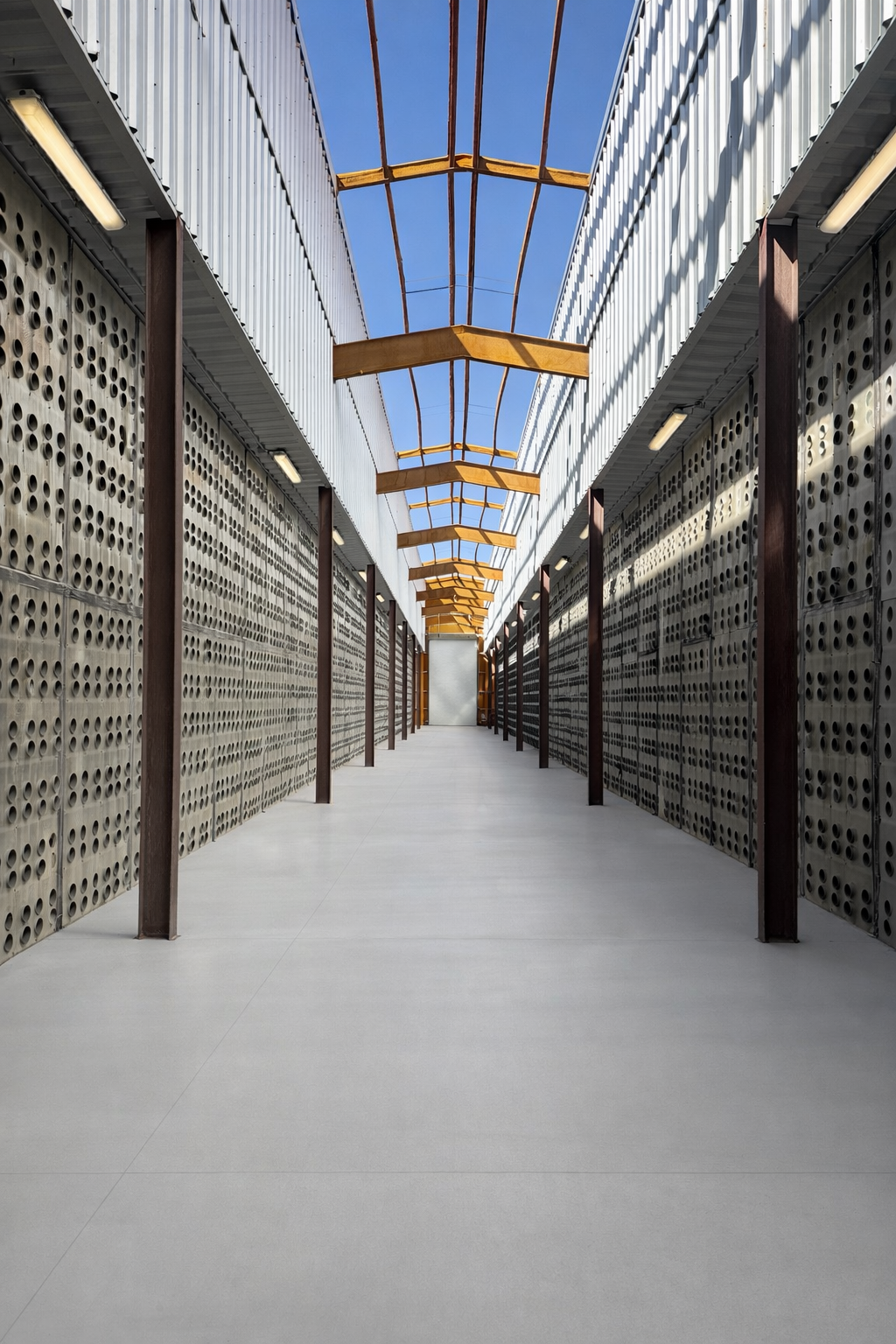
To ensure absolute fairness and accuracy in the evaluation, GDA structured the experiment by dividing a portion of its 40MW deployment into three distinct groups. Crucially, all groups operated within the exact same physical facility, sharing identical ambient conditions, electrical infrastructure, and hardware constraints. Temperature limits and fan parameters were applied uniformly across the board.
The test ran continuously from late August through early September, coinciding with some of the most intense summer heat of the year. In this controlled environment, firmware was kept as the single isolated variable.
The evaluation meticulously tracked key operational metrics, most notably hashrate per miner, chip-level temperatures, and overall stability under sustained thermal loads. The results exposed a profound divergence in how different software environments manage silicon under stress. While stock firmware configurations plateaued heavily under the ambient heat, Braiins OS maintained a vastly superior, highly consistent output profile throughout the entire testing duration.
Observed Performance and Thermal Behavior Under Peak Heat
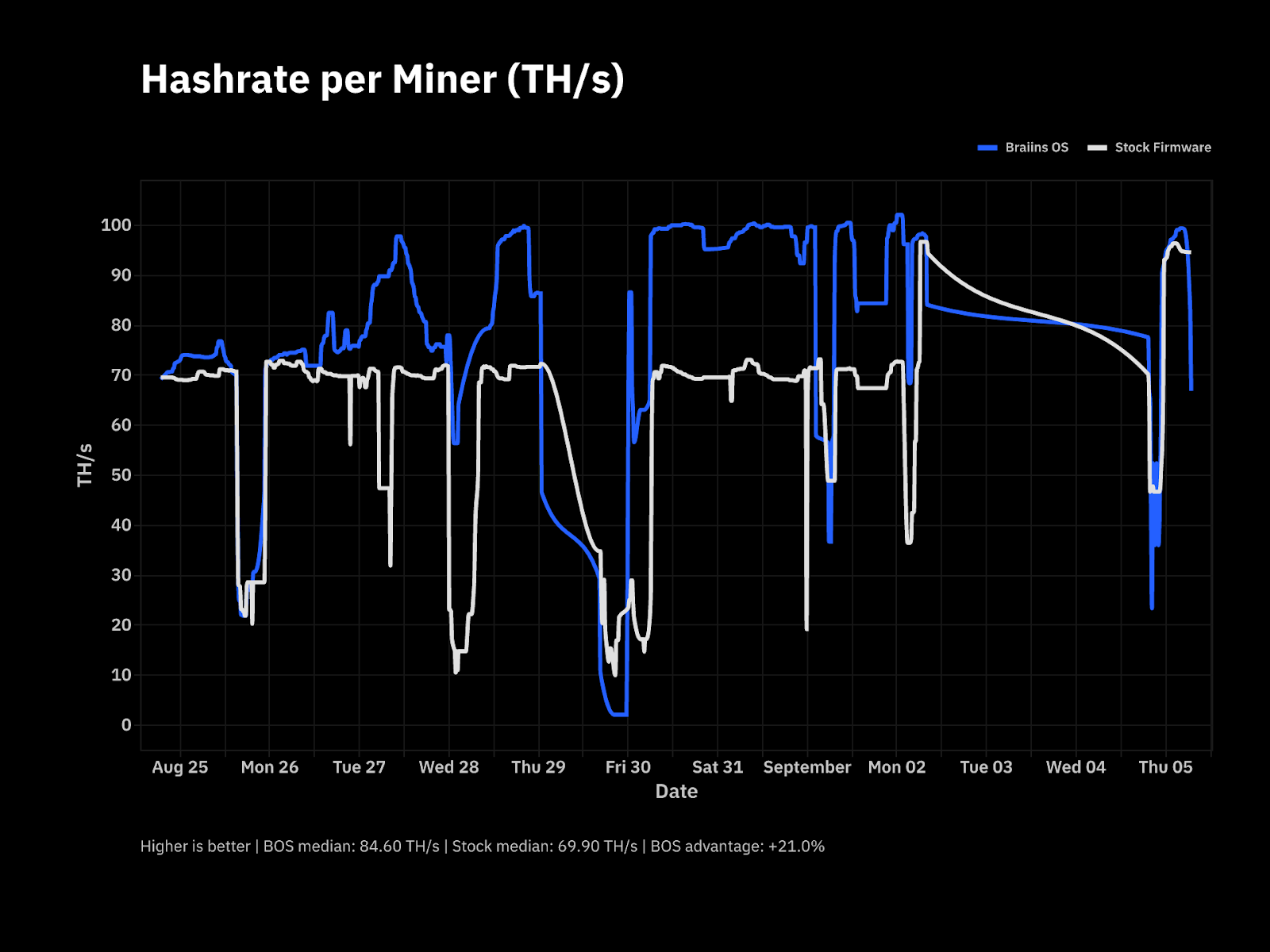
Under standard stock firmware, individual miners labored near an average of roughly 70 terahashes per second (TH/s) throughout the evaluation window. By contrast, when running Braiins OS, initial output climbed to approximately 84 TH/s during the initial tuning phase, eventually stabilizing between 97 and 98 TH/s once the system’s automated chip profiling and auto-tuning routines completed their optimization cycles.
During the most intense peak period of the test—spanning from August 30 to September 1—Braiins OS averaged an impressive 97.1 TH/s per miner. Meanwhile, the group running stock firmware struggled to average 69.6 TH/s under the exact same environmental conditions. This yielded a staggering 40% performance delta achieved purely through software-level optimization and precise per-chip voltage and frequency tuning, without any physical modifications to the underlying hardware.
Salter emphasized the significance of these findings, confirming that the Braiins OS optimization alone materially elevated performance under sustained heat without requiring any alterations to the physical equipment.
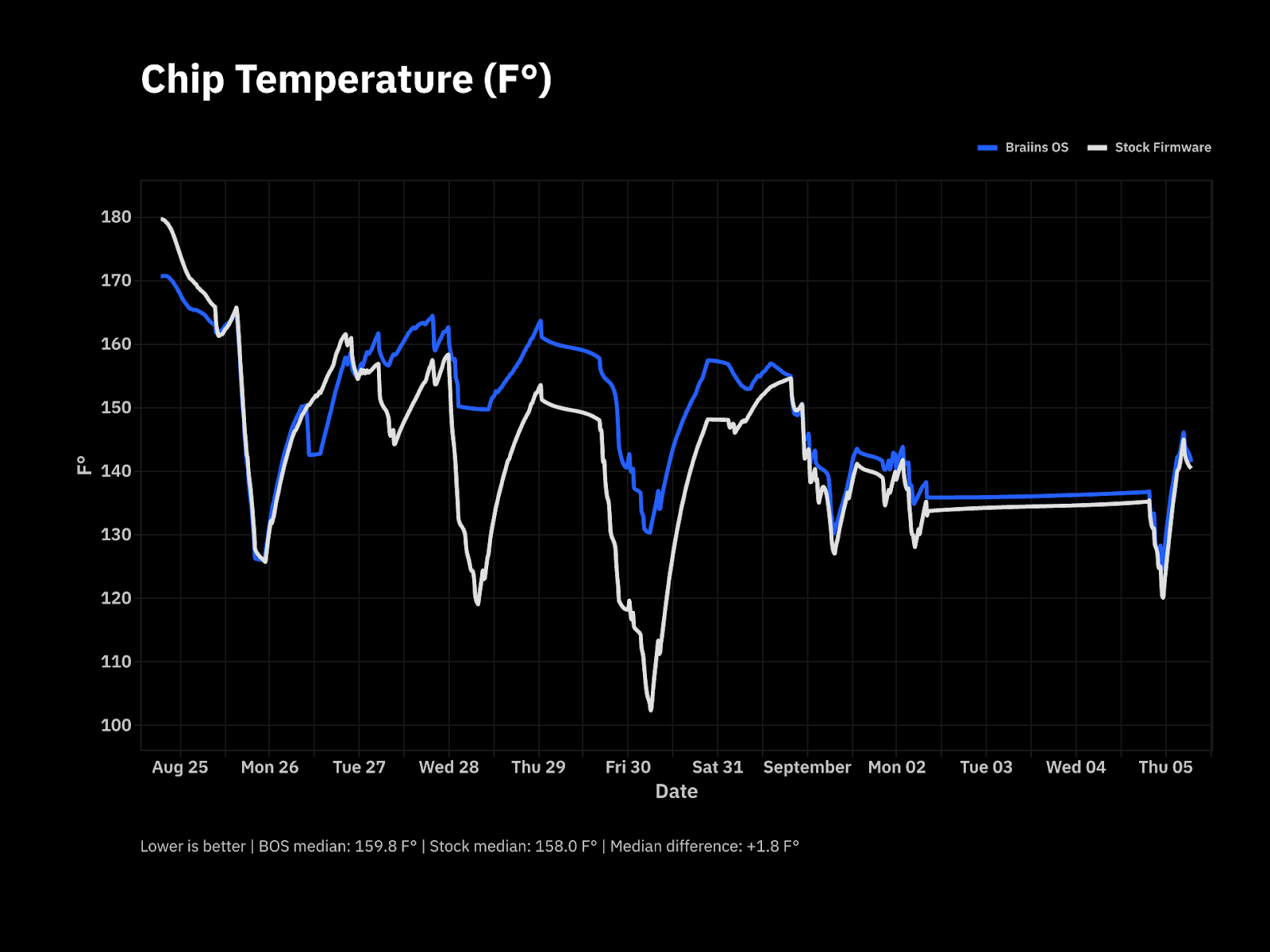
A central question in any high-performance firmware evaluation is whether such dramatic hashrate gains are simply being manufactured by pushing the hardware beyond safe thermal limits. However, data collected during the study disproved this concern. Both firmware configurations operated at nearly identical chip temperatures throughout the test. Stock firmware maintained an average chip temperature of 156 degrees Fahrenheit (69 degrees Celsius), while Braiins OS operated at an average of 159 degrees Fahrenheit (71 degrees Celsius)—a negligible difference of roughly 2 degrees Fahrenheit (1 degree Celsius).
Despite this virtually identical thermal reality, the hashrate delta between the two configurations hovered around 32% even during the most demanding windows of the peak comparison. This proved conclusively that the performance gains were the direct result of sophisticated firmware optimization rather than running the hardware outside of normal, safe thermal parameters.
Per-Chip Auto-Tuning and Dynamic Performance Scaling
The fundamental driver behind this discrepancy lies in how the respective firmware packages manage the silicon chips on the hash boards. Stock firmware universally applies a single, blanket set of voltage and frequency parameters across all chips on a given board. When ambient temperatures rise or dust accumulates on the cooling fins, this crude, uniform approach fails to account for variances in silicon quality. It results in erratic performance volatility and frequent, blunt-force transitions into low-power protective states.
Braiins OS approaches the problem through individualized chip profiling. Through its autotuning engine, the software optimizes each individual ASIC chip rather than treating the entire board as a homogenous block. By matching precise voltage and frequency configurations to the unique characteristics of every single chip on the board, stronger silicon is permitted to operate at higher efficiencies while weaker silicon is kept safely within stable thermal limits.
This granular control enables the miner to deliver a vastly steadier, more predictable hashrate while strictly adhering to facility thermal constraints. Consistency, in the context of industrial mining, is just as vital as raw peak output. During the evaluation, Braiins OS operated above 80 TH/s per miner for 88% of the operational time, whereas stock firmware achieved that threshold merely 2% of the time. In fact, the 10th percentile performance floor for Braiins OS sat at 79.0 TH/s, meaning its lowest operational troughs were consistently higher than the absolute best sustained output levels achievable by the stock firmware.
By utilizing Dynamic Performance Scaling to adjust power incrementally in response to thermal spikes rather than executing disruptive binary throttling, Braiins OS effectively insulates mining operations from the daily drama of heat and dust. As Salter noted, the ability of Braiins OS to maintain superior performance even when downclocked makes a profound operational difference during the hottest hours of the day.
Unlocking Hidden Capacity Without Capital Expenditure
For enterprise-level bitcoin miners, expanding operational capacity traditionally involves heavy capital outlays and protracted logistical timelines. Constructing 16 megawatts of fresh mining capacity requires securing vast tracts of land, installing heavy-duty transformers, negotiating complex power purchase agreements, building out industrial cooling infrastructure, and acquiring thousands of brand-new ASICs—a process that typically demands many months of planning and millions of dollars in capital expenditure.
Yet, through the deployment of advanced custom ASIC firmware at its 40MW site, GDA achieved the operational equivalent of 16 megawatts of additional effective capacity purely by extracting latent performance from assets already installed on the racks. There was no infrastructure expansion and no additional capex required—only a smarter, more mathematically rigorous utilization of existing hardware investments.
As the bitcoin mining sector matures into an increasingly competitive, margin-driven industry, the ability to squeeze maximum utility out of deployed capital will continue to differentiate surviving operators from the rest of the market. Technical partnerships that successfully validate these efficiency gains under harsh real-world conditions highlight a clear path forward for enterprise miners looking to optimize their fleets without expanding their physical footprint.

Related News