French High School Students Resume Limited Protests Following Holiday Break
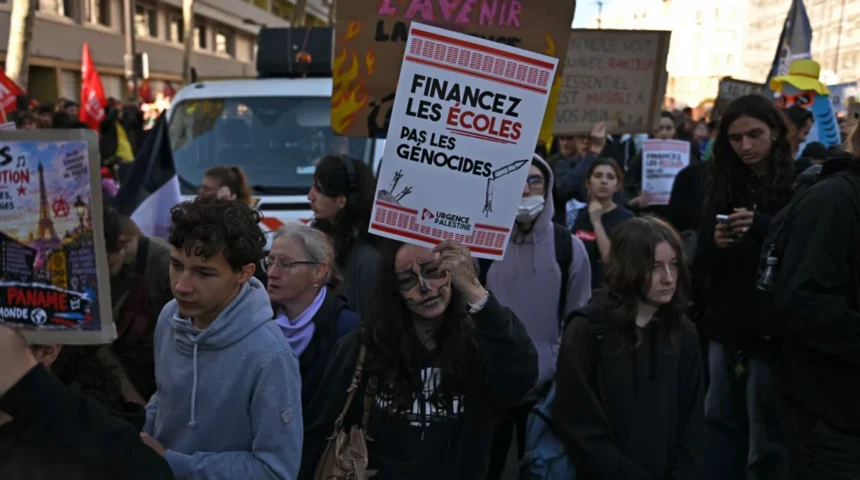
High school students across France have resumed demonstrations following the conclusion of their two-week holiday break, though the scale of the unrest appears significantly reduced compared to the widespread disruptions seen in previous weeks.
According to data released by the Ministry of Education, approximately 41 high schools were blockaded on Monday morning. This figure represents about one percent of the country’s roughly 3,700 high schools, based on calculations reported by the French public broadcaster Franceinfo.
While the numbers are drastically lower than the hundreds of schools that faced blockades in the weeks leading up to the holiday, localized disruptions were still registered in major urban centers. Reuters reported that students attempted to set up blockades at institutions located in Paris, Marseille, and Rennes, causing temporary delays and localized security responses.
Government officials were quick to downplay the renewed demonstrations as marginal, emphasizing that the vast majority of French schools opened without incident.
"In terms of blockades, or attempted blockades, the phenomenon is very marginal. We’re talking about a handful of units, a few individual schools," Education Minister Edouard Geffray stated during an interview with France Inter radio.
While reaffirming that students maintain the constitutional right to express their opinions and engage in peaceful protests, Geffray stressed that physically preventing access to educational facilities remains strictly illegal under French law.
"The school year is now at risk for several hundred thousand pupils and we can’t allow that," Geffray added, highlighting the administration’s growing concern over cumulative instructional time lost to ongoing civil unrest.
The student movement first erupted in the suburbs of Paris back in September before rapidly cascading across various regions of France. What began primarily as a localized grievance over educational infrastructure quickly expanded in scope. By last month, the focus of the student anger broadened to encompass broader socioeconomic grievances, most notably the escalating cost of living. This expansion drew the active participation of trade unionists, labor activists, and broader political movements.
For President Emmanuel Macron’s minority government, the unrest has presented a severe political and administrative test. In several major French cities, peaceful student demonstrations devolved into violent clashes with police forces, accompanied by incidents of rioting and the looting of commercial establishments. The merging of student demands with broader anti-government sentiments placed considerable pressure on state security and civil authorities.
At the core of the student movement are longstanding demands aimed at overhauling the nation’s public education framework. Pupils are explicitly demanding comprehensive renovations for ageing and deteriorating school facilities, the hiring of additional teaching staff to reduce educator burnout and class sizes, an increase in available university places, and the complete abolition of the centralized university admissions platform, which many students argue is socially inequitable and stacked against working-class applicants.
In an effort to defuse the mounting social tensions, the French government announced a series of major concessions last week. According to reports from Franceinfo, the administration outlined a gradual plan to replace the controversial Parcoursup university admissions platform entirely by the year 2028. Furthermore, the government officially cancelled previously planned cuts to education sector jobs, promised the creation of 500 additional staff posts, and instituted a strict cap of 28 pupils per class specifically for the first year of high school.
Financial commitments were also put on the table. The state pledged a dedicated investment of 4 billion euros, equivalent to approximately $4.47 billion, aimed directly at modernizing and renovating secondary schools nationwide. Additionally, the government promised to open 15,000 new places within the higher education system to ease the bottleneck faced by graduating seniors.
Despite these sweeping policy shifts and financial allocations, student representatives and union leaders immediately deemed the government’s offers insufficient to meet their core demands, vowing to maintain pressure through continued mobilization.
"Of course we’re calling for a blockade," Pierre Sourzat, president of the student organisation Les Lyceens!, asserted on Sunday, according to statements broadcast by France 24.
Further straining the situation, major student organizations have already mapped out an escalating schedule of disruptions. The Union Syndicale Lyceenne and the broader Student Union have issued formal calls for additional high school blockades scheduled for Tuesday and Thursday. Meanwhile, the UNEF student union has designated Tuesday as a national "black day" for higher education, urging students and sympathetic faculty to enforce blockades across universities throughout the country.

Related News