Assessing Market Valuations: Why Above-Average Returns Face Headwinds in the Coming Decade
By Lance Roberts
November 2, 2026
In 2016, consulting firm McKinsey issued a prominent warning that the "golden era" for equity investors had officially drawn to a close. According to their projections, falling interest rates, expanding profit margins, and rising valuation multiples—the primary drivers of the preceding bull run—had largely run their course. The report suggested that younger savers would either need to work seven additional years or nearly double their savings rate to achieve their financial goals.

Reflecting on that call years later, market analyst Ben Carlson graded the forecast against reality. Since that spring, U.S. stock markets have delivered roughly 15% annualized returns, more than tripling in value. European shares compounded at a rate near 10%, leaving savers who diligently increased their contributions in a very comfortable position. The initial prediction was incorrect, demonstrating that sometimes the most valuable phrase in financial analysis is simply admitting uncertainty. Market observers who claim they accurately timed the last sixteen years of above-average returns are often selling a narrative rather than an objective analysis.
While the bull market has firmly controlled the macroeconomic narrative, treating the scoreboard as the final word obscures critical underlying mechanics. Skeptics were not entirely wrong about the foundational inputs; rather, they misjudged a single variable. Understanding which variable matters dictates whether the cautious outlook remains relevant today.
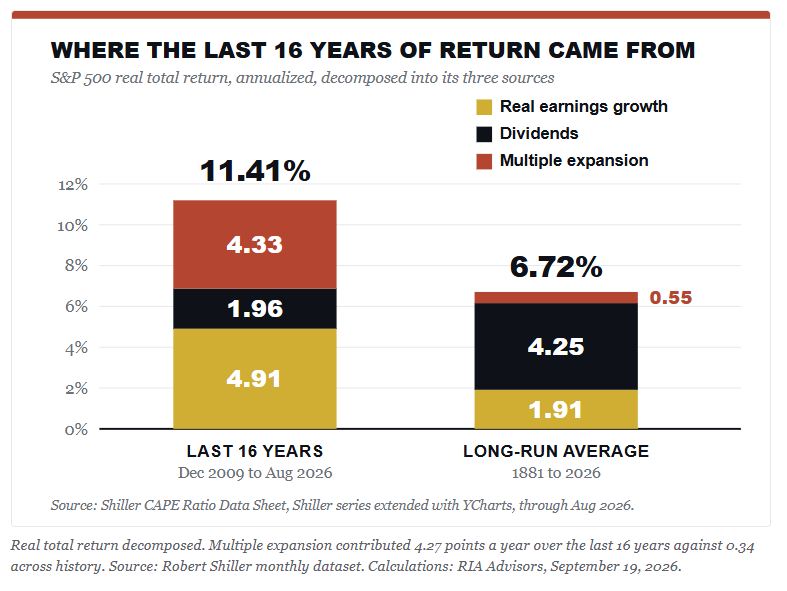
Examining historical data from Robert Shiller’s monthly series dating back to 1871 provides a clearer breakdown of real market returns into distinct components: corporate earnings, dividend payouts, and how much investors were willing to pay for those earnings. Over the modern era, real earnings grew at a robust 4.91% annually, roughly triple the long-run historical rate. Dividends contributed an additional 1.96 points, suppressed compared to historical norms because contemporary yields remain relatively thin.
The decisive factor, however, lies in valuation multiples. The Cyclically Adjusted Price-to-Earnings (CAPE) ratio climbed from 20.32 at the end of 2009 to a staggering 41.04. This single re-rating of the identical corporate earnings stream—entirely independent of underlying profit growth or dividend payouts—added 4.33 percentage points per year to investor returns. Stripping out the multiple expansion reveals that the past sixteen years delivered roughly 7% in real terms, which aligns almost perfectly with the long-run historical average. Every point of excess return stemmed directly from investors agreeing to pay higher prices for every dollar of smoothed profit.

Why Above-Average Returns Cannot Be Repeated From Here
Projecting those same dynamics forward illustrates the mathematical hurdles facing the market today. For similar returns to materialize, the CAPE multiple would need to expand by another 4.33 points annually for sixteen years, driving the ratio north of 83. No recorded major stock market has sustained half that valuation level for a prolonged period.
This reality raises questions about what catalyzed the initial doubling of multiples. Low discount rates played a monumental role. Roughly half of those sixteen years were spent with the federal funds rate pinned near zero, spanning from January 2010 through December 2015, and again from March 2020 into 2022. The ten-year average treasury yield hovered at 2.20% from 2010 to 2021, compared to a historical average of 4.71% across the entire Shiller dataset. Simultaneously, the Federal Reserve’s balance sheet swelled from under $1 trillion to a peak near $9 trillion. Cheap money lifted what buyers were willing to pay per dollar of earnings while simultaneously flattering corporate bottom lines.
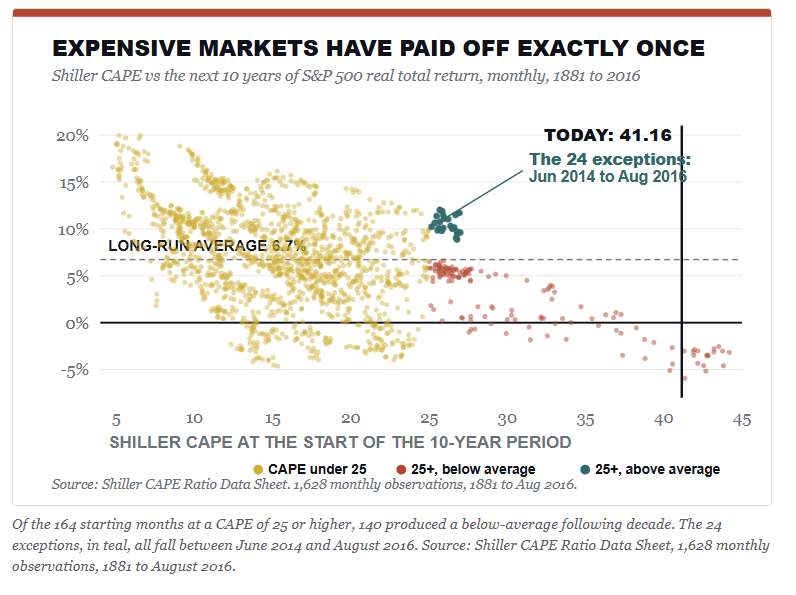
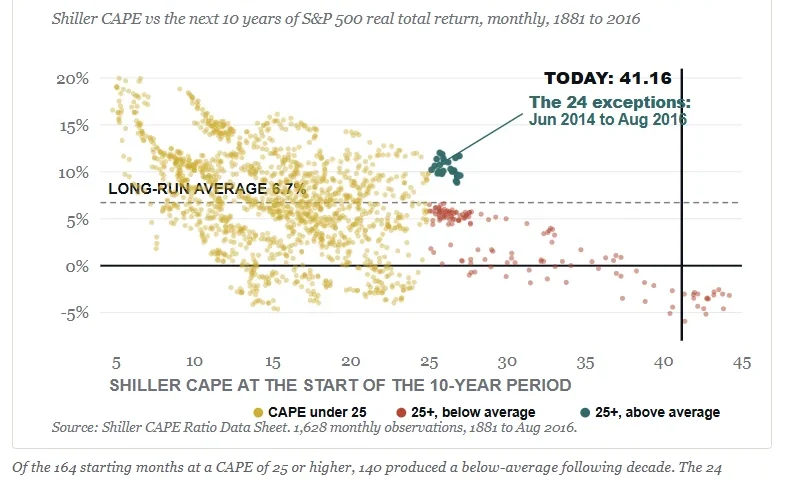
Relying on a return to zero-interest-rate policies and quantitative easing introduces severe systemic risk, as those monetary measures are typically deployed only during deep economic crises. With corporate debt refinancing at higher prevailing interest rates, the margin for error has narrowed significantly. Historical analysis of overlapping ten-year windows shows that starting from a CAPE ratio at or above 25 historically resulted in subsequent decade returns falling below the long-run average approximately 85% of the time. When the CAPE exceeded 30, subsequent decades frequently posted nominal or negative real returns.
The Bullish Case Against the Next Secular Bear
Despite sobering historical metrics, bullish analysts present coherent arguments defending the sustainability of elevated returns. Proponents point to structural shifts in corporate efficiency, dominant technology sectors capable of sustaining high margins, and the ongoing capital expenditure boom surrounding artificial intelligence. These factors help explain why real earnings have grown at multiples of historical averages rather than reverting to the mean.
Furthermore, the market’s resilience during the Federal Reserve’s aggressive tightening cycle—which drove the federal funds rate above 5%—demonstrated that valuation multiples can climb even amidst restrictive monetary policy. Rather than responding strictly to interest rates, current valuations are heavily anchored in exuberant expectations for future corporate earnings growth. Corporate earnings have recently broken above a multi-decade trend channel, creating a foundation that depends entirely on continuous profit expansion.
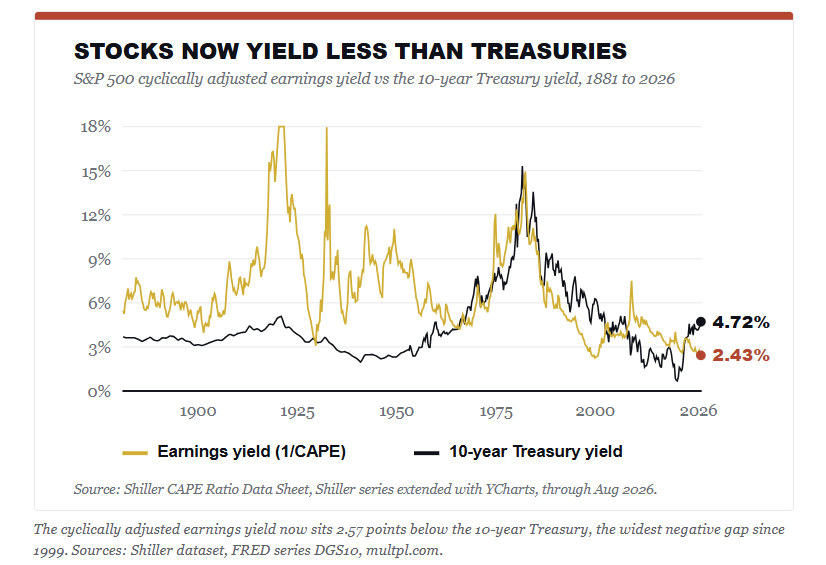
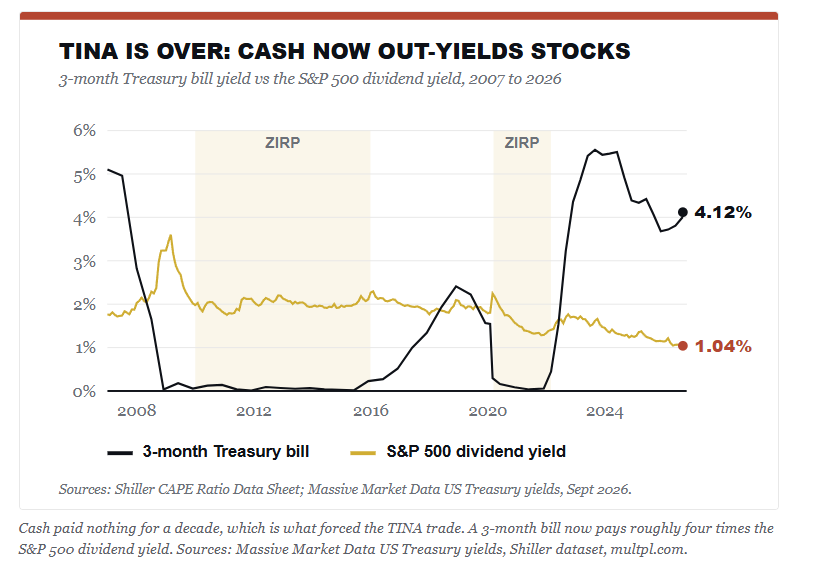
However, even if corporations sustain robust earnings growth, other valuation engines now operate in reverse. Dividend yields on smoothed earnings sit at low historical levels, and 10-year Treasury yields offer stiff competition. The "TINA" dynamic—the post-crisis era where "There Is No Alternative" to equities because cash and short-term debt yielded next to nothing—has fundamentally shifted. With short-term Treasury bills offering attractive yields with zero drawdown risk, conservative investors and retirees face viable alternatives that did not exist for much of the previous decade.
What a Reasonable Investor Does With This Information
Valuations have historically proven to be notoriously ineffective timing tools for predicting short-term market movements over the span of a few months or quarters. Yet, elevated CAPE ratios provide substantial insight into long-term probability distributions. Scenario modeling indicates that maintaining real total returns near historical highs from a starting CAPE of 41 requires an unprecedented continuation of peak valuations paired with aggressive earnings growth.
Recognizing these mathematical realities does not advocate for abandoning equities entirely. Market cycles consistently feature pronounced volatility, and exiting the market prematurely can carry a heavy opportunity cost. Instead, financial planners emphasize the importance of expectation management. Adopting realistic return assumptions helps savers align their long-term financial plans, ensuring retirement timelines and savings strategies account for a more modest economic environment.

By maintaining disciplined risk management, diversifying income streams, and acknowledging the constraints imposed by starting valuations, investors can navigate the transition away from the extraordinary monetary conditions of the previous decade. The arithmetic of the market ultimately requires careful calibration, rewarding those who balance optimism with a realistic assessment of long-term value.

Related News