Anthropic Files for Nasdaq IPO as Markets Brace for Big Tech Earnings and Fed Decision
By RIA Team | October 28, 2026 | 7 min read
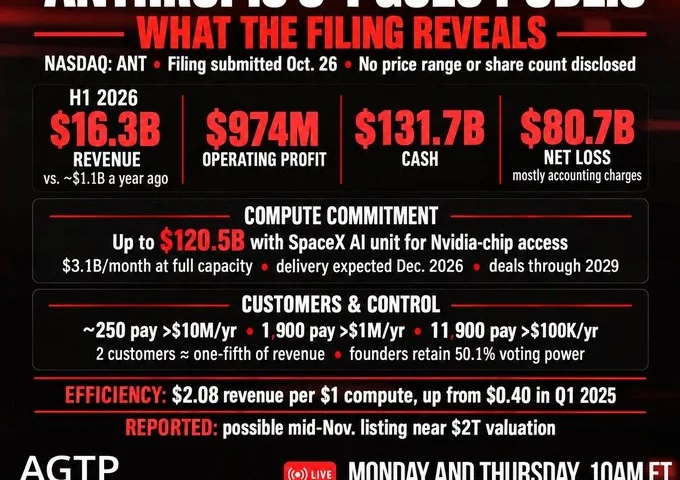
Artificial intelligence pioneer Anthropic officially stepped into the public spotlight on Monday morning, filing an SEC S-1 registration form to launch its initial public offering on the Nasdaq exchange under the ticker symbol ANT. The highly anticipated filing immediately drew intense scrutiny from Wall Street analysts and investors, who parsed the document for insights not only into Anthropic’s financial health and capital expenditure trajectory but also into the broader dynamics powering the modern technology sector.

Three primary themes within the filing commanded immediate attention from market observers. The first involves the company’s underlying financials, which reveal a picture considerably more robust than initial top-line headlines might suggest. According to the SEC filing, Anthropic’s revenue for the first half of 2026 surged to $16.3 billion, marking a dramatic escalation from the $1.2 billion reported during the same period a year prior.
While mainstream headlines quickly highlighted an eye-popping net loss of $80.7 billion—a figure calculated to give any conservative investor pause—a deeper examination of the financial statements clarifies the true nature of that deficit. The vast majority of the loss, specifically $72.4 billion, represents a non-cash accounting charge stemming from the revaluation of convertible notes and similar financial instruments. This massive charge is largely a byproduct of the company’s rapidly appreciating private valuation over the past year. In operational terms, Anthropic actually generated an operating profit of $974 million during the period, underpinned by a formidable cushion of $131.7 billion in cash and short-term investments as of June 30.

Despite this substantial cash reserve, the filing underscores that the capital demands of the artificial intelligence revolution are virtually insatiable. Anthropic reported spending $8.9 billion on compute infrastructure and hardware in the first half of 2026 alone, already eclipsing the $7.3 billion deployed across the entirety of 2025. Furthermore, the company disclosed a web of purchase commitments and long-term lease agreements stretching out to 2045, with a portion maturing prior to 2030 and the remainder falling between 2031 and 2045. Credible industry estimates place the total financial obligation of these commitments well above $500 billion.
Adding to the narrative, Anthropic explicitly stated its intention to secure additional computing power well beyond these existing commitments and to build out proprietary data centers. The revelation that a firm sitting on more than $131 billion in liquid assets must still plan for massive future financing highlights the staggering scale of the ongoing infrastructure buildout. This reality is particularly timely given recent corporate maneuvers across the sector, such as Meta’s stock split, which effectively create new avenues for equity financing to support relentless infrastructure expansion.
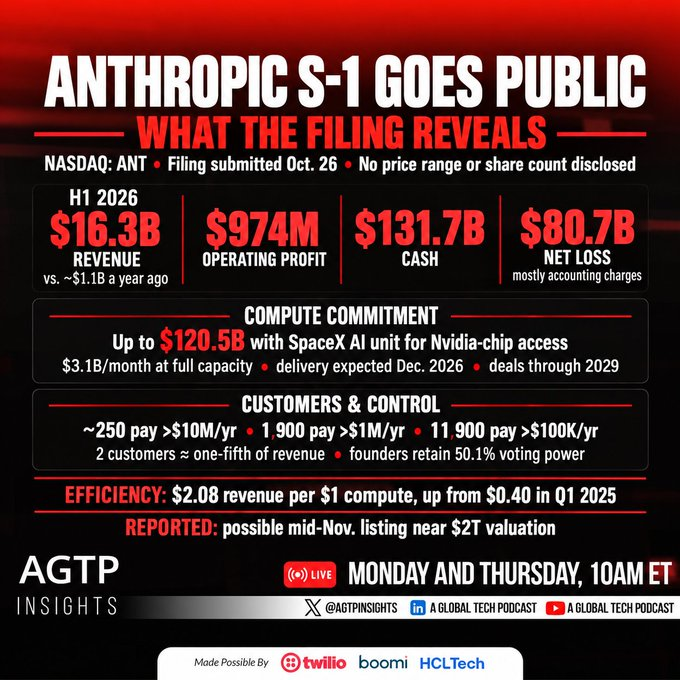
The third major area of focus centers on corporate governance and voting structure. Anthropic’s seven co-founders will retain a single share of Class F common stock that grants them 50.1% of the total voting power while carrying no economic rights. Meanwhile, a separate trust will be empowered to elect a majority of the board through another nonvoting share class. The company’s S-1 filing explicitly warns prospective investors that this dual-class configuration "may effectively eliminate the ability of holders of our Class A common stock to influence important decisions, including a change in control." By insulating management from short-term shareholder pressures, Anthropic is clearly following a governance playbook established by industry giants like Meta, effectively decoupling operational control from capital funding.
Market Context and the Concentration Dilemma
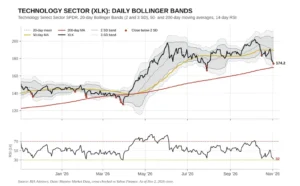
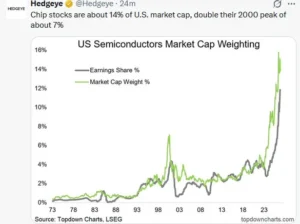
As the IPO news reverberates across financial markets, equity investors are navigating a delicate macroeconomic and trading environment. The broader market is currently grappling with extreme concentration risk, where a handful of mega-cap technology and artificial intelligence names dictate the trajectory of major indices.
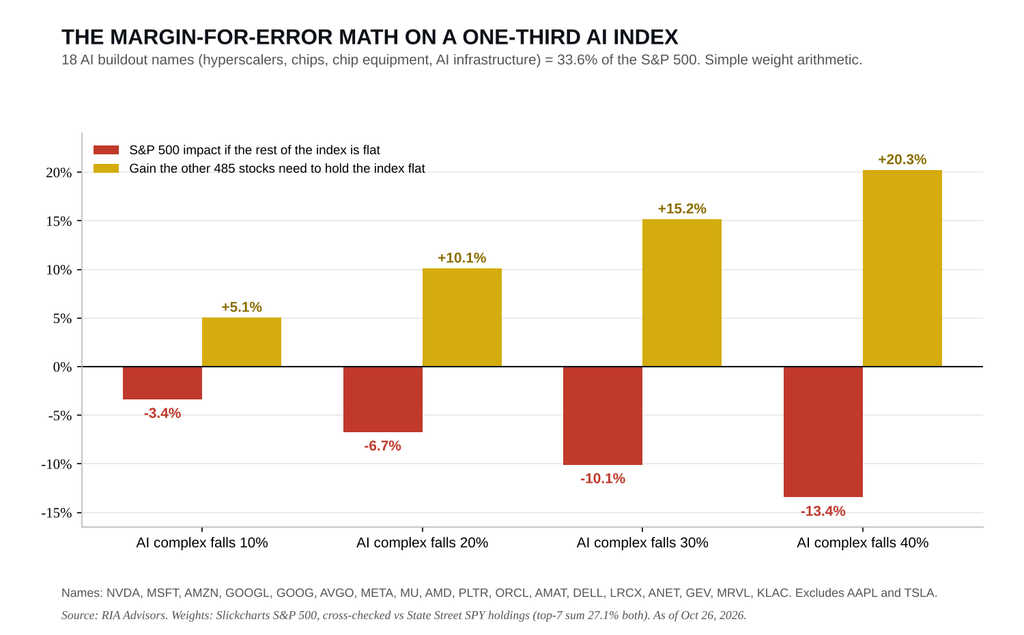
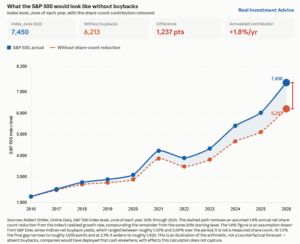
Market commentary from institutional desks has increasingly highlighted the paper-thin margin for error inherent in current index valuations. With a significant portion of the S&P 500 tied directly to the artificial intelligence buildout—encompassing hyperscalers, semiconductor designers, equipment manufacturers, and energy suppliers—any sudden correction in the AI complex carries systemic implications. Quantitative analysis demonstrates that even a modest pullback in these leading names requires extraordinary, broad-based participation from the remaining hundreds of index constituents simply to keep the benchmark flat.
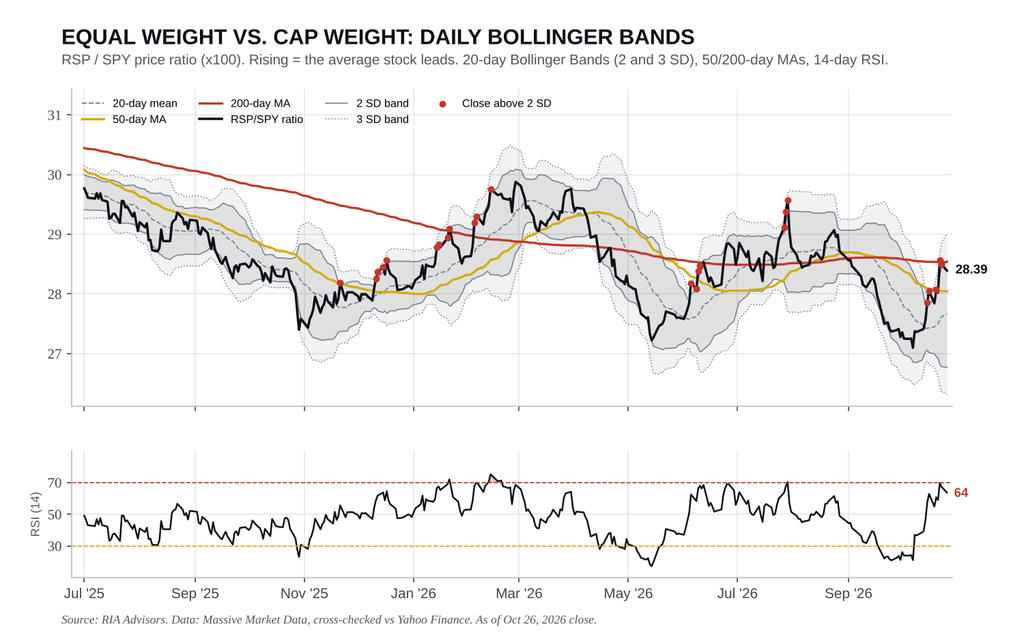
Interestingly, October has witnessed a notable rotation beneath the surface of the market. While cap-weighted indices have experienced choppy consolidation, equal-weighted market measures have shown renewed strength, outperforming their capitalization-weighted counterparts. Market participants are intensely debating whether this behavior signals a healthy broadening of the equity rally or the early stages of institutional distribution away from market leaders. Because the absolute weight of the top tech titans remains overwhelmingly dominant, the broader market can rally substantially on an equal-weighted basis while major headline indices struggle to make decisive upside progress.
Upcoming Economic Catalysts and Earnings Focus
The timing of Anthropic’s public debut coincides with a high-stakes convergence of corporate earnings reports and monetary policy decisions. Market participants are closely monitoring upcoming financial results from critical bellwethers across the industrial, technology, and financial sectors. Key earnings reports from major infrastructure suppliers and enterprise software leaders are set to provide further color on corporate spending patterns and enterprise technology adoption rates.
Simultaneously, the Federal Open Market Committee is concluding its monetary policy meeting, with investors widely anticipating an interest rate decision alongside commentary from the Federal Reserve Chair. While rate futures suggest little expectation of immediate adjustments to the benchmark target range, market participants remain hyper-focused on forward guidance regarding economic resilience, labor market dynamics, and inflation trends. Key economic indicators released concurrently, including advance trade balances and wholesale inventory data, continue to feed into the broader narrative of a slowing yet resilient economic expansion.

Against this backdrop, the underlying economics of the artificial intelligence boom remain under a powerful microscope. While the transformative potential of artificial intelligence as a foundational technology is widely accepted by industry analysts, the financial sustainability of the current capital expenditure cycle is subject to rigorous debate. Financial frameworks comparing total capital outlays by hyperscalers and smaller cloud providers against projected annual recurring revenue highlight a critical timing challenge. While mega-cap technology giants possess diversified revenue streams that comfortably cushion their infrastructure investments, smaller neocloud providers facing tighter borrowing conditions must navigate a much narrower path to profitability.
As public markets absorb the details of Anthropic’s impending Nasdaq debut, investors are reminded that the evolution of major technological shifts inevitably brings both historic innovation and rigorous market testing. Navigating this landscape requires a disciplined approach to portfolio concentration, careful risk management, and a close eye on the shifting economics of the digital infrastructure boom.

Related News