Corporate Credit Spreads Are Sending a Mixed Signal to Stock Investors: Calm on the Surface, Stress Below

Stock market investors dedicate countless hours to examining fundamental data, tuning into high-stakes earnings calls, charting price movements, and keeping a close pulse on macroeconomic indicators. Yet, one of the most reliable and revealing gauges of financial conditions and systemic liquidity—the corporate credit spread—sits quietly in a market that many equity-focused investors routinely overlook. Even for those who do not own a single corporate bond, credit spreads deserve a prominent position on any comprehensive equity dashboard.

In essence, credit spreads act as a real-time referendum by some of the world’s most sophisticated fixed-income investors on the overall health of corporate America, the broader economy, and underlying financial market liquidity. Understanding how these spreads behave provides crucial context that can either validate a stock market rally or warn of impending trouble beneath the surface.
What Is a Credit Spread?
A credit spread measures the difference in yield between a corporate bond—or an index composed of corporate bonds—and a U.S. Treasury security of a similar maturity. Because U.S. Treasuries are widely considered to be free of default risk, the spread represents the extra compensation investors demand for taking on the risk that a company might fail to repay its debt, alongside factors like liquidity and structural risks.

The most widely tracked market spread data originates from the ICE BofA indices, which rely on option-adjusted spreads (OAS). These metrics strip away the value of embedded options found in callable bonds, allowing analysts to fairly compare debt instruments with varying structures. Spreads are typically quoted in basis points, where 100 basis points equal one full percentage point.
To evaluate broader market trends, participants generally categorize bonds by their credit ratings, distinguishing between investment-grade debt and high-yield, or junk, debt. Investment-grade bonds span from AAA down to BBB-, while anything rated BB+ or lower falls into the high-yield category. As an investor moves down the ratings ladder, default risk increases, causing spreads to widen significantly.
Stock vs. Bond Analysis
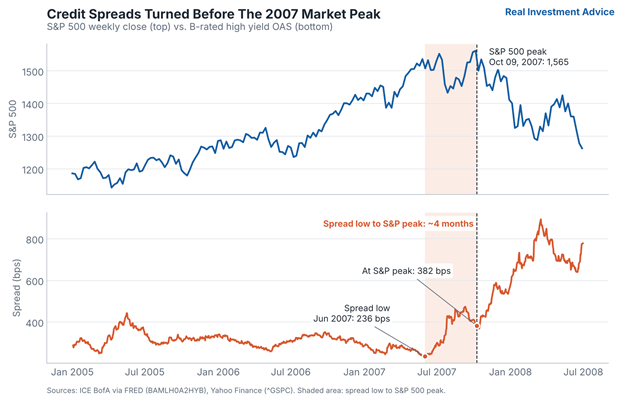
The analytical framework used by bondholders differs fundamentally from that of equity investors. For a bondholder planning to hold an asset to maturity, the best-case scenario involves receiving a steady series of coupon payments followed by the return of the full principal amount. Consequently, bond analysis focuses heavily on downside risk, forcing investors to scrutinize whether a company can consistently service its debt and ultimately return capital.
Equity investors, by contrast, frequently emphasize long-term growth, valuation multiples, and the operational execution of corporate management teams. This divergence in mindset—with bond investors remaining acutely sensitive to downside risks—makes credit spreads a uniquely valuable cross-check on the stock market and individual equities.

Furthermore, spreads reflect broader financial market liquidity. Corporate bonds trade far less frequently than equities or Treasuries, and primary dealers maintain limited balance sheet capacity to absorb heavy selling pressure. When system-wide liquidity dries up, credit spreads can widen rapidly even among high-quality bonds as forced sellers encounter a thin pool of buyers. This type of widening, driven by liquidity constraints rather than deteriorating business fundamentals, often points to underlying funding stress in the financial system—the exact kind of market friction that tends to prompt a policy response from the Federal Reserve.
Is CCC the Canary in the Credit Mine?
Recent market data highlights a striking divergence across credit tiers. As of late October 2026, the ICE BofA BBB-rated investment-grade OAS stood at 107 basis points, while the BB-rated high-yield OAS hovered at 184 basis points. Although both figures expanded modestly over the preceding months, they remained historically tight, sitting in the 8th and 9th percentiles of their respective 20-year ranges.
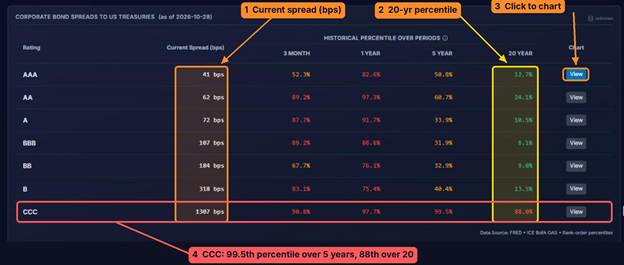
However, looking solely at BB and B junk-rated indexes fails to capture the full picture of the high-yield debt market. CCC-rated bonds, representing the riskiest tier of corporate borrowers, exhibited a spread of 1,307 basis points. That reading placed CCC spreads in the 99.5th percentile over a five-year horizon and the 88th percentile over a 20-year span. Having climbed by more than 500 basis points since September and touching 1,356 basis points, these spreads reached their highest level in three years. This stark contrast indicates that while high-quality and mid-tier borrowers enjoy relatively easy financing conditions, the lowest-quality corporate entities are facing severe and mounting financial strain.
To analyze these developments in greater detail, market analysts frequently utilize proprietary tools like SimpleVisor’s updated Credit Spreads page, which pulls ICE BofA data directly from the Federal Reserve’s FRED portal to evaluate the width of spreads, historical comparisons, and the precise concentration of market stress.
Evaluating Historical Context and Market Graphs
When examining current spread levels against long-term history, a low percentile indicates tight spreads where investors receive minimal extra yield for taking on credit risk, while a high percentile signals wide spreads and heightened market caution. Across major rating tiers from AAA through B, metrics recently hovered between the 8th and 24th percentiles of their 20-year ranges, with CCC standing out dramatically at the 88th percentile. Yet, despite these historically tight levels, broader short-term trends show that spreads across all rating tiers have climbed above their respective 75th percentiles over the past year, reflecting recent widening from extraordinarily low baselines.
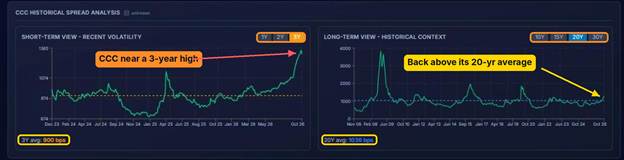
Historical charts of CCC-rated debt illustrate a steep climb since the summer months, pushing well above the three-year average of 900 basis points. While this short-term ascent naturally raises concerns, a longer-term perspective reveals that current levels—while sitting above the 20-year average of 1,036 basis points—remain far below the extreme disruptions witnessed during the 2008 financial crisis and moderately below the peaks recorded in 2016 and 2020.
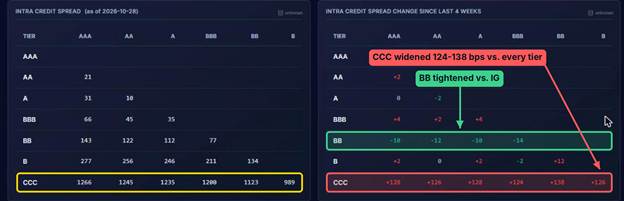
Intra-credit spread metrics further illuminate whether investors are drawing sharp distinctions between strong and weak borrowers. Over a four-week observation window, the yield gap between CCC-rated debt and every other tier widened substantially by 124 to 138 basis points. Concurrently, the gap between BB bonds and investment-grade tiers actually narrowed slightly, while internal spreads within the investment-grade spectrum barely moved. This confirms that the severe stress visible in CCC-rated debt has not migrated upward along the ratings ladder.
Examining ETF Implied Spreads and the Quality Premium
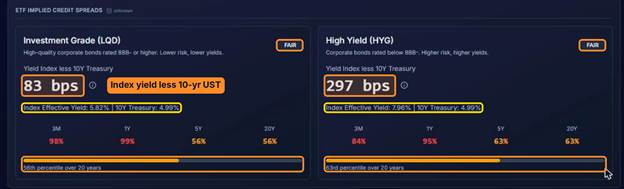
Analyzing implied investment-grade and high-yield spreads derived from popular corporate bond exchange-traded funds, such as LQD and HYG, provides an additional perspective. By subtracting the 10-year Treasury yield from the effective yield of these funds, analysts can track broader market sentiment. The investment-grade index recently yielded 83 basis points over the 10-year Treasury, while the high-yield index yielded 297 basis points over, placing both in a fair valuation range between the 20th and 80th percentiles of their 20-year histories. While noticeable, recent increases in these ETF-implied figures echo the measured behavior seen in individual rating indexes rather than signaling systemic panic.
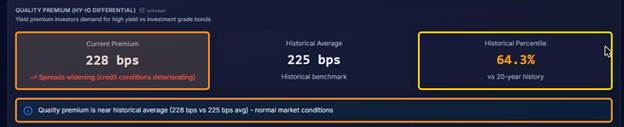
Additionally, the quality premium—which measures the yield difference between high-yield and investment-grade spreads—stood at 228 basis points, aligning closely with its long-term historical average of 225 basis points and sitting in the 64th percentile of its 20-year history. A rising quality premium typically signals that investors are growing increasingly selective, hinting at potential deterioration in underlying credit conditions.
What the Credit Market Is Communicating
Taken together, the corporate credit market is delivering a nuanced and multifaceted message. On the surface, spreads remain historically tight. Investment-grade corporations continue to borrow at spreads sitting near the bottom of their 20-year ranges, while the broader high-yield index occupies a comfortable position near the middle of its long-term range. This overall structure suggests that institutional credit investors harbor little fear of an imminent, broad-based economic recession or a severe tightening of financial conditions.
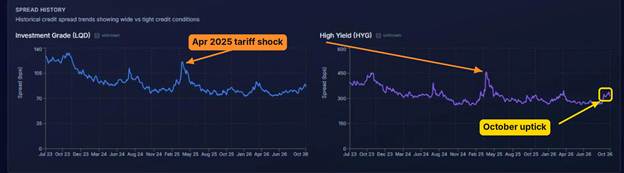
Beneath the surface, however, the sharp widening of CCC spreads flashes a distinct warning sign. This divergence demonstrates that investors are ruthlessly differentiating between enterprises capable of managing elevated borrowing costs and those facing severe refinancing walls. Weaker borrowers naturally feel the impact of higher interest rates first because they depend heavily on debt rollover. Encouragingly, this localized stress has failed to contaminate higher-quality tranches like B, BB, and investment-grade BBB credits. If the widening currently isolated within CCC bonds begins to propagate upward into healthier ratings tiers, it would represent a far more ominous signal for the broader economy and the stock market.
At the same time, persistently tight spreads remain a double-edged sword. While they reflect underlying economic confidence, they can also indicate complacency among market participants willing to accept minimal compensation for credit risk. Just as low risk premiums in other asset classes do not automatically trigger a sell-off, they leave portfolios with virtually no cushion if the macroeconomic outlook deteriorates unexpectedly.
Ultimately, corporate credit spreads serve as a vital diagnostic tool for equity investors. While current conditions signal broader calm and constructive financial liquidity, the concentrated distress among the lowest-rated borrowers warrants close supervision. Should the turbulence currently confined to CCC-rated debt spread to higher-quality corporate tiers, equity investors may need to reassess their portfolio risk and consider defensive positioning.

Related News