The AI Bubble Dilemma: Why Being Early Can Cost More Than the Crash Itself
To paraphrase veteran investor Peter Lynch, timing the artificial intelligence bubble is arguably the hardest part of modern market navigation, and financial history demonstrates that rushing into cash too early can ultimately cost investors far more than the market crash itself.
During a recent gathering of financial leaders, Citadel founder Ken Griffin told an audience of investors that the broader financial markets are "almost certainly" trapped within an artificial intelligence bubble. Griffin’s assessment aligns with numerous prevailing media narratives and analytical warnings circulating across Wall Street. However, the perennial challenge of financial markets remains simple yet brutal: being "right" is not the same thing as executing a profitable trade. Successfully timing an asset bubble is where fortunes are either secured or lost, and financial history is littered with brilliant minds who correctly identified a market bubble only to cost their clients a fortune by acting far too soon.
As Howard Marks famously noted, being right and being early amounts to the same thing as being wrong. While Griffin’s cautionary stance is grounded in historical precedent, the underlying mechanics of technological revolutions create a complex environment where two seemingly contradictory arguments can both be entirely correct at the same time. The core dilemma facing modern portfolio managers is determining how to navigate a market where speculative excess and fundamental technological progress run parallel for years.

Griffin And Fink Are Both Right
Griffin’s remarks at Citadel’s Future of Global Markets conference were not meant as a wholesale dismissal of artificial intelligence technology. Instead, they served as a pragmatic description of how every major technological transformation throughout economic history has been financed. Griffin noted that any radical restructuring of the global economy is generally intertwined with an asset bubble, adding that corporate America has shown a very uneven ability to extract tangible financial value from its deployed AI models.
That perspective carries considerable weight. Yet, just a day later, BlackRock CEO Larry Fink presented a sharply contrasting view of the primary risks on Bloomberg Television. Fink emphasized that raw computational power remains exceptionally scarce and expensive, arguing that the faster infrastructure developers can build data centers and expand compute capacity, the faster the industry can drive down costs. In Fink’s view, the greater economic danger lies in slowing down this vital infrastructure buildout, which he warns could jeopardize broader economic growth.
The critical takeaway for investors is that Griffin and Fink are not actually offering opposing viewpoints. Griffin is addressing the elevated prices and financial speculation that investors are paying for future potential, whereas Fink is focusing on whether the underlying physical infrastructure needs to exist at all. Historical precedents such as the nineteenth-century railroad boom, the widespread electrification of the economy, and the expansion of fiber-optic cables all profoundly transformed productivity while simultaneously destroying a massive share of the capital that initially funded them.

Both of these realities can exist simultaneously. Most uncomfortably for risk-conscious investors, this overlap means that a speculative bubble and genuine technological progress can march forward together for an extended period.
The Case That Griffin Is Right
To fully understand Griffin’s perspective, it is necessary to examine the foundational arguments of market bears who claim that artificial intelligence is a bubble driven entirely by a lack of real revenue.
A closer look at recent corporate filings reveals that this specific bearish narrative is factually inaccurate. Anthropic, for instance, booked $16.3 billion in revenue during the first half of the year, representing a massive surge from $1.1 billion during the same period a year earlier, according to a review of draft regulatory filings. The underlying concern for market skeptics is not a lack of revenue, but rather the sheer scale of the financial liabilities relative to those earnings. Financial disclosures indicate roughly $450 billion in committed compute obligations over the coming decade, with much of that capital payable regardless of whether the capacity is ultimately utilized, alongside potential deals pushing total commitments as high as $750 billion.
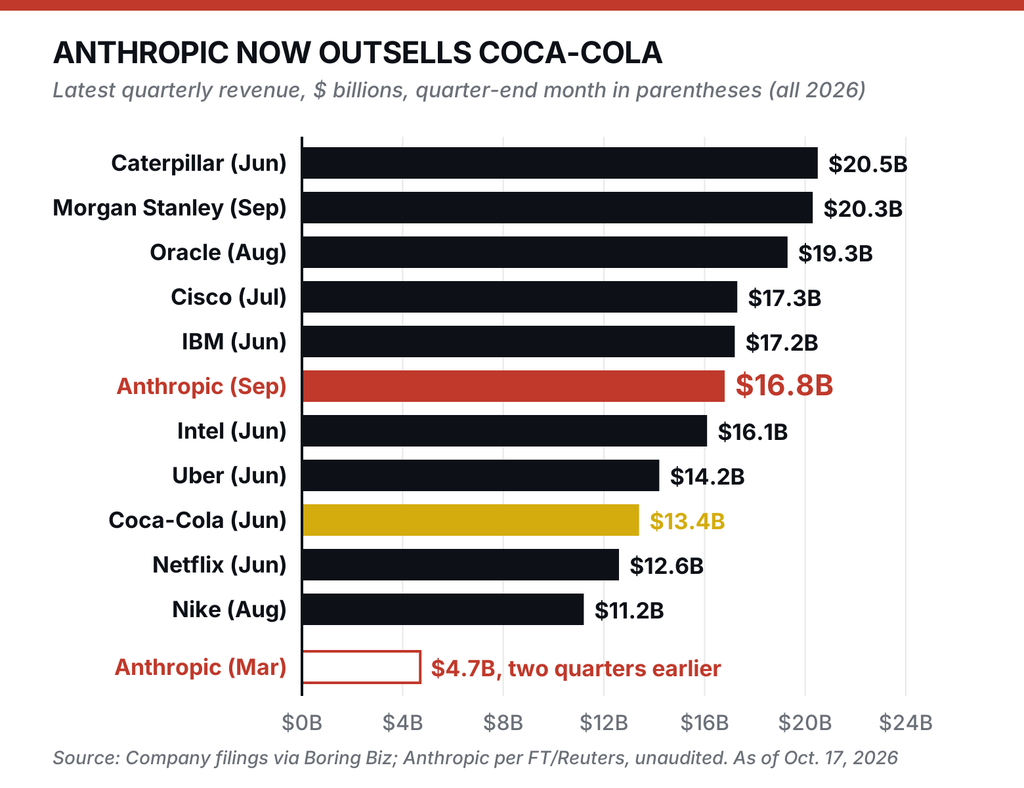
To put Anthropic’s explosive revenue trajectory into proper perspective, consider its timeline against traditional corporate giants. Anthropic did not commercialize its first product until 2023, whereas companies like Coca-Cola have been selling consumer goods for more than a century. Yet, in recent quarters, Anthropic booked revenue eclipsing major legacy enterprises like Netflix, Uber, and Intel, while more than tripling its figures from just two quarters prior.
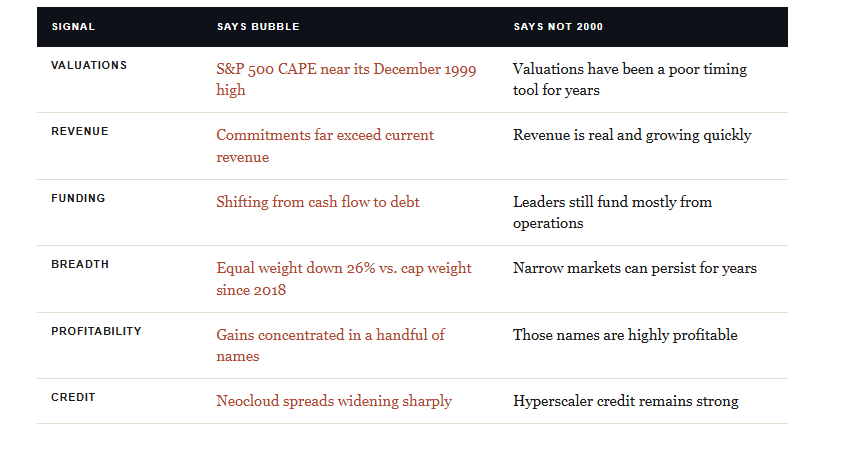
Annualizing these recent quarterly figures places the company’s revenue run rate near $67 billion. That performance already exceeds the roughly $45 billion annual average of its signed decade-long infrastructure commitments, compressing the initially alarming valuation gaps into much tighter operational margins. Furthermore, the mechanics behind financing the broader AI buildout are rapidly evolving. Early capital expenditure was funded primarily through the massive free cash flows generated by the largest technology conglomerates. More recently, Wall Street credit teams project that project financing and direct corporate debt issuance will scale up dramatically, shifting a larger portion of the capital burden onto specialized financing structures.
At the same time, artificial intelligence capital expenditures currently drive roughly half of all earnings growth across the broader benchmark indices. Consequently, the primary risk to the market may not necessarily be an outright decline in spending that damages corporate earnings, but rather a simple deceleration in the rate at which that spending accelerates.
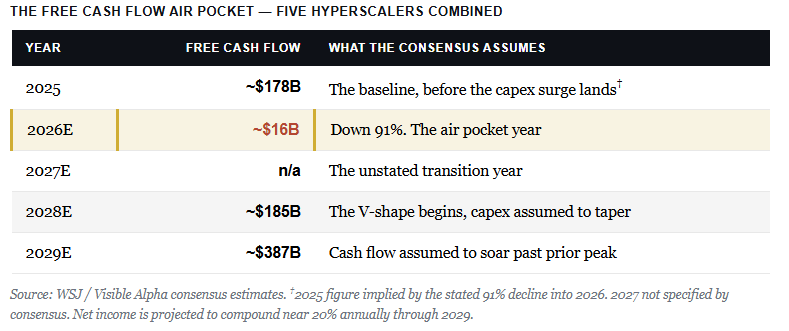
A temporary contraction in free cash flow does not automatically signal a deeper corporate distress. The crucial metric for investors is understanding why free cash flow is declining. A business burning through cash because its customer base is eroding or its profit margins are collapsing is facing a severe operational problem. Conversely, a highly profitable enterprise intentionally deploying its capital into expanding infrastructure capacity is making a deliberate long-term investment decision.
Consensus financial projections indicate that the combined free cash flows of major technology hyperscalers will experience a significant near-term dip as infrastructure spending peaks, before eventually recovering sharply once the heaviest phase of physical construction concludes. The critical question for the market is whether the eventual returns on this massive capital expenditure materialize before accumulated debt obligations mature.
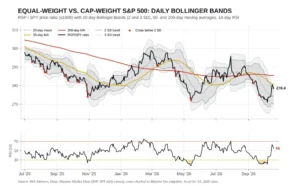
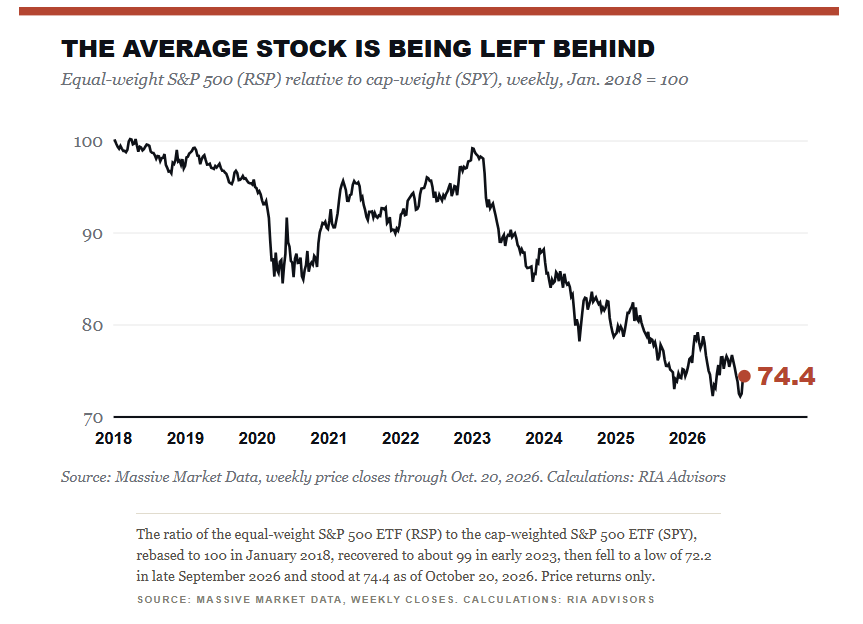
Market breadth represents another vital dimension of the current financial landscape. A healthy equity market typically sees the average stock keep pace with the performance of its largest constituents. However, since the broader AI trade took hold, equal-weight market benchmarks have lagged significantly behind their capitalization-weighted counterparts, highlighting a widening performance gap that commands close attention from institutional risk managers.
The Case That This Isn’t 2000
Evaluating the current market environment requires a careful balancing of real versus perceived risks, keeping historical comparisons to the dot-com era in perspective. While various market indicators share similarities with the environment of late 1999, a fundamental distinction separates the modern market leaders from past speculative manias. Companies like Microsoft, Alphabet, Amazon, and Meta generate staggering amounts of net income and fund the vast majority of their ambitious capital outlays directly from ongoing operational cash flows, distinguishing them starkly from speculative ventures of the past that went public with minimal cash reserves.
The macroeconomic productivity argument also warrants careful consideration. During the early 1980s, personal computers began appearing across corporate offices, yet their transformative impact failed to register significantly in official productivity statistics until the mid-1990s. The sluggish productivity growth observed today may simply indicate that artificial intelligence integration remains in its early innings rather than signaling a structural failure.
When these competing perspectives are weighed against one another, the most accurate answer to whether artificial intelligence constitutes a financial bubble remains heavily nuanced.

Is AI A Bubble? Right Is Not The Same As On Time
Assuming that Ken Griffin’s assessment of a market bubble is entirely accurate, the critical question remains whether investors should immediately liquidate their portfolios. Financial history overwhelmingly suggests that the answer is no, or at least that the timing for such a drastic move has not yet arrived. Recognizing the formation of a market bubble requires one specific analytical skill, but executing the precise timing required to take profitable action is an entirely different discipline.
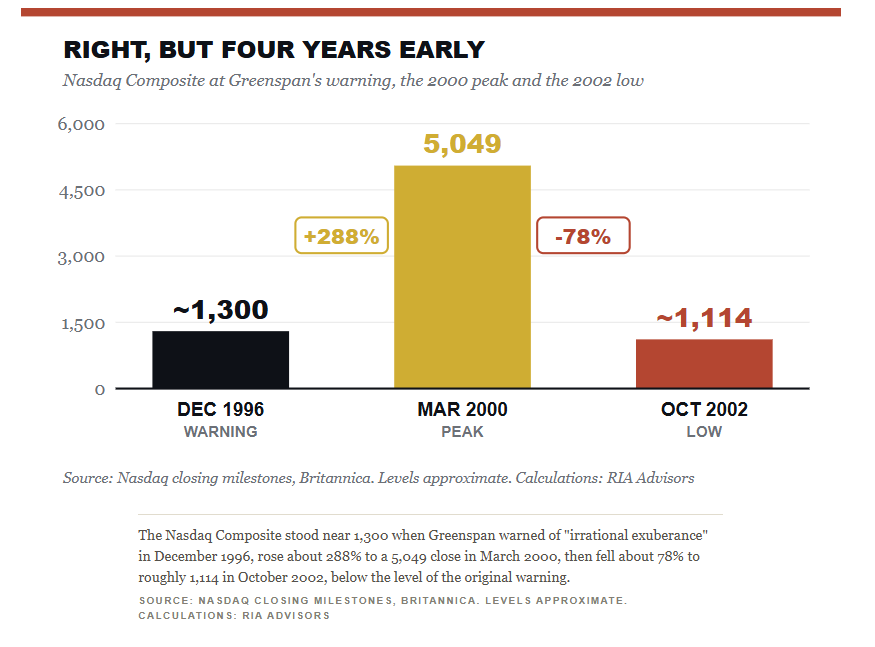
A classic historical parallel can be found in former Federal Reserve Chairman Alan Greenspan’s famous warning regarding "irrational exuberance," delivered in December 1996 when major indices were trading at a fraction of their eventual peak levels. Greenspan’s macroeconomic evaluation was entirely correct. However, investors who immediately liquidated their equity holdings based on that warning watched the market nearly quadruple over the next three and a half years before the speculative bubble finally burst in earnest. Most individual investors lack the psychological fortitude to sit on the sidelines for years watching a rising market without buying back in near the top, thereby experiencing the worst of both outcomes.
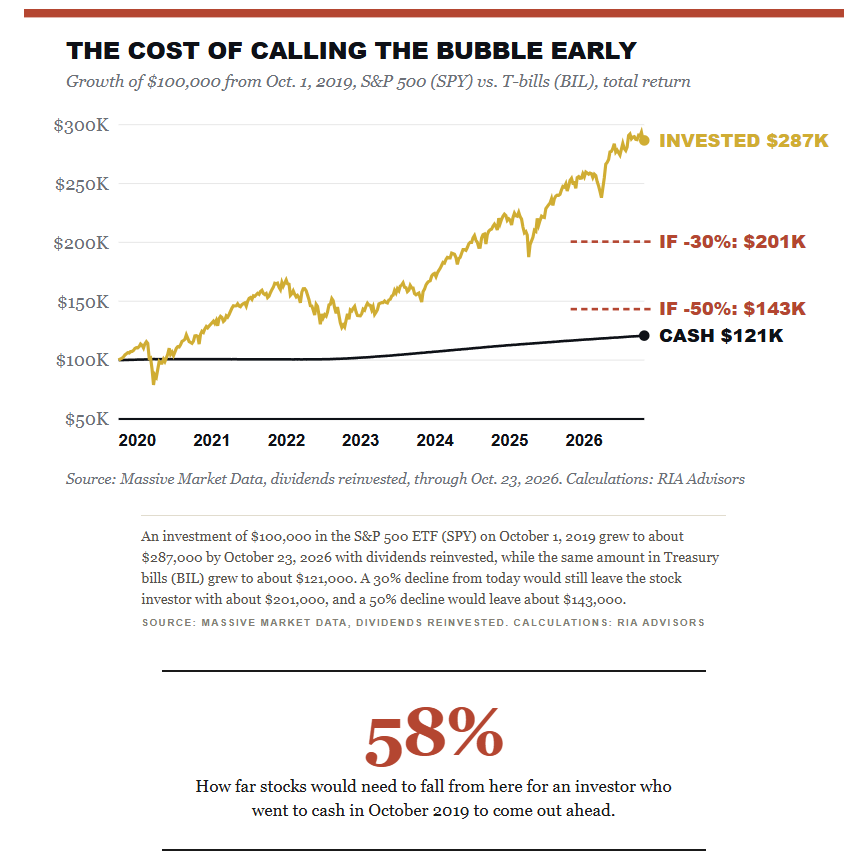
A more recent case study involves the prominent market bubble warnings issued by veteran investors in late 2019 and early 2020. At that time, benchmark valuations traded significantly above long-term median levels, and the necessary catalyst arrived swiftly with the pandemic-induced market correction. However, investors who exited the market entirely during those early warnings and failed to participate in the subsequent recovery faced severe opportunity costs.
An investor who moved entirely to cash during late 2019 would require a historic market drawdown far exceeding the severity of the 2008 financial crisis simply to match the cumulative returns of an investor who maintained their disciplined market exposure. Being early on a bubble call is far from a minor miscalculation; the financial penalty compounds with every passing year that the speculative cycle continues to inflate. As Peter Lynch famously observed, far more capital has been lost by investors attempting to anticipate market corrections than has ever been lost during the corrections themselves.
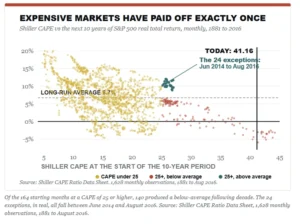
Valuations remain a critical metric for long-term expected returns, but they notoriously fail as precise timing tools. This fundamental duality is precisely why portfolio management decisions should rarely be framed as an all-or-nothing choice between total investment and complete cash liquidation.
The Strongest Case Against Staying Invested
While historical data strongly cautions against premature liquidation, dismissing the legitimate risks of asset bubbles would be a mistake. When speculative bubbles ultimately reach their breaking point, the resulting market drawdowns are frequently severe, with historical equity washouts ranging from dramatic double-digit declines to near-total losses of capital. Major historical market peaks have sometimes required over a decade or even a generation to fully regain their previous highs.
This reality highlights the importance of individual investment horizons. The mathematical logic of remaining fully invested over long time horizons works effectively for investors with decades until retirement, but it presents a drastically different risk profile for individuals entering their retirement years. Time remains the ultimate commodity because it cannot be replenished. A substantial market decline is entirely survivable for an early-career professional, but for a retiree drawing immediate income from a static portfolio, a major drawdown can permanently alter their financial security.
This challenge underscores the well-documented danger of sequence of return risk. An individual’s personal timeline, rather than macroeconomic forecasts regarding speculative bubbles, should dictate the appropriate level of portfolio risk they choose to carry. For retirees or those nearing the end of their accumulation phase, surviving a potential market contraction takes precedence over attempting to squeeze out the final gains of an ongoing market rally.
How To Participate With The Bubble: Rules To Follow
Determining whether current markets represent a definitive bubble remains a subject of intense debate among institutional economists, and definitive confirmation typically only arrives after the cycle has run its course. Consequently, rushing entirely to cash based on unproven timing carries a measurable historical penalty, while riding a speculative trade with zero risk management protocols introduces catastrophic vulnerability.
The rational middle path involves disciplined market participation governed by pre-established rules formulated during calm market conditions, as effective risk controls are rarely designed successfully during a sudden market drawdown. Attempting to precisely time the peak of an artificial intelligence cycle is statistically unreliable, but managing portfolio exposure and downside risk is entirely manageable through structured planning.
Investors benefit from avoiding extreme portfolio shifts, recognizing that portfolio exposure can be adjusted incrementally as underlying conditions evolve rather than treating market participation as an all-or-nothing binary choice. Establishing clear position sizing limits in writing before deploying capital helps prevent any single market trend from dominating overall portfolio volatility. Recognizing that standard equity index funds already incorporate substantial exposure to leading technology themes allows investors to utilize systematic rebalancing schedules to take profits automatically without emotional friction.
Prioritizing enterprises that fund their research and capital expenditure through robust operational free cash flow provides an essential layer of fundamental defense compared to relying on aggressive leverage or debt-financed obligations. Furthermore, defining clear exit strategies and predetermined risk thresholds in advance helps safeguard portfolios against unexpected macroeconomic shifts. Closely monitoring broader liquidity metrics, monetary policy developments, and credit spreads offers reliable early indications of underlying market stress long before headline narratives shift.

Ultimately, aligning portfolio risk tolerances with personal financial timelines ensures that normal market volatility does not compromise long-term financial security. While speculative cycles will inevitably run their course, maintaining disciplined risk management protocols remains the most effective way to preserve accumulated capital while navigating evolving market environments.

Related News