Hedge Funds Scale Back Tech Exposure as Retail Investors Double Down on Semiconductors
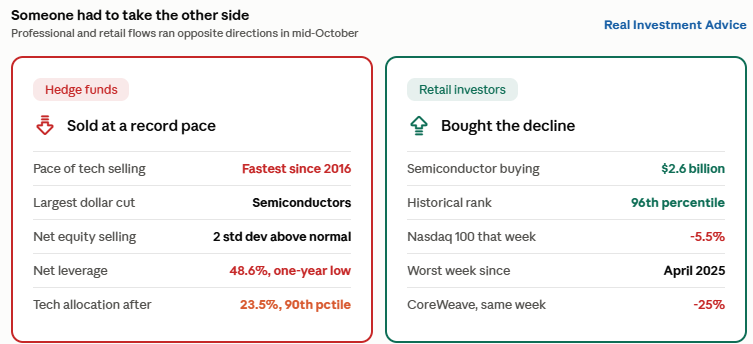
According to recent data from Goldman Sachs’ prime brokerage division, hedge funds cut their technology sector positions in mid-October at the fastest rate since 2016. This sharp bout of selling helps account for the recent weakness observed in the Nasdaq 100, which recently suffered its worst weekly performance since April 2025. Furthermore, Goldman’s figures indicate that global artificial intelligence stocks have completely relinquished every dollar of net buying accumulation that hedge funds had built up since early 2025. While observers might interpret this data as a sign that institutional managers are aggressively bracing for a broader market downturn, a closer examination reveals a more nuanced picture.

Despite the rapid reductions, technology shares continue to represent 23.5% of Goldman’s global prime book, maintaining an allocation in the upper 90th percentile relative to the past five years. While total technology holdings remain elevated, market analysts suggest that the velocity of the recent reductions is the more telling metric. To that end, hedge fund net leverage drifted down to a one-year low of 48.6%. This drop indicates that institutional players adopted a more defensive posture by reducing leverage, yet they largely maintained their foundational exposure to underlying technology stocks.
This distinction holds significant importance for market positioning. Liquidating a crowded position at a record pace from a 90th-percentile allocation does not constitute a wholesale capitulation. Instead, it represents a crowded trade becoming marginally less crowded. Considerable room remains for institutional investors to further deleverage and sell should the broader AI financing narrative deteriorate. Conversely, this positioning also leaves ample room for hedge funds to scale their leverage back up within the technology sector if market conditions stabilize.

Diverging from institutional caution, retail investors—frequently categorized by market professionals as the "dumb money"—poured $2.6 billion into semiconductor equities during the exact same week that hedge funds were aggressively offloading shares. This $2.6 billion influx registers at the 96th percentile of historical retail activity. Historically, when professional managers exit a crowded trade while retail participants step in to absorb the selling pressure, the market has interpreted the dynamic as a distinctly bearish signal. However, recent market history demonstrates that retail investors have increasingly found themselves on the correct side of major sector trades.
What To Watch Today
As the market navigates these shifting institutional currents, investors are turning their attention to a heavy slate of third-quarter corporate earnings and critical macroeconomic data. Tuesday marks the beginning of the two-day Federal Open Market Committee (FOMC) meeting, with the central bank currently operating under its standard pre-meeting blackout period. No Federal Reserve officials are scheduled to speak ahead of Wednesday afternoon’s official interest rate decision and subsequent press conference.
On the macroeconomic front, morning releases include September Durable Goods Orders, which consensus estimates project to rise 1.5% month-over-month following a flat reading in the prior period. Economists are also closely watching the S&P/Case-Shiller Home Price Index for August, alongside the Conference Board’s Consumer Confidence Index for October, which is forecast to hover near 80.0. The Treasury Department is scheduled to auction off $5-year notes during the early afternoon session.
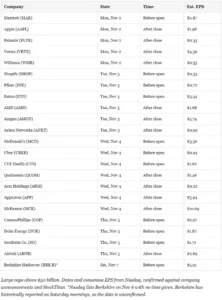
Corporate earnings reports are rolling out across multiple sectors. Major market movers reporting ahead of the opening bell include Boeing, Coca-Cola, United Parcel Service, HCA Healthcare, S&P Global, and PayPal. Meanwhile, post-market reports are slated from Visa, Seagate Technology, NXP Semiconductors, Waste Management, and Robinhood Markets, providing fresh insights into consumer health, enterprise spending, and semiconductor demand.
Market Trading Update
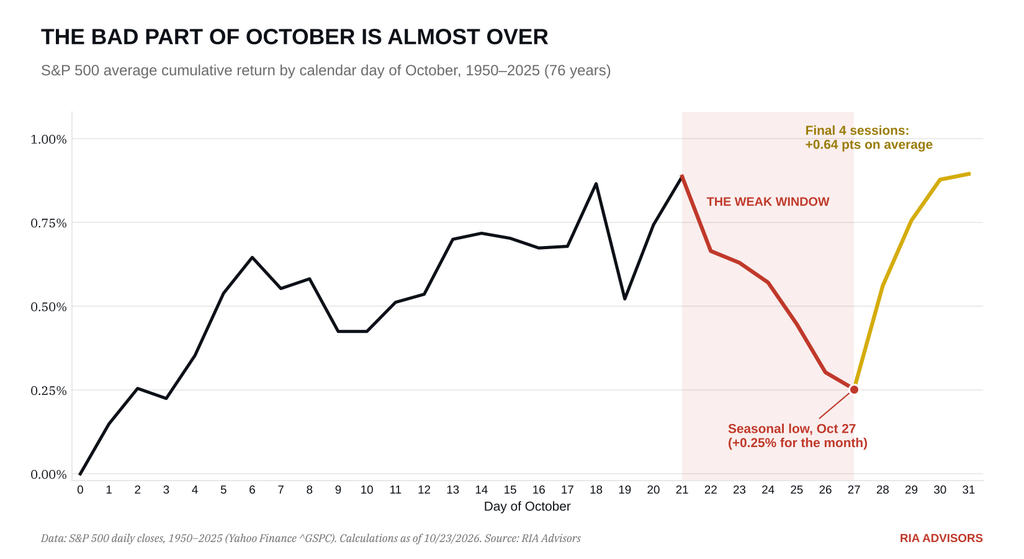
Recent market commentary highlights that the stock market’s primary engine of support has temporarily stepped back, leaving the S&P 500 hovering near its 100-day moving average at 7,605. Looking at historical seasonal patterns, however, the calendar is poised to pivot in favor of the bulls as year-end approaches.
Historical data going back to 1950 shows that the stretch between October 21st and October 27th typically represents the weakest seasonal window of the entire month. During this span, the S&P 500 historically surrenders roughly 70% of its total October gain, frequently bottoming out precisely on October 27th before the final four sessions of the month recoup those losses and push higher. This year’s market action followed that script closely, with the index slipping 1.7% from an October 21st close of 7,757 down to Friday’s finish at 7,623.68.
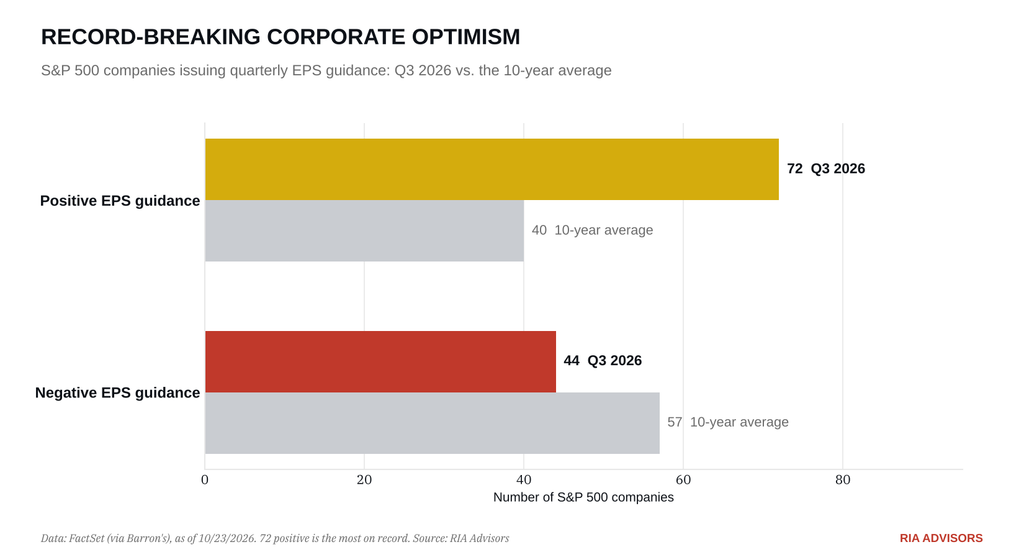
Underlying corporate fundamentals provide supportive ballast for this anticipated seasonal turn. According to FactSet, approximately 24% of S&P 500 companies have reported third-quarter results thus far, with 83% beating consensus estimates—outperforming the five-year average beat rate of 78%. Blended third-quarter earnings growth currently stands at a robust 29.5%. More importantly, a record 72 companies have issued positive earnings-per-share guidance for the quarter, compared to a ten-year average of 40 firms. Only 44 companies have issued negative guidance, well below the historical norm of 57. The primary caveat lies in the magnitude of the beats, with the aggregate earnings surprise registering at a modest 2.1% compared to a five-year average of 7.5%, indicating that analyst estimates have largely caught up with operational realities.
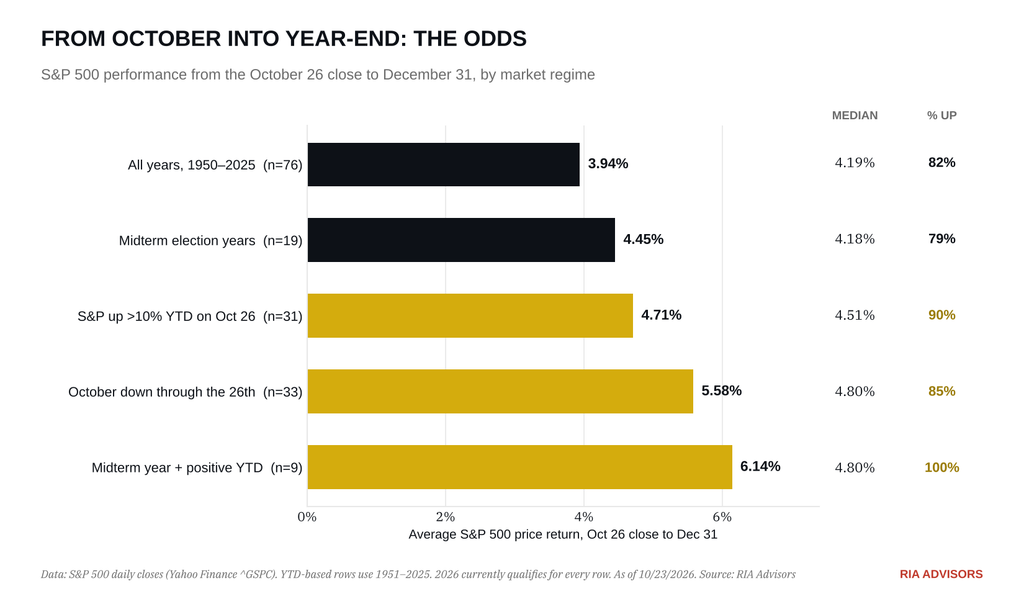
Historically, from the October 26th close through December 31st, the S&P 500 has generated an average gain of 3.94% and finished the period in positive territory 82% of the time. The current year layers on additional favorable historical analogs: 2026 is a midterm election year, the index maintains a year-to-date gain of 11.4%, and October is tracking slightly negative month-to-date. Each of these structural regimes historically elevates average year-end returns to a range between 4.5% and 5.6%. Across the nine previous midterm years that featured a positive year-to-date gain heading into late October, the market finished the year higher on every single occasion.

Applying these long-run averages to Friday’s close points toward an index level near 7,925, which would eclipse the record set on October 6th. Nevertheless, market averages do not constitute deterministic forecasts. The worst historical performance during this window occurred in 1973, marked by a 12.4% decline. A closer modern analog may be found in 2018, another midterm year, when a Federal Reserve actively hiking interest rates into a rising yield environment generated a 5.7% loss over the final months of the year. With the FOMC meeting underway and the 10-year Treasury yield hovering near 5.0%, the risks associated with monetary over-tightening warrant careful risk management.
Trading strategies remain disciplined around key technical levels. The 100-day moving average at 7,605 serves as the critical line in the sand. If this support level holds steady through the Federal Reserve’s policy announcement and upcoming high-profile earnings from mega-cap technology names, market participants can utilize seasonal tailwinds to rebalance portfolios back toward growth assets. Conversely, a decisive break below this threshold would shift focus toward the September 16th low of 7,564 or the 200-day moving average at 7,293 before introducing new risk exposure.
Healthcare Is Red Hot: Time For a Change?
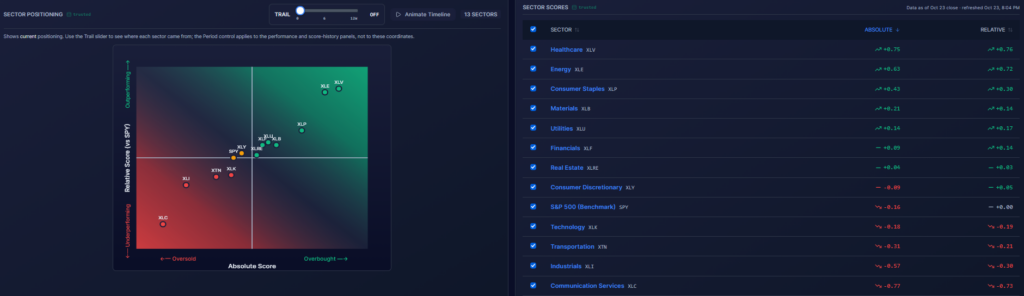
The ongoing rotation away from technology is manifesting clearly across sector leadership metrics. Roughly a month ago, the technology sector occupied a dominant position in market momentum rankings, boasting absolute and relative strength scores in the 80s and low 90s. At that time, nearly every other sector outside of energy was oversold, with several deeply depressed. Over the span of less than four weeks, healthcare has surged into overbought territory, joining the energy sector, which remains elevated due to geopolitical tensions in the Middle East. Meanwhile, interest-rate-sensitive sectors cluster near fair value, while technology, transportation, and industrial stocks hover near oversold levels.
Healthcare stocks offer unique defensive characteristics, remaining largely insulated from immediate fluctuations in interest rates and broad economic activity. Consequently, as investors retreat from technology, healthcare has emerged as the preferred safe haven. In contrast, traditional rate-sensitive sectors such as utilities, consumer staples, and real estate have shown modest improvement but lack decisive leadership as bond yields remain elevated and the trajectory of the ongoing bond rally remains uncertain. With the Federal Reserve maintaining a restrictive posture, market participants remain cautious regarding economically sensitive cyclical sectors. For the time being, healthcare occupies the position of the premier defensive sector, though its overbought status suggests a potential secondary rotation may loom in the coming weeks.
Griffin May Be Right About AI: The Timing Could Be Very Wrong

Recent remarks from Citadel CEO Ken Griffin suggest that financial markets are "almost certainly" operating within an artificial intelligence bubble. While his fundamental assessment aligns with numerous structural concerns regarding capital expenditure versus monetization, the core challenge for active market participants remains the timing of the cycle. Financial history is replete with astute investors who correctly identified market bubbles only to incur substantial losses for their clients by attempting to trade on that thesis prematurely.
As Howard Marks famously noted, being right and being early amount to the same thing as being wrong. While the debate regarding the sustainability of artificial intelligence infrastructure spending and revenue generation will likely persist for years, the immediate operational challenge for investors is determining how to position portfolios effectively while both competing market realities remain partially true.

Related News