Oracle’s Buyback Reversal Highlights Broader Market Shocks and Fed Policy Dilemmas
By RIA Team | November 6, 2026
Corporate share repurchases have long been championed as a reliable way to return capital to shareholders, but their long-term efficacy often depends entirely on valuation. No company illustrates this better than Oracle, which is now executing a sharp pivot from a prolific buyer of its own stock to an active equity issuer. Having repurchased roughly $96 billion of stock since 2019, Oracle’s strategy is undergoing a dramatic reversal that exposes the strategic pitfalls of the decade-long corporate obsession with buybacks.

As analysts have
noted, Oracle is now selling equity, issuing $10 billion on top of an additional $19.9 billion issued between February and August of this year. This sudden shift underscores a fundamental rule of capital allocation articulated by Warren Buffett back in 2011, when he noted that repurchases only make sense when a company has ample operational and liquidity funds and when its stock sells at a material discount to its intrinsic business value.
A closer examination of Oracle’s recent history reveals the cost of ignoring this principle. Between 2019 and 2022, the software giant bought back approximately $92 billion in stock, retiring those shares at a weighted average of roughly 21 times trailing earnings. Buybacks subsequently ground to a halt between 2023 and 2025 due to the company’s massive $28 billion acquisition of Cerner and the accompanying debt load.

Today, Oracle shares trade at roughly 18.7 times trailing earnings—marking a one-year low—and about 15 times forward earnings, compared to a five-year average near 21. By historical standards, the stock is relatively cheap, which under normal circumstances would make it an ideal time to resume buybacks. Instead, the company is issuing equity at a multiple roughly 13% lower than the price at which it bought back shares, and nearly 30% below its recent norm on forward earnings.
In essence, Oracle acquired high-quality earnings streams at 21 times and is now diluting its shareholders by issuing equity and selling earnings back at 15 to 19 times. Had the company conserved cash for future investments rather than aggressively bolstering its share price years ago, its credit rating would not be teetering near junk status today, nor would it rely so heavily on dilutive equity issuances to fund its burgeoning artificial intelligence investments. Poor short-term capital allocation has left the enterprise in a precarious structural position.
Market Trading Update and the Aftermath of Midterm Shocks
Oracle’s capital management missteps form part of a broader, highly volatile macroeconomic backdrop that rocked Wall Street. Earlier in the week, market participants laid out year-end tailwinds and established critical technical lines in the sand, noting that a close below the early November lows would stall market momentum and trigger a temporary halt to risk exposure.
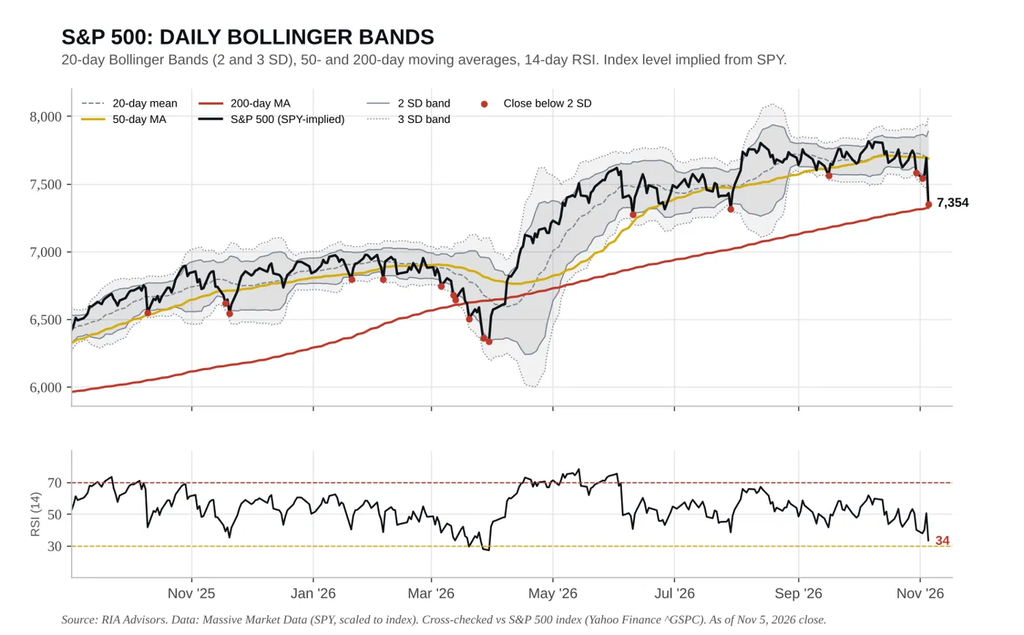
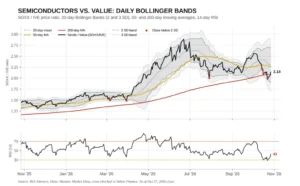
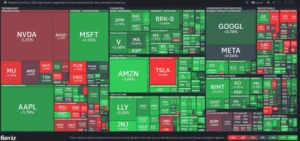
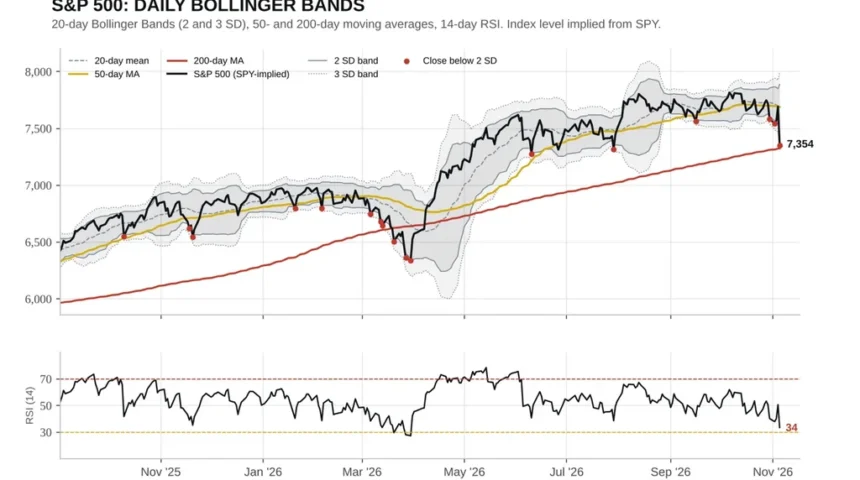
That line was crossed definitively. The S&P 500 tumbled 4.4% to close at 7,354, hitting the low of the day. The Nasdaq 100 absorbed an even steeper blow, dropping 6.5%, while the semiconductor exchange-traded fund cratered 11%. Memory chip manufacturers bore the brunt of the selling, with firms like Micron and AMD plunging roughly 17%, and Nvidia shedding 9%. By the closing bell, defensive sectors offered no safe harbor, as even Staples and Utilities finished in negative territory. Historical market data shows that daily losses of this magnitude are exceptionally rare for the S&P 500.
The immediate catalyst behind the sudden rout was political. Reports attributed the aggressive selling to sweeping midterm victories by Democrats, which stoked investor anxiety over potential future congressional scrutiny and regulatory headwinds facing the massive data-center buildout. Legislative proposals, such as the proposed AI Data Center Moratorium Act, have fueled fears of construction pauses on new data facilities until federal oversight is codified. Concurrently, softer-than-expected earnings reports from Qualcomm and Arm added downward momentum, quickly transmitting stress to energy infrastructure suppliers like GE Vernova and Constellation Energy.
Despite these immediate jitters, market analysts emphasize that a proposed moratorium bill is vastly different from enacted law. Even a Democratic-controlled Congress requires executive branch approval, and numerous lawmakers remain opposed to policies that could impair national competitiveness against foreign rivals like China. Consequently, the most probable outcome of these political shifts is a wave of high-profile hearings and headlines rather than a sudden halt to hyperscaler capital expenditures. Corporate earnings forecasts for the coming years remain fundamentally unaltered; rather, it was the valuation multiple that investors were willing to pay for those earnings that experienced a violent reset.

The mechanics of a forced institutional de-risking compounded the sell-off. Prime brokerage data from major financial institutions revealed that both fundamental and systematic hedge funds sustained heavy losses, prompting rapid unwinding of existing long positions at a pace vastly exceeding short additions. With gross leverage lingering near historic highs, crowded trades tend to unravel simultaneously, forcing institutional risk managers to liquidate assets regardless of underlying business fundamentals.
Historical Context and Oversold Market Conditions
Examining past midterm election cycles reveals just how unprecedented this specific sequence of events has been. While the S&P 500 historically registers initial post-election optimism—rallying strongly immediately following ballots are cast—the subsequent sharp second-day decline has virtually no direct precedent outside of crisis periods like 2008. While seasonal tailwinds frequently support year-end rallies, historical analogs serve as a reminder that market resilience is never guaranteed.
Nevertheless, the speed and scale of the recent correction have pushed major equity indices into deeply oversold territory. The S&P 500 closed more than three standard deviations below its 20-day moving average, with its Relative Strength Index sliding toward 34. The index is down roughly 6% from its recent peak, hovering just above its critical 200-day moving average, while the Nasdaq 100 has slipped into a technical correction down 15% from its highs, and semiconductor equities have officially entered a bear market.
Historically, extreme technical stetches of this nature rarely persist indefinitely. Long-term market data indicates that when the S&P 500 experiences extreme short-term oversold readings while remaining above its 200-day trendline, subsequent recovery over a one-to-three-month horizon is highly probable. When long-term structural trends hold firm, extreme market corrections have historically functioned as accumulation opportunities rather than the inception of prolonged bear markets.
Navigating this environment requires disciplined risk management. Rather than chasing falling knives or panicking out of core positions, market participants are watching to see if the 200-day moving average successfully acts as a structural floor. A reflexive bounce toward short-term resistance levels will likely offer a natural window to rebalance portfolios, while sustained institutional support could lay the groundwork for measured reinvestment in growth sectors.
Monetary Policy and Disinflationary Realities
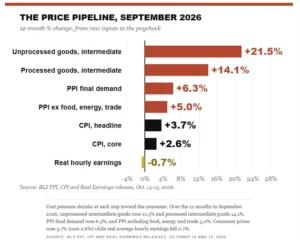
Compounding the equity market’s structural adjustments is an ongoing debate regarding Federal Reserve policy and the trajectory of inflation. Recent commentary has highlighted the limits of central bank influence over global supply chains and corporate investment cycles. While the Federal Reserve controls overnight lending rates, it does not dictate geopolitical developments in key energy corridors, nor does it control the multi-hundred-billion-dollar capital expenditure budgets deployed by technology giants.

Inflationary pressures have shown signs of shifting, driven largely by factors outside the direct purview of monetary policymakers. Global crude oil prices have experienced notable pullbacks from recent peaks, driven by evolving diplomatic efforts and shifting expectations surrounding regional conflicts. Meanwhile, the massive infrastructure buildout surrounding artificial intelligence has generated distinct cost pressures, including sharp increases in dynamic random-access memory pricing and elevated software and hardware import costs.
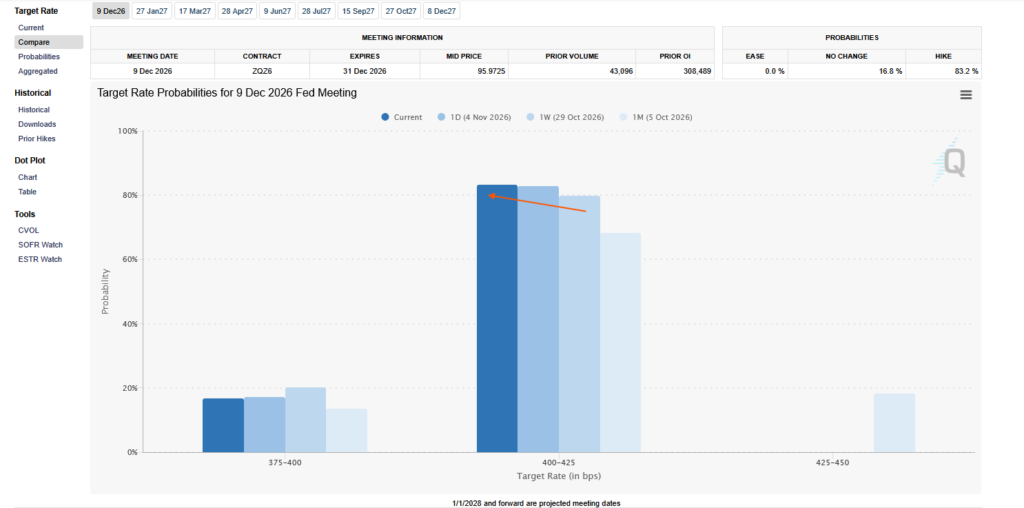
Despite emerging disinflationary impulses and falling commodity prices, financial markets continue to price in the probability of future interest rate adjustments by the central bank. This disconnect raises ongoing questions among economists and market strategists regarding whether aggressive monetary tightening risks becoming a policy error if deployed against price pressures driven by technological investment and supply-side dynamics that traditional interest rate hikes cannot directly control. As corporations navigate capital allocation missteps and equity markets digest rapid regulatory and political repricing, market participants remain focused on technical discipline, fundamental valuation, and the broader macroeconomic horizon heading into year-end.

Related News