Decoding Fractional Reserve Banking: How the Modern Financial System Shapes Inflation and Economic Stability
For many observers, the mechanics of the modern banking system remain profoundly unintuitive. Yet, developing a comprehensive grasp of how banks function is an invaluable asset for investors and economists alike. Understanding the architecture of commercial and central banking provides critical insight into whether an economy faces monetary inflation or disinflation, as well as gauging the underlying risks of widespread financial panics.
For years, many market participants have remained overly fearful of investing due to lingering anxieties over the 2008-style banking crises, while others continue to lock their capital into low-yielding bonds based on misguided theories of financial mechanics. Conversely, a segment of the financial commentary sphere periodically forecasts hyperinflation or systemic collapse with misplaced probabilities and distorted timeframes. Financial historians and macroeconomic analysts have long explored these banking dynamics, examining how the architecture of fractional reserve banking versus full reserve banking fundamentally impacts the nature of money itself.

Custodians vs. Lenders
To understand modern banking, it is essential to distinguish between pure custodians and lenders. A pure custodian is an enterprise that holds items of value on behalf of customers, typically charging a fee for safekeeping. Safe deposit boxes, gold vaulting services, and exchange-traded funds holding equities are classic examples. These entities manage assets while clients pay for administrative and physical security.
Some stored assets are non-fungible, meaning they are distinct and interchangeable. The contents of one individual’s safe deposit box, for instance, differ entirely from another’s, requiring the institution to maintain strict separation. However, when dealing with fungible assets—such as identical one-kilogram gold bars stored at a specialized vault—the logistics change. Because the bars are interchangeable, the custodian does not need to track individual serial numbers. Instead, the facility maintains a centralized vault containing enough total gold to cover all customer ownership claims, drastically reducing logistical overhead.

When custodians hold fungible assets that function as money or money-like instruments, a new commercial possibility emerges: lending. Most depositors do not demand immediate redemption of their stored wealth on any given day. Recognizing statistical regularities—such as an annual redemption rate of ten to twenty percent—custodians realize they can deploy a portion of those stored assets to generate interest income. By keeping a safe reserve margin to cover normal withdrawals, the custodian transforms into a lender, effectively becoming a bank.
This transformation creates a dual benefit on the surface: the bank secures a new revenue stream, and depositors enjoy lower or waived fees. Historically, when gold served as legal tender or backed paper banknotes, this dynamic fueled the expansion of bank deposits and tradeable bearer claims. However, unlike a pure custodian whose assets match liabilities entirely, a lender holds a significant percentage of its assets in illiquid loans. This structural shift introduces institution-specific vulnerabilities and systemic risks across the broader financial sector.

How Financial Crises Happen
Terms like financial crisis, bank run, and financial panic describe situations where multiple banking failures cascade through the economy simultaneously. Much like discovering a pest in a domestic kitchen, the failure of a single prominent financial institution often signals systemic vulnerabilities. In 2023, the collapse of Silicon Valley Bank triggered a wave of distress that eventually engulfed institutions halfway across the globe, including the 167-year-old Swiss banking giant Credit Suisse.
Unlike other industries where corporate failures remain isolated events, banks are structurally interconnected by design through fractional reserve lending. Any fractional reserve system relies on a distinction between base money and broad money. Base money represents the actual physical or digital currency issued by a central authority, such as the Federal Reserve, or governed by a decentralized network protocol like Bitcoin. Broad money, conversely, encompasses the total volume of liquid claims—primarily bank deposits—that exist across all financial institutions.

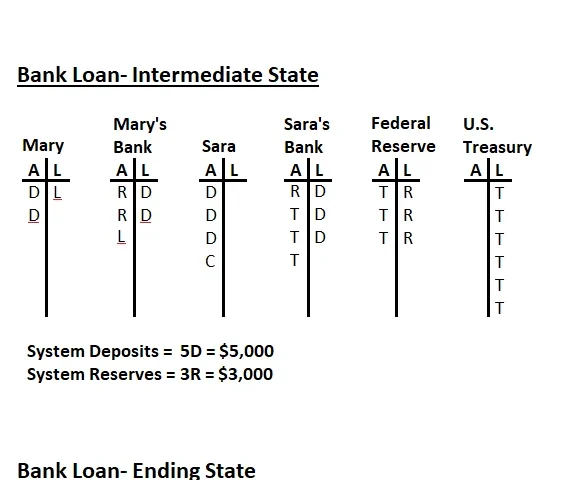
At any given time, the volume of liquid claims drastically exceeds the physical base money available. In the United States, historical data indicates that broad-to-base money ratios and bank deposit-to-cash ratios fluctuate significantly, spiking during periods leading up to major systemic stress, such as the 2008 financial crisis. When a bank issues a loan, it creates new broad money by crediting a borrower’s account, expanding the total volume of IOUs in the system without altering the underlying volume of base reserves.
Regulators typically attempt to manage this leverage through minimum reserve requirements or risk-weighted capital ratios, mandating that banks hold a specific percentage of assets in liquid cash or government securities. However, because commercial bank lending operates as a recursive, interconnected series of transactions—where a loan deposited in one bank becomes the reserves for another—each base dollar is effectively counted multiple times across the economy.

Under normal conditions, banks maintain minimal cash reserves because only a small fraction of depositors request redemptions simultaneously. If a solvent bank faces an unexpected liquidity drain where withdrawals exceed its cash-on-hand, it can typically borrow liquid reserves from another commercial bank in exchange for collateral. However, when the entire banking system becomes overleveraged, interbank lending freezes due to a lack of trust. Solvent institutions can fail simply because they cannot convert illiquid loan portfolios into immediate cash fast enough to satisfy panicking depositors.
This vulnerability mirrors the classic parlor game of musical chairs, where the number of available seats is always fewer than the participants. As long as market participants maintain trust and the music continues, a small pool of liquid cash reserves can accommodate the cyclical withdrawal needs of depositors. When trust evaporates and the music stops, the structural fragility of the system becomes apparent. In systems with unprintable base money, excessive credit claims default and contract toward the baseline of physical money. In systems managed by central banks, monetary authorities expand the base money supply to rescue overleveraged institutions, socializing losses and devaluing currency for holders over the long term.

Fractional Reserve vs. Full Reserve Lending
Economic theorists distinguish between different forms of credit creation, often categorized as duration-matched versus duration-mismatched lending. In fractional reserve banking, institutions systematically practice duration mismatching, funding illiquid, long-term loans with liquid demand deposits that clients can withdraw at any time. This creates an inherent fragility, forcing banks to rely on statistical probability, interbank borrowing, or central bank bailouts.
Full reserve banking, by contrast, operates on strict duration matching. Under this model, demand deposits are held entirely in liquid reserves, ensuring that every depositor can redeem their funds instantaneously without relying on external bailouts. Loans are financed exclusively through time deposits or structured investment contracts of matching or longer durations, with risks explicitly disclosed to capital providers. While a full reserve bank can still experience solvency issues from poor lending decisions, those losses impact only the investors who intentionally locked up capital for yield, leaving daily transactional deposits untouched.

The practice of duration mismatching is the primary engine of broad money creation. It allows commercial banks to expand the money supply by leveraging non-monetary assets like loans against liquid claims. While debt-driven monetary systems often accelerate short-term economic growth, they introduce systemic instability, whereas equity-based systems prioritize resilience over rapid, debt-fueled expansion.
In the modern global economy, true full reserve commercial banks are virtually nonexistent, as sovereign fiat systems rely entirely on central banking backstops. Proposals by specialized financial institutions to establish narrow banks focused purely on holding 100% reserves at central banks have repeatedly faced regulatory pushback. Instead, shadow banking entities and private credit funds operate closer to duration-matched models, explicitly warning investors that liquidity is constrained by the maturity schedules of underlying business loans.

Technological Impacts on Lending and the Future of Money
The technological infrastructure of an era profoundly shapes how money moves and how lending is conducted. During the classical gold standard, physical gold moved slowly due to transportation and authentication limits, while telegraphic communications accelerated financial claims. As nineteenth-century economists like William Stanley Jevons observed, the increasing efficiency of banking networks allowed trade and debt claims to expand to dangerous multiples of the underlying gold reserves. When international payment imbalances flared up, the system repeatedly faced severe interest rate spikes and liquidity crunches, culminating in the structural fractures of World War I.
In the contemporary fiat era, central banks manage flexible base money supplies, intervening to print liquidity whenever credit bubbles rupture. This dynamic institutionalizes a slow, persistent debasement of currency, encouraging financial arbitrage and debt accumulation. Conversely, digital, decentralized monetary networks like Bitcoin combine unprintable base scarcity with instantaneous global settlement speeds. Because users can easily audit and withdraw digital assets peer-to-peer without relying on traditional intermediaries, attempting to scale fractional reserve banking on top of an unyielding base asset carries immense structural risk, as demonstrated by the collapse of prominent cryptocurrency lenders.

Ultimately, the choice of monetary standard dictates the prevalence of speculative arbitrage versus productive lending. While productive loans—such as capital deployed for high-return business expansions—thrive across all economic environments, large-scale arbitrage debt depends heavily on the softness of a society’s unit of account. As financial history demonstrates, understanding the distinction between matched and mismatched liabilities remains essential for navigating the complex interplay between banking stability, credit expansion, and long-term economic health.

Related News