Institutional Market Perspectives: How Crypto Market Structure and TradFi on Rails Are Reshaping Q4
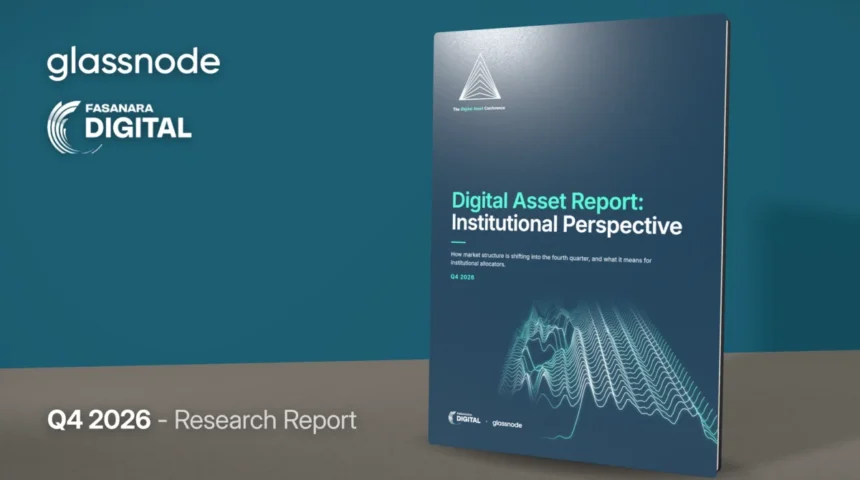
As the fourth quarter gets underway, institutional allocators are navigating a rapidly evolving market landscape characterized by shifting macroeconomic conditions, renewed on-chain activity, and an unprecedented convergence between traditional finance and decentralized infrastructure. A comprehensive joint report published by Glassnode and Fasanara Digital sheds light on these structural transformations, examining how the digital asset ecosystem has evolved following a prolonged period of consolidation and low volatility.
The preceding twelve months presented a distinct duality across financial markets. While traditional equities notched record highs, Bitcoin experienced a protracted consolidation phase following
its all-time high set in October of the previous year. During this stretch, capital outflows from major blockchain networks pushed trading volumes and market volatility down to cycle lows.

However, beneath the surface of subdued price action, fundamental network activity continued to expand. Stablecoin settlement volumes steadily increased, the count of active tokenized-equity holders grew, and the adoption of perpetual futures tracking traditional assets gained persistent traction. This underlying momentum culminated in an aggressive market turn in August, sparked initially by a notable short squeeze. According to the data compiled in the latest joint report, the market dynamics observed since August indicate a structural shift that extends far beyond mere short covering.
To map out these changes layer by layer, the new Digital Asset Report explores multiple facets of the digital economy, including the broader macroeconomic backdrop, on-chain capital distribution, spot and order-book liquidity, derivatives markets, the migration of traditional assets onto crypto rails, and evolving institutional allocations. Glassnode’s advanced on-chain metrics and market statistics form the backbone of the report’s analytical charts, while Fasanara Digital contributes granular order-book capture and trading-volume datasets to illustrate liquidity shifts and TradFi integration. The study ultimately highlights the specific technical levels and behavioral signals required to confirm a sustained market recovery.
A focal point of the research is the rapidly expanding section dedicated to traditional finance moving onto crypto rails. This domain proved to be a rare bright spot of growth during a period when native crypto volumes were contracting. Last autumn, perpetual futures tracking equities, major market indices, commodities like gold, and energy products such as oil accounted for a negligible fraction of trading on decentralized crypto exchanges. Today, these instruments represent a substantial and growing share of perpetual trading volume across major venues, illustrating a structural appetite for tokenized exposure to traditional asset classes.

Crypto volume is still a fraction of the US equity tape
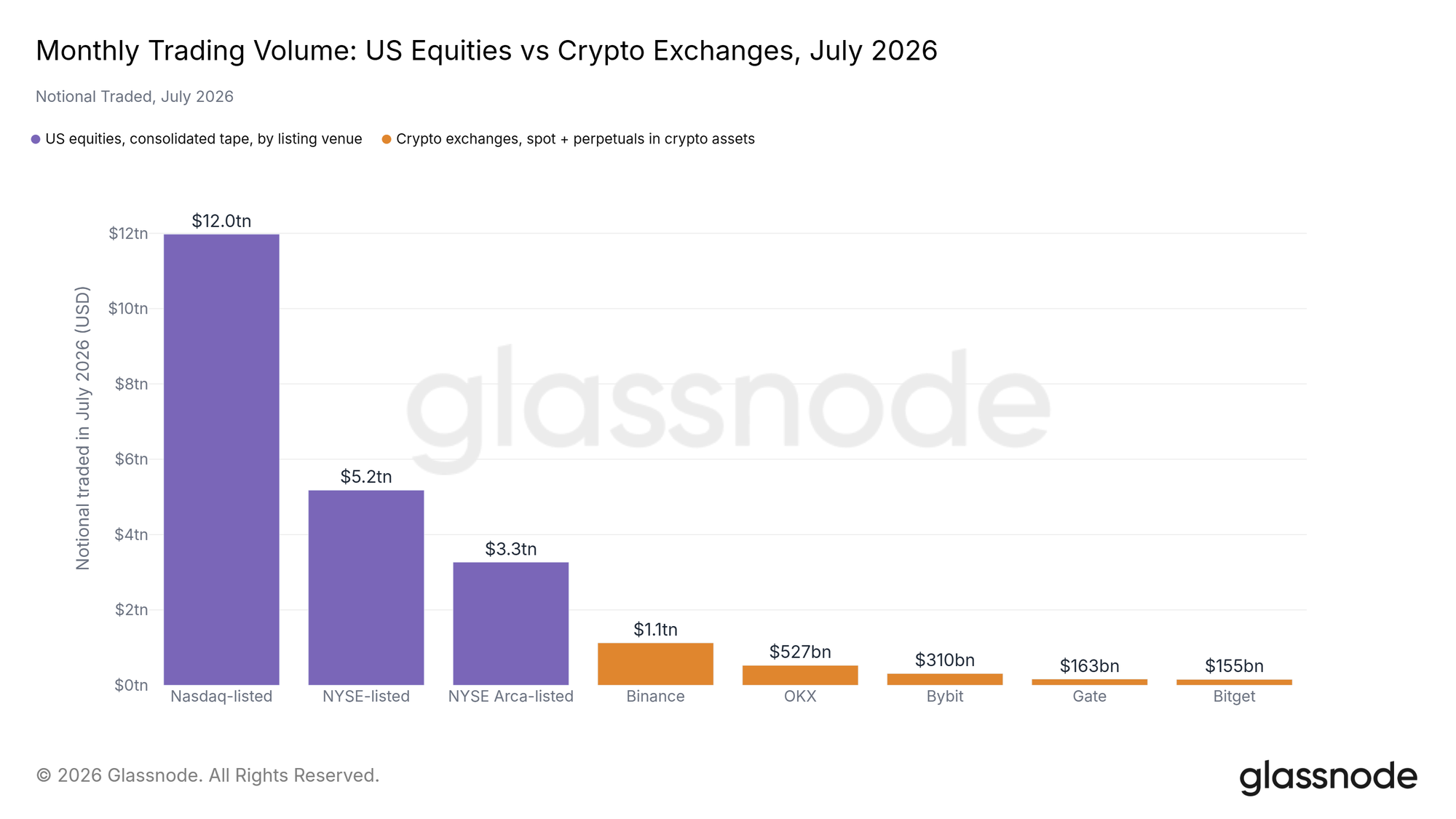
Despite significant maturation within the digital asset sector, traditional financial markets continue to dwarf crypto trading figures by a wide margin. A comparative analysis featured in the report highlights the sheer scale of US equities relative to digital asset exchanges.
During July, the five largest centralized cryptocurrency exchanges collectively handled approximately $2.28 trillion in trading volume. While substantial, this figure accounts for roughly 11 percent of the $20.5 trillion that changed hands across US equity listing venues over the same timeframe. Analysts note that while the aggregate crypto figure acts as a baseline—excluding several prominent trading platforms that were not captured in the primary dataset—the comparison underscores the vast runway remaining for institutional market penetration and capital inflows.
The disparity in volume reflects the different stages of market development and accessibility between traditional equity market infrastructure and digital assets. Nevertheless, the steady expansion of institutional-grade tooling, regulatory clarity in key jurisdictions, and the bridging of traditional financial instruments onto blockchain rails are gradually narrowing the structural gap between the two asset classes.

Perpetuals on traditional assets now rival Bitcoin on Hyperliquid
One of the most striking developments highlighted in the report is the rapid ascension of alternative perpetual futures markets on decentralized derivatives platforms. On venues such as Hyperliquid, where market participants can launch perpetual contracts on any asset equipped with a reliable price feed, trading activity has diversified far beyond native digital assets.
These non-traditional markets achieved a significant milestone in April, when their aggregate trading volume surpassed the venue’s native Bitcoin perpetual book for the first time. Recent data indicates that perpetual futures tracking a diverse basket of equities, global indices, and commodities now trade at more than four-fifths the volume of the platform’s primary Bitcoin market.
This trend demonstrates a clear demand among crypto-native and hybrid traders for unified liquidity pools where they can execute leveraged strategies on traditional macroeconomic assets without leaving decentralized infrastructure. By bringing equities and commodities onto high-performance execution rails, these platforms are effectively functioning as round-the-clock trading hubs that blur the traditional operating hours and jurisdictional boundaries of legacy financial exchanges.
Bitcoin is back above its on-chain cost bases
From an on-chain perspective, the market turnaround initiated in August has fundamentally altered Bitcoin’s technical health. The subsequent price recovery successfully lifted Bitcoin back above its primary on-chain cost bases, reclaiming key valuation levels that define broader market regimes.
Specifically, the price action cleared the aggregate average cost basis for all circulating coins, the adjusted cost basis for active investors whose coins still change hands regularly, and the realized price metrics associated with the most recent cohort of buyers. Historically, maintaining a market valuation above these three major cost thresholds is considered a hallmark of a healthy, functioning bull market.
The joint report from Glassnode and Fasanara Digital provides a detailed examination of these thresholds, identifying the specific price levels and network signals that institutional allocators should monitor to determine whether this bullish market structure will hold through the remainder of the fourth quarter and beyond.

Disclaimer: This report does not provide any investment advice. All data is provided for information and educational purposes only. No investment decision shall be based on the information provided here and you are solely responsible for your own investment decisions. Users are urged to exercise caution and discretion when utilizing these metrics. Glassnode shall not be held responsible for any discrepancies or potential inaccuracies.

Related News