Strategy Watch #9: Institutional Demand Rebounds as Bitcoin and Ether Lead Strongest Net Inflows Since November

As the digital asset investment community navigates an evolving macroeconomic landscape, institutional demand and capital allocation strategies are undergoing notable shifts. Strategy Watch, a monthly publication designed to deliver high-signal, impartial analysis of fund-level performance and allocation trends in digital assets, has released its latest report. By examining fund returns, structured product trends, and allocator shifts, the publication provides a comprehensive window into how institutional exposure is evolving across crypto markets.
Built to address a clear demand for reliable, data-driven insights, Strategy Watch relies heavily on direct input from market participants. Funds and allocators that contribute data and insights help shape a more complete and valuable view of the landscape, ensuring that the monthly publication remains an essential resource for the digital asset investment community.

The latest edition of Strategy Watch is structured across six core sections, each focusing on a distinct dimension of institutional activity in digital assets. From institutional flow monitors and fund performances to on-chain vault dynamics and manager positioning, the report captures a pivotal moment for the market as capital re-enters the space following months of cautious positioning.
Institutional Flow Monitor
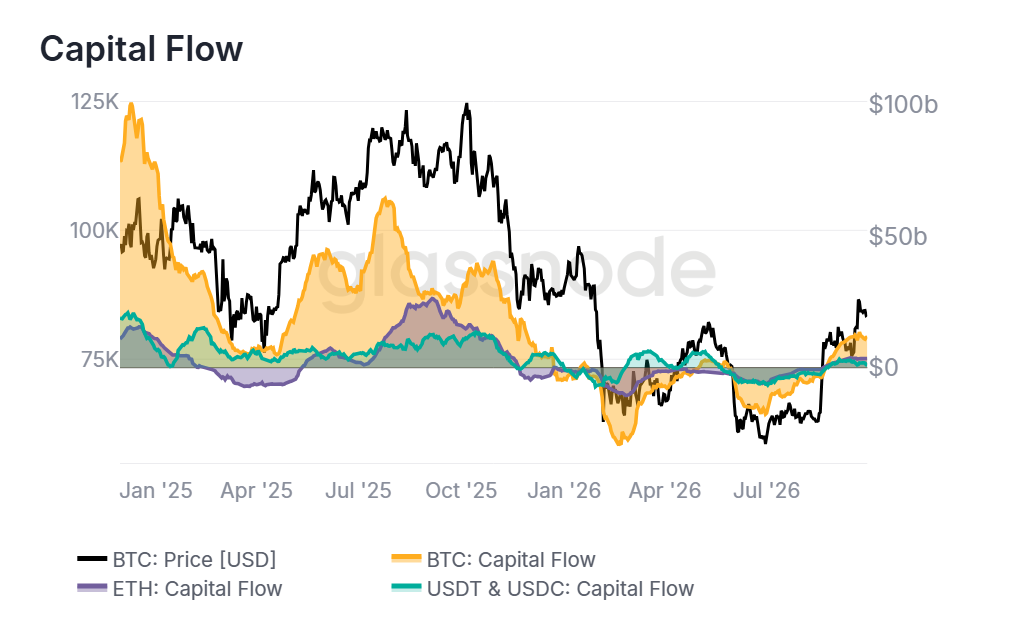
The capital inflows that first began to materialize in late August maintained their momentum and continued building throughout September, marking a significant shift in market sentiment. According to the report, Bitcoin experienced its strongest net inflows since November, with 30-day net inflows peaking near $13.5 billion on September 22. Ether followed a remarkably similar trajectory, drawing robust participation from institutional investors.

Interestingly, stablecoin inflows slowed as the month progressed, suggesting that the capital driving the market higher was primarily comprised of liquidity already residing within the crypto ecosystem rather than fresh fiat entering from the sidelines. Both leading assets eventually eased from their local peaks during the final week of September. Because these inflows coincided with rising asset prices, it became clear that buyers were actively chasing upward momentum. Market participants now face the critical test of whether these institutional buyers will maintain their positions and conviction if prices stabilize or face extended consolidation.
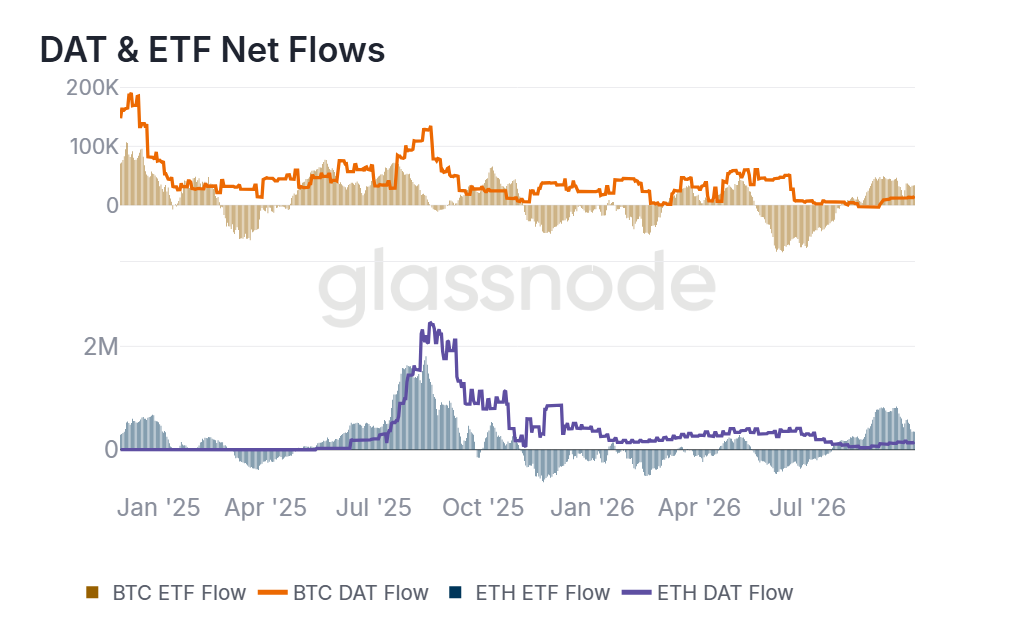
ETF and DAT Net Flows
The behavior of institutional investment vehicles paints a nuanced picture of corporate and fund-level accumulation. US spot Bitcoin exchange-traded funds (ETFs) continued to absorb Bitcoin throughout the month, albeit at a noticeably slower pace compared to prior periods of aggressive accumulation. Their 30-day rolling inflow dipped to roughly 13,700 BTC around September 20 before recovering strongly to reach 34,000 BTC by the end of the month.

Concurrently, corporate entities holding Bitcoin on their balance sheets—collectively known as Digital Asset Treasuries (DATs), which had acted as net sellers in late August—returned decisively to the buy side. Their 30-day net flow metric reached its highest level since June, signaling renewed confidence among corporate allocators. A similar dynamic played out within the Ethereum ecosystem, where ether ETF inflows more than halved over the course of the month, while corporate ether treasury companies steadily continued adding to their holdings. This convergence contrasts sharply with August, a period when almost exclusively ETFs were responsible for adding Bitcoin exposure, whereas September saw both ETFs and corporate treasuries buying in tandem.
DeFi Total Value Locked (TVL)
Decentralized finance (DeFi) activity on the Ethereum network demonstrated notable resilience during a volatile trading month. Total Value Locked (TVL), which measures the aggregate dollar value of assets deposited into Ethereum lending, borrowing, and trading protocols, held remarkably steady through a sharp mid-month market sell-off. As prices rebounded during the rally that began around September 21, TVL surged alongside asset valuations, peaking near $54.5 billion—the highest level recorded since April.

Analysts note that because TVL is denominated in US dollars, the metric naturally rises with the price of ether even if no additional capital is deposited by users. Nevertheless, the underlying data reveals that depositors largely resisted the urge to withdraw funds during the mid-month price correction, reflecting a higher degree of holding conviction among DeFi participants. While the 30-day change in TVL halved over the course of September, this deceleration was primarily a statistical artifact of larger jumps from late August rolling out of the 30-day measurement window.
CME Basis Yield
Derivatives markets also reflected shifting sentiment, particularly through the lens of CME basis yields. Basis yield measures the annualized return traders can capture by simultaneously buying spot assets and selling corresponding futures contracts against them, aggregated over a 30-day period. For Bitcoin, the CME basis yield climbed rapidly from the middle of the month, peaking near $176 million on September 19—its highest mark since January. This spike indicated that leveraged market participants were increasingly willing to pay a premium to maintain long futures positions during the broader market advance.
However, this surge in leverage proved to be short-lived. Within ten days of reaching its peak, the Bitcoin basis yield retreated back to where it started the month. Meanwhile, ether’s basis yield climbed steadily through September, ultimately finishing the month at its highest level since June. Industry managers reported that carry trades paid off only in brief, concentrated bursts, corroborating the on-chain and derivatives data showing that leverage re-entered the market swiftly during the rally but did not linger.
Manager Positioning and Broader Allocation Trends
Beyond flows and derivatives, the broader behavior of digital asset managers and institutional allocators underwent measurable transformations during September. Average manager cash holdings declined sharply from 19.1% down to 12.2%, indicating that fund managers felt sufficiently confident in market conditions to put idle capital back to work. Concurrently, fundraising conversations and pitch activities ticked up from previous survey lows, offering a glimmer of optimism for managers seeking to close new capital commitments. Notably, Bitcoin temporarily slipped from second to fourth place in terms of receiving the primary focus of manager attention, as capital and strategic focus diversified across a wider array of digital assets and strategies.
On the allocation front, the macro ecosystem continued to witness major traditional financial institutions expanding their digital asset capabilities. US spot Bitcoin ETFs collectively pulled in $2.65 billion over the period, while Standard Chartered officially commenced Bitcoin and ether trading services for institutional clients in the United Arab Emirates. In the banking and tokenization sector, Goldman Sachs integrated its tokenized Treasury fund into an emerging crypto settlement network, highlighting the continued institutional push toward blockchain-based financial market infrastructure. At the same time, the broader industry experienced structural consolidation, underscored by the winding down of operations at Deus X Capital.
As the digital asset market looks toward the final quarter of the year, the combination of steady corporate accumulation, resilient decentralized finance infrastructure, and shifting manager cash deployments sets a complex stage for institutional allocators. With high-signal analyses continuing to track these rapid developments, market participants remain focused on how sustainable these capital flows will prove to be as macroeconomic conditions continue to evolve.

Related News