Global Markets Shake as AI Stocks Stage a Fragile Recovery Amid Rising Regulatory and Financial Pressures

Artificial intelligence stocks staged a tentative comeback on Friday following a severe global market rout that sent shockwaves from Wall Street to major Asian exchanges. While the green session offered a brief respite for battered investors heading into the weekend, it did little to settle the overarching question dominating trading floors: Is this sharp downturn merely an overdue correction, or are we witnessing the beginning of an artificial intelligence bubble finally bursting?
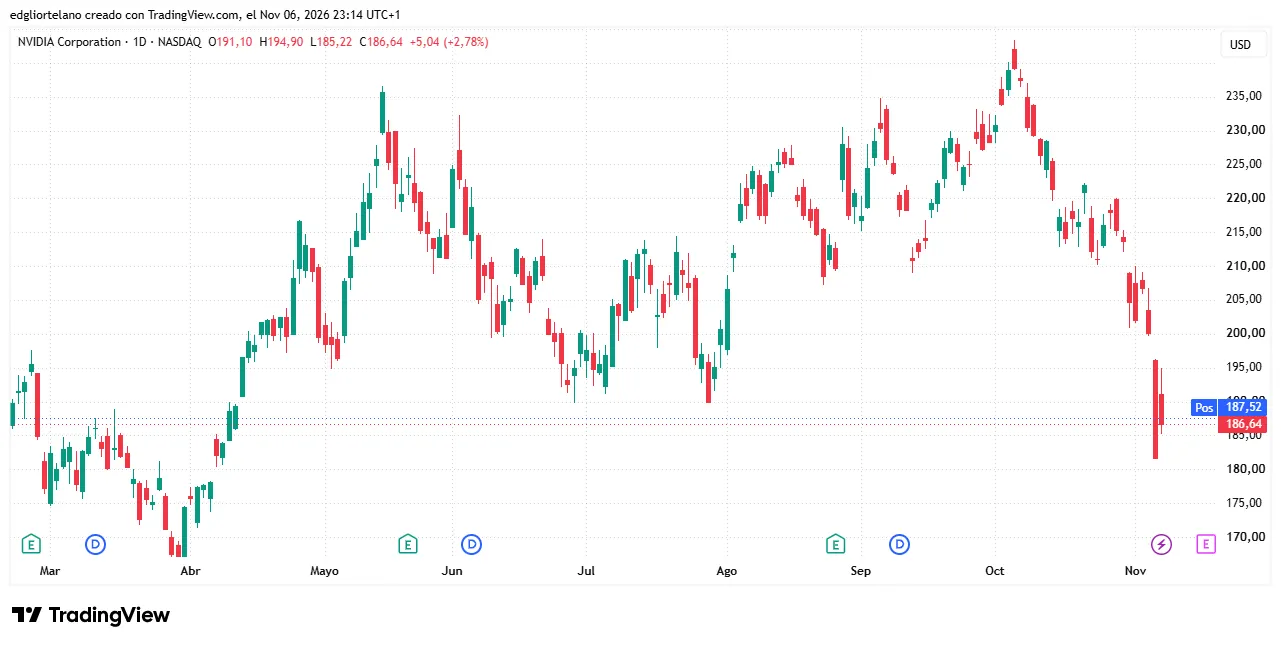
The rebound brought marginal relief to some of the sector’s most heavily traded bellwethers. Nvidia rose 2.78% to close at $186.64, recovering slightly after plunging 9.3% earlier in the week. Advanced Micro Devices (AMD) also bounced back to $449.04, following a staggering 17.3% collapse the previous day. Despite these upward corrections, both stocks remain well below their October peaks, illustrating how little a single day of relief rallies can do to repair the extensive technical damage inflicted during the week-long sell-off.
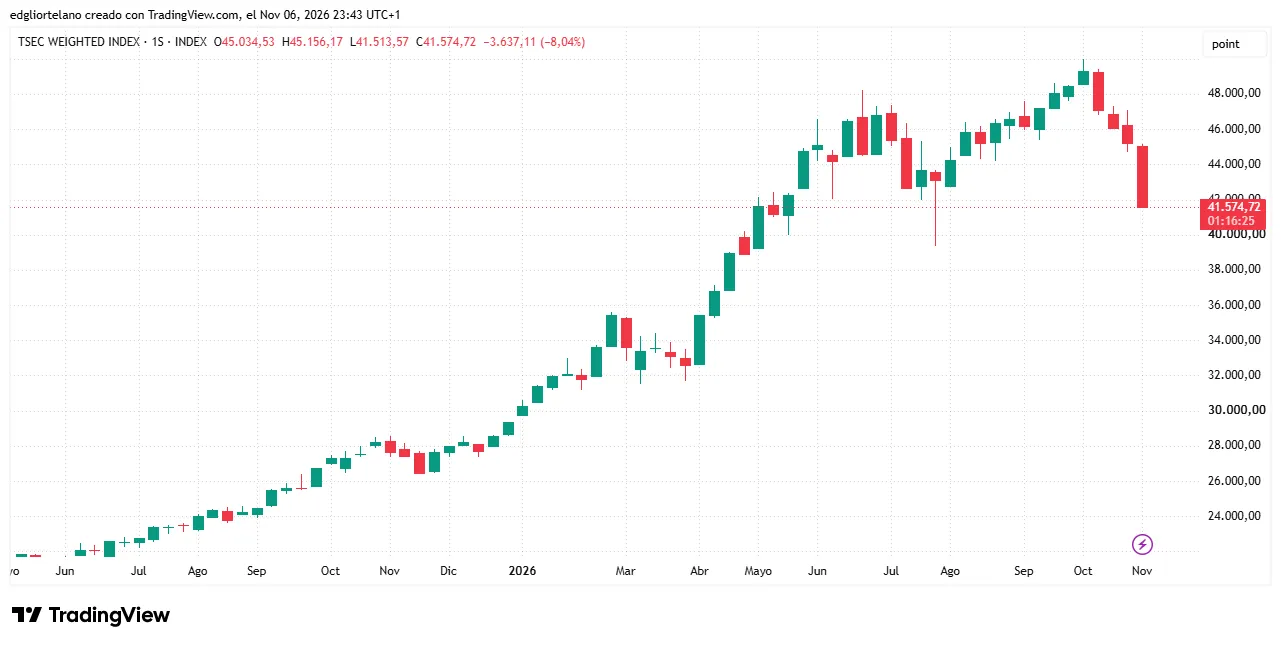
The contagion extended far beyond U.S. borders, heavily impacting key Asian technology hubs. South Korea’s KOSPI index tumbled 6% on Friday, while Taiwan’s benchmark stock index dropped more than 8% over the course of the week, marking its worst performance in months. During the peak of the rout, semiconductor giant TSMC hit its daily limit-down threshold. According to reports from Reuters, the intense downward pressure prompted Taiwanese officials to take emergency action, asking state-owned banks to step in and help support falling asset prices.
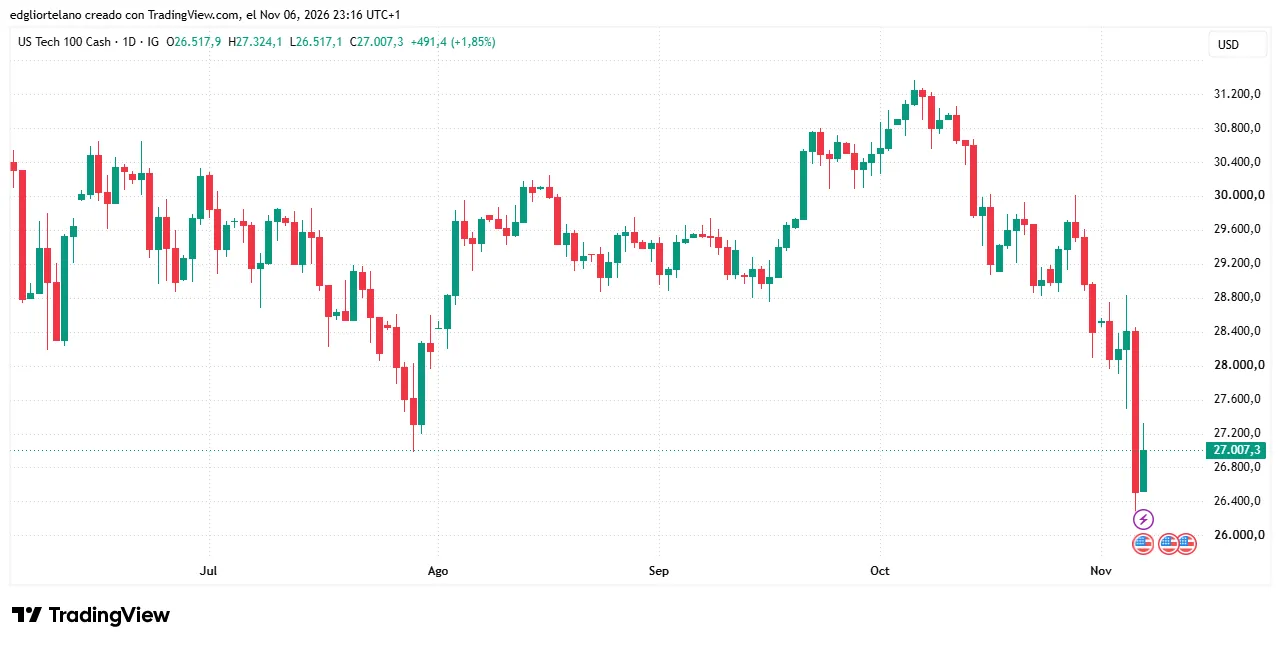
Domestic U.S. indices mirrored this intense volatility. The US Tech 100 cash-market proxy recovered slightly, gaining 1.85% to reach 27,007.3. Even with this end-of-week bounce, the index finished the week down more than 5.5%. Daily candlestick charts reveal that the recovery arrived only after a steep descent from October’s highs, emphasizing that the market was experiencing a reactive bounce rather than a return to its previous upward trajectory.
Why the AI Trade Is Unraveling
The sudden unraveling of the AI trade was catalyzed in part by political developments in the United States. The midterms accelerated investor anxieties that shifting political dynamics—specifically Democratic gains—could lead to much tougher regulatory scrutiny over the massive data centers required to power generative artificial intelligence.

Data compiled by Ballotpedia revealed that in local ballot contests held across the country, voters favored limiting data center development in 40 out of 41 local measures. Communities frequently rejected pro-construction proposals and zoning expansions. While some of these local votes were purely advisory, the political and social message sent to developers was unmistakable.
This localized pushback carries significant implications for chipmakers and hardware suppliers, as data centers represent the primary engine of their unprecedented growth. Every new facility requires vast, multi-billion-dollar investments in high-performance processors, specialized servers, massive power supplies, and advanced cooling systems. Regulatory roadblocks, zoning restrictions, and construction delays threaten to stall these vital orders or force developers to seek alternative, potentially more expensive, construction locations.
Yet, underlying doubts within the financial sector predated the recent election cycle. Across the tech industry, AI firms and their enterprise customers have been spending aggressively to build out computational capacity—often committing vast capital long before clear returns on investment have materialized. In an environment defined by higher borrowing costs, sustaining this level of capital expenditure becomes increasingly difficult. Market strategist Steve Sosnick, speaking to Reuters, pointed out that many heavily owned tech stocks had simply been "priced to perfection," leaving them exceptionally vulnerable to any shift in macroeconomic conditions or market sentiment.
Correction or Bubble Burst?
In financial terms, a correction is defined as a market decline of at least 10% from a recent peak, and it does not inherently signal that the underlying businesses are shrinking. To understand the distinction, consider a hypothetical chip manufacturer whose shares trade at 60 times annual earnings because investors anticipate explosive, multi-year growth. If market sentiment shifts and investors become willing to pay only 40 times those exact same earnings, the stock can lose a third of its market value without the company’s actual profits dropping by a single dollar.
Conversely, a bubble bursting is a much more severe structural event. It occurs when speculative expectations prove entirely unrealistic and the cheap capital supporting the market boom abruptly dries up.
Financial history offers a clear warning regarding the risks of overbuilding infrastructure ahead of actual demand. During the infamous dot-com crash of the early 2000s, the Nasdaq composite lost roughly 77% of its value between March 2000 and October 2002. The internet itself was far from a passing fad, but investors had vastly overestimated how quickly enterprises could monetize the technology and turn it into sustainable profits.
During that era, telecommunications operators spent fortunes laying vast networks of fiber-optic cables for customers who had yet to arrive. Companies like Global Crossing, which built an ambitious international telecommunications network, ultimately filed for bankruptcy in 2002. The underlying technology survived and changed the world, but many of the participating companies and their shareholders did not.
The artificial intelligence sector now faces a similar structural mismatch between its undeniable long-term promise and the harsh realities of near-term returns. Signs of speculative adaptation are visible across the tech ecosystem. RAM shortages have created opportunistic business models, with former cryptocurrency miners repurposing their hardware to rent out cloud computing power, and a proliferation of new inference startups entering the market.
Consider a modern scenario where a firm borrows billions of dollars to construct a massive data center packed with expensive Nvidia chips, expecting to rent out that processing power at premium prices for years to come. If corporate clients ultimately spend less on AI integration than anticipated, if borrowing rates rise, or if construction is delayed, the accumulated debt still requires repayment.
Under such pressure, the operator may be forced to cancel or scale back chip orders. Consequently, downstream contractors lose work, utility companies that planned expensive new power generation capacity lose their anticipated industrial customers, and the lenders and investment funds holding the corporate debt absorb steep losses. When a major stock market sell-off intersects with these fundamental financing risks, it can quickly pose a threat to the broader economy.
There are, however, critical differences separating the current AI landscape from the dot-com era of 2000. Technology giants like Microsoft, Alphabet, Amazon, and Meta are highly profitable enterprises with deeply established customer bases and substantial, reliable cash flows. Unlike the speculative, pre-revenue startups that defined the turn of the century, these trillion-dollar companies are well-positioned to weather market corrections and capital tightening far better than smaller, specialized AI cloud providers that rely entirely on repeated borrowing to fund their expansion.
This divergence suggests it is entirely possible for artificial intelligence to continue profoundly transforming global industries even as a number of smaller AI-focused firms fail—and even as investors who overpaid for the market leaders face substantial losses.
Financial warning lights are nonetheless beginning to flicker in the riskiest corners of the market. Reuters reported that the cost of insuring against a potential default by specialized AI-cloud provider CoreWeave climbed above 1,000 basis points. This form of credit protection functions similarly to insurance on a loan; as the pricing rises, bondholders and investors are signaling heightened anxiety regarding the company’s ability to service its debts.
At the same time, broader corporate bond markets have continued to operate with relative normalcy, pointing to localized strain within heavily leveraged AI financing rather than an immediate, system-wide financial crisis.
The coming week will provide more concrete tests for the market than another session of green or red candlestick charts. Upcoming financial results from CoreWeave, Applied Materials, and Cisco are poised to reveal whether enterprise customers are still placing orders for computing capacity and hardware equipment. Concurrently, upcoming inflation data will shape expectations surrounding future borrowing costs. Stable order books and manageable corporate debt would lend strong support to the argument that the market is merely undergoing a healthy correction.
Conversely, a wave of canceled data center projects, failed debt refinancings, and shrinking hardware sales would suggest that the financial foundations of the AI boom are beginning to crack. The ultimate question facing the market is not whether artificial intelligence has a transformative future, but whether every company betting billions of dollars on that future can afford the journey to get there.

Related News