‘Steps’ Review: Cinderella’s Story with a Goth Girl Twist (Plus, a Hot Troll!)
By Kristy Puchko
November 8, 2026
While last year’s grim cinematic landscape brought audiences The Ugly Stepsister—a biting horror-movie critique of the extreme physical lengths young girls are pressured to go to achieve conventional beauty—Netflix is preparing to deliver a vastly different, far more family-friendly spin on the classic fairy tale. Slated to debut on the streaming platform on November 20, the animated feature film Steps reimagines the time-honored narrative of magic, fairy godmothers, and glass slippers from the perspective of the traditionally maligned stepsisters. Far from being a savage deconstruction, the film offers a charming, witty, and surprisingly heartfelt alternative to the usual prince-centric storytelling.

Aimed squarely at family audiences, Steps builds cleverly on the foundational animated tropes laid down by decades of Disney and DreamWorks cinematic adventures. The movie establishes a familiar baseline: there is a picture-perfect maiden in Cinderella, who embodies classic archetypes by being relentlessly kind, perpetually cheerful, and prone to conversing with woodland creatures when she isn’t bursting into spontaneous song for local villagers. However, much like Shrek subverted fairy-tale expectations years ago, Steps opens with a traditional storybook framing device before a snarky, weary protagonist steps directly into the frame, entirely over being misrepresented by history.
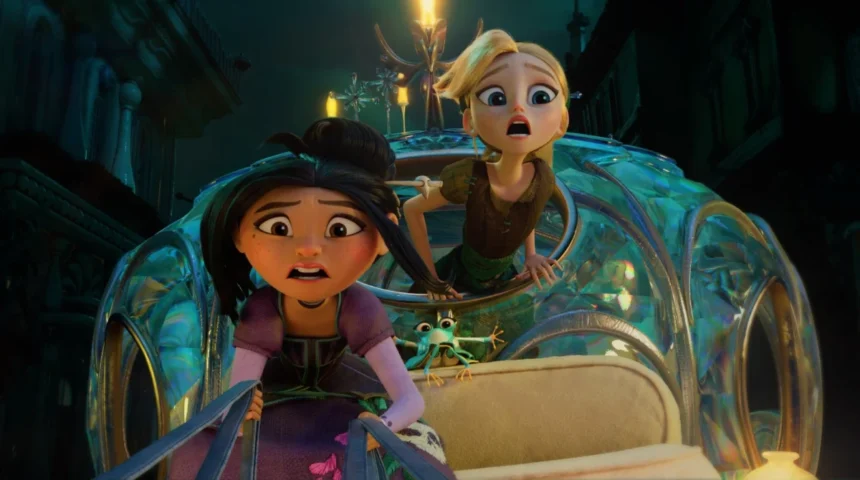
In this universe, the central figure is not an ogre, but rather a teenager labeled as an "Evil Stepsister." Voiced by Ali Wong, Lilith is admittedly a bit rough around the edges when it comes to the orphaned Cinderella. She did, after all, technically order her to clean the hearth and fireplace. She also scoffed at Cinderella’s loyal animal companions and ultimately tore up the dress that Cinderella had painstakingly fashioned for the royal ball. Yet, when viewed within its proper narrative context, Lilith’s behavior shifts away from pure malice and lands squarely in the relatable territory of teenage angst. This is less a traditional princess romance and more a modern exploration of misfits, alternative fashion, sisterhood, and the painful realities of social assimilation.
Steps Offers a Parable About Being True to Yourself
Lilith actively objects to being branded as a universally evil character and sets out to reclaim the narrative of Cinderella by sharing her side of the story. While viewers might already know the broad strokes of the tale—the bad behavior, the magical intervention, the sweeping romance, and the exhaustive kingdom-wide search for the foot that fits the lost glass slipper—Lilith’s very name carries centuries of complex folklore. Depending on who is telling the tale, the mythological figure of Lilith has been alternately demonized and revered. In this Netflix feature, she is portrayed as an accidental witch with a distinct Gothic aesthetic, but long before acquiring any magical traits, she was simply the new kid in town desperately seeking a friend.

Before intersecting paths with Cinderella, who is voiced by Amanda Seyfried, Lilith and her younger sister, Margot (voiced by Stephanie Hsu), traveled continuously from town to town alongside their seamstress mother, selling her handcrafted wares. That transient lifestyle came to an end when romance blossomed, bringing Lilith and Margot into a new household with Cinderella and her welcoming father. While Cinderella and her dad were initially warm toward the newcomers, the broader, predominantly white kingdom proved far less welcoming. Locals openly sneered at the Asian seamstress and her daughters, who wore distinctive Eastern styles of dress and shared traditional stories of a mystical snake-woman.
At Lilith’s very first social engagement in her new home, she faces harsh shunning from the resident socialite and mean girl, Priscilla, voiced by Nikki Glaser. When the surrounding gaggle of village teenagers quickly follow Priscilla’s lead, Cinderella—despite her sterling reputation for innate goodness—stands by and does nothing to intervene.
This catalyst sparks a classic musical makeover sequence set to Olivia Rodrigo’s "Brutal," charting Lilith’s descent into the Doc Martens-wearing lineage of cinematic outcasts. Viewers who have ever quoted The Craft line "We are the weirdos, mister" or earnestly insisted to their parents that a dark aesthetic "is not a phase" will find plenty of reflective familiarity here. While Lilith’s peers diligently mimic Priscilla’s pristine white bouffant hairstyles and elaborate pink gowns, Lilith carves out her own identity through a palette of blacks and purples. Her look features a DIY asymmetrical haircut, homespun skirts adorned with embroidered skulls, and heavy leather boots. Her philosophy is simple: if the townspeople are going to stare anyway, she will give them something genuinely worth looking at.

However, Lilith’s fierce drive for self-expression becomes inevitably tangled with her complicated jealousy toward her seemingly flawless stepsister. That underlying resentment sparks a larger rebellion that not only jeopardizes Cinderella’s storybook romance with the prince, voiced by Daniel Radcliffe, but also places Lilith and both of her sisters in genuine peril. Consequently, whether they want to or not, Lilith and Cinderella are forced to forge an alliance, teaming up to rewrite their shared narrative before a rampaging Priscilla manages to tear everything apart.
Steps Makes Moves Disney Would Never
In the early acts of the film, Cinderella initially presents as a quintessential Disney princess archetype, complete with an agreeable nature, animal sidekicks, and an irrepressible urge to burst into song. However, the introduction of the fairy godmother, voiced by Bette Midler, pulls back the curtain on a crucial dynamic: Lilith realizes that her stepsister has been quietly backed by a powerful magical guardian the entire time.
Through this plot point, Steps introduces a sharp parable concerning privilege. The fairy godmother’s potent magic essentially gifted the wealthy, white princess distinct advantages that her marginalized stepsisters were systematically denied. Lilith’s fiery resentment over this realization is entirely justified, but the narrative does not stop there. When the protective magical spell is temporarily broken, Cinderella finds herself entirely unequipped for basic realities, baffled by concepts like perspiration and body odor while naively stumbling from one hazardous situation into another. Fortunately for her, Lilith’s heart is far kinder than her dark reputation suggests, leading her to rescue Cinderella repeatedly, even when she complains about doing so.

The film benefits from a large, collaborative writing team credited with the screenplay and story, including Ava Tramer, James Madejski, Jen Chuck, Dana Schwartz, Felicia Ho, Riki Lindhome, and Kate Micucci. Together, they manage to ground the movie in familiar fairy-tale tropes before using them as a vehicle to explore nuanced topics that can otherwise prove challenging to explain to younger audiences—such as the quiet, pervasive pressure placed on individuals to assimilate into a dominant culture to avoid social alienation.
The social friction in the kingdom stems less from a genuine hatred of Lilith’s alternative clothing or her affinity for spooky folklore, and more from the teenagers’ collective fear of Priscilla’s cruelty overriding their capacity for independent thought. It is specifically through the ongoing conflict between two contrasting sisters—one privileged and playing safely by established rules, the other marginalized and defiantly independent—that both characters learn how to cultivate greater self-compassion and empathy for one another, demonstrating that kindness can ultimately become infectious.
To elevate these themes, Steps populates its world with wonderfully eccentric elements, including a rowdy biker gang of trolls who ride giant goats like motorcycles, a maniacal manservant voiced by Peter Dinklage, and a surprisingly crush-worthy troll voiced by Young Mazino. This particular character bears an odd, highly specific resemblance to Nicolas Cage’s performance in Moonstruck—lanky yet muscular, emotionally expressive, and prone to dramatic hair flips while confessing his intense feelings.

The combination of these unconventional creative choices yields a delightfully weird fairy tale that honors both Cinderella and Lilith, acknowledging their respective virtues and flaws with genuine warmth and emotional intelligence. Steps ultimately delivers a viewing experience that feels fresh, entertaining, and positioned to become a frequent rewatch for subscribers when it officially arrives on Netflix later this month.

Related News