Bitcoin Holds Near $80K as Failed Rally Leaves Elevated Leverage and Defensive Hedging in Place

Bitcoin continued to trade near the $80,000 threshold at the start of the week, digesting the aftermath of a rejected mid-week push toward $85,000. The leading cryptocurrency faced intense selling pressure following last week’s failed breakout, briefly slipping below $80,000 over the weekend and revisiting those local lows early Monday morning. Market data indicates that despite the downward price correction, the derivatives market has failed to fully clear its accumulated leverage, while options traders aggressively bid for downside protection as spot demand notably cools.
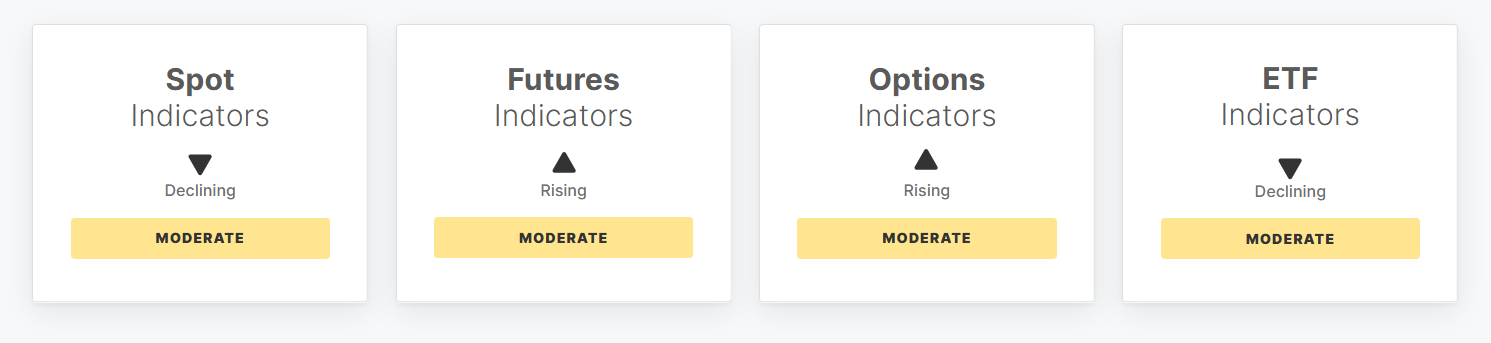
The turbulence began on Wednesday when market participants attempted to drive prices higher toward the $85,000 mark. However, perpetual market takers immediately capitalized on the rally, initiating a heavy wave of selling starting Thursday. This aggressive distribution quickly erased the weekly gains and dragged prices back down. Open interest in futures markets has remained stubbornly high, sitting near the upper boundary of its historical range at $37.5 billion. Simultaneously, leveraged long positions continue to pay elevated funding rates above the high band, underscoring a persistent willingness among bullish speculators to pay a premium for long exposure despite the recent price rejection.
Spot Demand Fades and ETF Flows Reverse
Beneath the derivatives-driven volatility, spot market participation has noticeably tapered off. Spot takers transitioned to net selling during the second half of the week, pushing the Spot Cumulative Volume Delta (CVD) deeper into negative territory at -$80.5M and keeping it constrained within the lower part of its range. Price momentum, while registering a modest 14.3% recovery from previous lows to stand at 39.0, remains trapped in the lower tier of its range. This reflects ongoing underlying selling pressure that continues to cap broader trend reversal signals, even as overall spot trading volume held relatively steady at $5.4 billion.
Institutional interest through U.S. spot Bitcoin exchange-traded funds mirrored the broader cooling trend. While weekly net inflows managed to finish in positive territory at approximately $296.8M—rebounding from the previous week’s outflows—the institutional capital deployment was heavily front-loaded. Buying activity occurred early in the week and quickly reversed as spot prices began to retreat. Furthermore, the U.S. Spot ETF Market Value to Realized Value (MVRV) ratio slipped just below its low band, indicating that the profitability of aggregate institutional holdings has compressed, leaving the average ETF investor with a thinner unrealized gain than usual.

Derivatives Markets Lean Toward Defensive Hedging
Options markets have responded to the shifting macroeconomic and technical landscape by pricing in significantly higher risks of further downside. The volatility spread widened dramatically over the week, surging by over 580% to 32.3% as implied volatility outpaced realized volatility by a wide margin. While the underlying asset’s actual price fluctuations remained relatively contained, options traders aggressively purchased protection, driving the volatility spread well above its high band.
This defensive posture is further corroborated by the options 25-delta skew, which climbed toward its high band to reach 10.4%. The rising skew highlights a heavy institutional and professional demand for put options relative to calls, making out-of-the-money downside protection notably more expensive. Meanwhile, options open interest contracted marginally by 0.7% to settle at $38.6 billion, reflecting routine position adjustments and minor profit-taking near major expiration cycles rather than a broader flight of capital from the derivatives space.
On-Chain Dynamics Highlight Rotating Capital and Quieter Retail Engagement
On-chain metrics reveal a distinct divergence between underlying economic settlement volume and immediate retail network activity. Entity-adjusted transfer volume surged by nearly 26% over the week to reach $5.5 billion, pushing the metric to the edge of its high band. This expansion points to robust larger-scale reallocations and economic settlement across the network, even as daily active address counts contracted by 2.2% to 615,200, lingering near the bottom of their established range and signaling subdued retail engagement.
Network fundamentals experienced a quiet week, with total fee volume drifting downward by 8.8% to $185.2K. Sits well below its low band, the diminished fee revenue reflects softened block space demand and a general lack of organic urgency for network throughput among everyday users.
Capital flow indicators continue to emphasize a structural rotation toward newer market participants. The short-term to long-term holder supply ratio, the hot capital share, and the monthly change in realized capitalization all remain positioned well above their respective high bands. The hot capital share expanded to 21.1%, signaling an ongoing influx of price-sensitive, short-term capital that is characteristic of high-volatility phases. Profit-taking behavior experienced a sharp spike above the high band during the mid-week price peak before easing back inside, while the percentage of circulating supply held in profit dipped slightly to 67.3%.
Ultimately, the market finds itself at a delicate crossroads. The failed breakout attempt has left significant leverage intact within the derivatives complex, while participants increasingly lean on options hedges to protect against potential downside. With spot and ETF buyers stepping back from aggressive accumulation, Bitcoin’s immediate trajectory depends on whether the market can absorb the lingering leverage or if further downside flushing will be required to reset the cycle.

Related News