Navigating the AI Startup Boom: Surviving the First 90 Days of High-Speed Growth
The artificial intelligence era has fundamentally rewritten the rules of startup velocity. Companies today are capable of scaling so rapidly that they can rocket past high annual recurring revenue (ARR) milestones almost overnight, only to crash and burn just a few months later due to structural fragility.
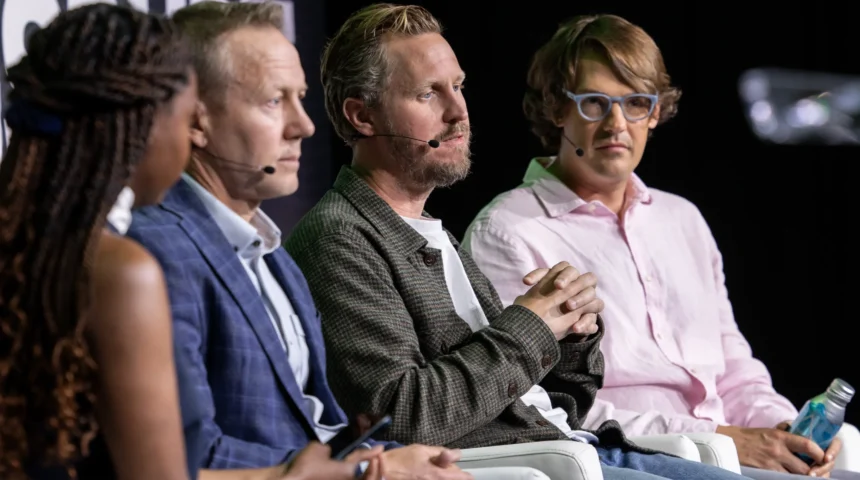
At this year’s TechCrunch Disrupt, venture capitalists and AI founders gathered to unpack this phenomenon, offering critical advice on how startup founders can properly structure their companies for long-term success during those pivotal first 90 days of commercial launch. The panel featured Luke Arno, go-to-market lead at Lovable; Ben Broca, co-founder of the AI platform Polsia; and Tomasz Tunguz of Theory Ventures. Together, they examined the intoxicating allure of hyper-growth and the hidden perils facing early-stage companies in an ecosystem flooded with capital and easily replicated technology.
Ben Broca, whose company Polsia leverages advanced AI agents to build and run entire businesses with a virtually non-existent human workforce—noting that he remains the company’s sole employee—emphasized that product-market fit is exceptionally difficult to secure in the current climate. This challenge is magnified by an era where software products can be effortlessly copied, cloned, or iterated upon by competitors within days of a public launch.
In response to these market realities, Luke Arno stressed that durable go-to-market strategies must be anchored in methods that can be reliably and predictably repeated.
“The most critical thing for founders or earlier-stage companies to do is develop learning density or pattern recognition for where your customers are,” Arno said during the panel discussion. “Don’t rush to build out a top-down go-to-market motion if you’re not there yet.”
That strategic restraint is precisely why, during the first 90 days following the launch of a commercial product that is ready to sell, founders must resist the temptation to mistake early, fast revenue for definitive proof that the startup is ready to scale.
According to Arno, once a startup identifies specific use cases that genuinely work, it is still not immediately ready to build out an expansive sales team and chase aggressive growth. That green light only arrives when the company can repeatedly attract new customers by deploying the exact same playbook that worked the first time. If every single sale requires inventing new tactics, messaging, or custom workarounds, the startup has not truly achieved product-market fit.
“If I bring on 10 new customers in 10 different ways to solve 10 different problems, sure, I brought revenue in, but I don’t have a way to go scale a go-to-market,” Arno explained. “If I bring three customers in with a similar motion to solve a similar problem, now I have high confidence that I can go scale.”
These cautionary insights carry immense weight in an industry currently fixated on outlier success stories. Lovable, the prominent AI app-building startup, established many of the industry’s early benchmarks through its blistering growth trajectory, inadvertently fueling a culture of intense pressure where founders everywhere feel compelled to match its meteoric rise. Backed by venture investors who value the company at more than $13 billion, Lovable has reported that its annualized revenue has surged past $600 million, alongside a fundraising total exceeding $700 million to date.
“The expectations for overall execution speed are absolutely tremendous,” Tomasz Tunguz observed.
However, Tunguz was quick to note that hyper-growth of Lovable’s magnitude remains a rare exception rather than the industry standard, even if founders must still maintain an aggressive operating cadence. The palpable pressure felt across the startup ecosystem is very real, driven largely by structural shifts in venture capital availability. According to Tunguz, vastly more money flows through the startup ecosystem at every single stage today compared to when he first began investing in 2008. In the current market environment, a seed-stage deal brought in by one of his partners can easily range from a $5 million raise to a $50 million or even a $500 million capital infusion.
Amidst this flood of capital and the relentless pursuit of speed, the companies that ultimately emerge as winners tend to focus on a singular, foundational objective: understanding their customers deeply enough to ensure retention long after initial market hype and industry buzz eventually subside.
“Community building is very important and being close to customers is very important,” Broca noted.
Detailing his operational approach, Broca explained that founders can effectively maintain this proximity through targeted emails, community events, and direct customer conversations. Reflecting on his own daily routine, he emphasized a straightforward maxim for early-stage operators: “The general rule is always to be talking to customers.”

Related News